
Pulp Fiction, 1926 · page 166 of 212
Adventure Magazine Cover — page 166: what you’re looking at
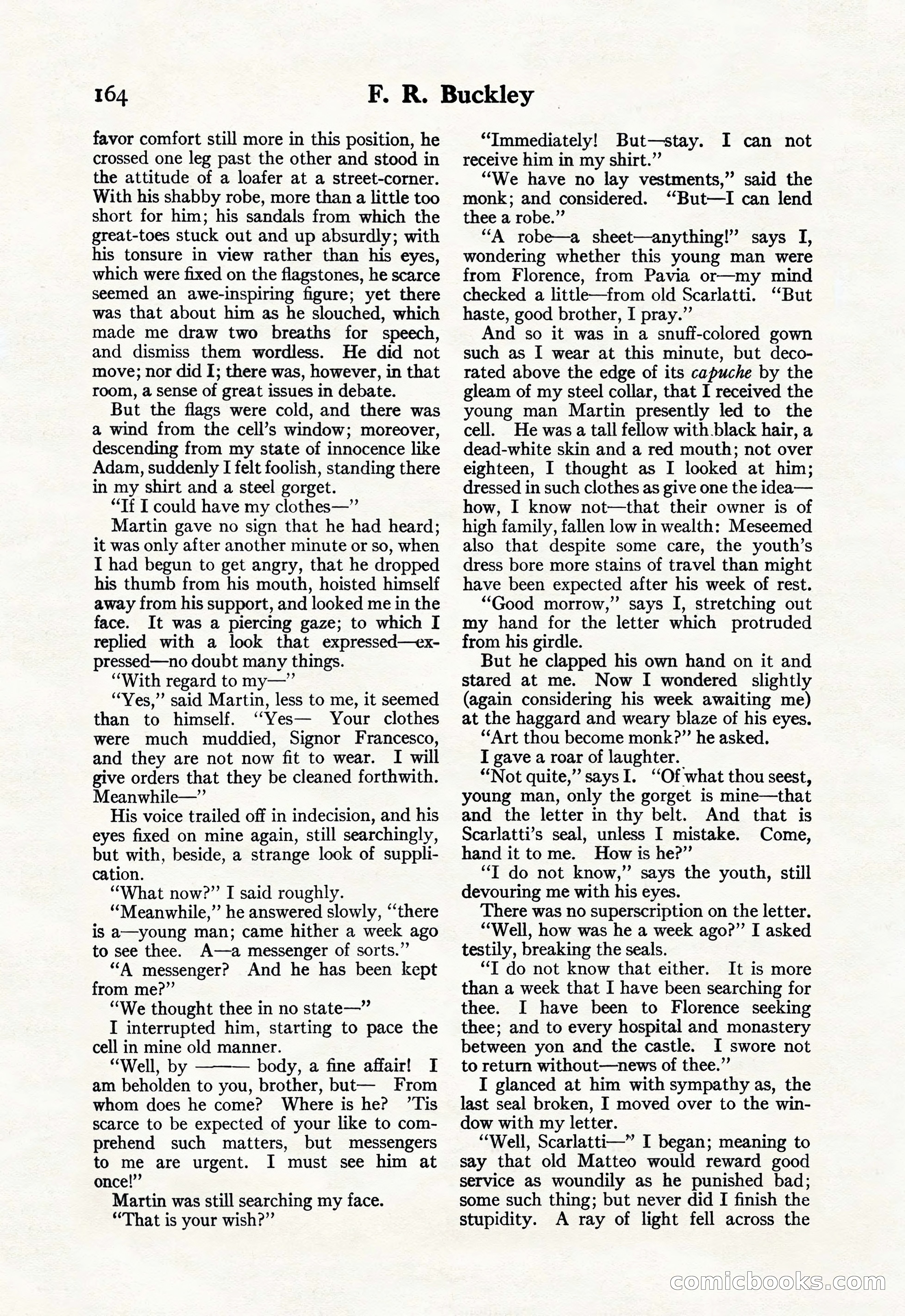
A restored page from Pulp Fiction, 1926. Page through the whole issue in the reader above.
📄 Transcribed text from this page (OCR, searchable)
Machine-transcribed from the original scan — historical spelling and the odd misread are preserved.
164 favor comfort still more in this position, he crossed one leg past the other and stood in the attitude of a loafer at a street-corner. With his shabby robe, more than a little too short for him; his sandals from which the great-toes stuck out and up absurdly; with his tonsure in view rather than his eyes, which were fixed on the flagstones, he scarce seemed an awe-inspiring figure; yet there was that about him as he slouched, which made me draw two breaths for speech, and dismiss them wordless. He did not move; nor did I; there was, however, in that room, a sense of great issues in debate. But the flags were cold, and there was a wind from the cell’s window; moreover, descending from my state of innocence like Adam, suddenly I felt foolish, standing there in my shirt and a steel gorget. “Tf I could have my clothes—”’ Martin gave no sign that he had heard; it was only after another minute or so, when I had begun to get angry, that he dropped his thumb from his mouth, hoisted himself away from his support, and looked me in the face. It was a piercing gaze; to which I[ replied with a look that expressed—ex- pressed—no doubt many things. “With regard to my—’”’ “Ves,” said Martin, less to me, it seemed than to himself. ‘‘Yes— Your clothes were much muddied, Signor Francesco, and they are not now fit to wear. I will give orders that they be cleaned forthwith. Meanwhile—” His voice trailed off in indecision, and his eyes fixed on mine again, still searchingly, but with, beside, a strange look of suppli- cation. “What now?” I said roughly. “Meanwhile,” he answered slowly, ‘‘there is a—young man; came hither a week ago to see thee. A—a messenger of sorts.” “A messenger? And he has been kept from me?” “We thought thee in no state—” I interrupted him, starting to pace the cell in mine old manner. “Well, by — body, a fine affair! I am beholden to you, brother, but— From whom does he come? Where is he? ’Tis scarce to be expected of your like to com- prehend such matters, but messengers to me are urgent. I must see him at once!”’ Martin was still searching my face. “That is your wish?” F. R. Buckley “Immediately! But—stay. I can not receive him in my shirt.”’ ‘“‘We have no lay vestments,” said the monk; and considered. ‘“But—I can lend thee a robe.” “A robe—a sheet—anything!” says I, wondering whether this young man were from Florence, from Pavia or—my mind checked a little—from old Scarlatti. “But haste, good brother, I pray.” And so it was in a snuff-colored gown such as I wear at this minute, but deco- rated above the edge of its capuche by the gleam of my steel collar, that I received the young man Martin presently led to the cell. He was a tall fellow with black hair, a dead-white skin and a red mouth; not over eighteen, I thought as I looked at him; dressed in such clothes as give one the idea— how, I know not—that their owner is of high family, fallen low in wealth: Meseemed also that despite some care, the youth’s dress bore more stains of travel than might have been expected after his week of rest. “Good morrow,” says I, stretching out my hand for the letter which protruded from his girdle. But he clapped his own hand on it and stared at me. Now I wondered slightly (again considering his week awaiting me) at the haggard and weary blaze of his eyes. *“‘Art thou become monk?” he asked. I gave a roar of laughter. “Not quite,” saysI. ‘Of what thou seest, young man, only the gorget is mine—that and the letter in thy belt. And that is Scarlatti’s seal, unless I mistake. Come, hand it tome. How is he?” “TI do not know,” says the youth, still devouring me with his eyes. There was no superscription on the letter. ‘Well, how was he a week ago?”’ I asked testily, breaking the seals. “I do not know that either. It is more than a week that I have been searching for thee. I have been to Florence seeking thee; and to every hospital and monastery between yon and the castle. I swore not to return without—news of thee.” I glanced at him with sympathy as, the last seal broken, I moved over to the win- dow with my letter. “Well, Scarlatti—” I began; meaning to say that old Matteo would reward good service as woundily as he punished bad; some such thing; but never did I finish the stupidity. A ray of light fell across the COMmICLoO S CO