
Pulp Fiction, 1926 · page 92 of 232
Adventure Magazine Cover — page 92: what you’re looking at
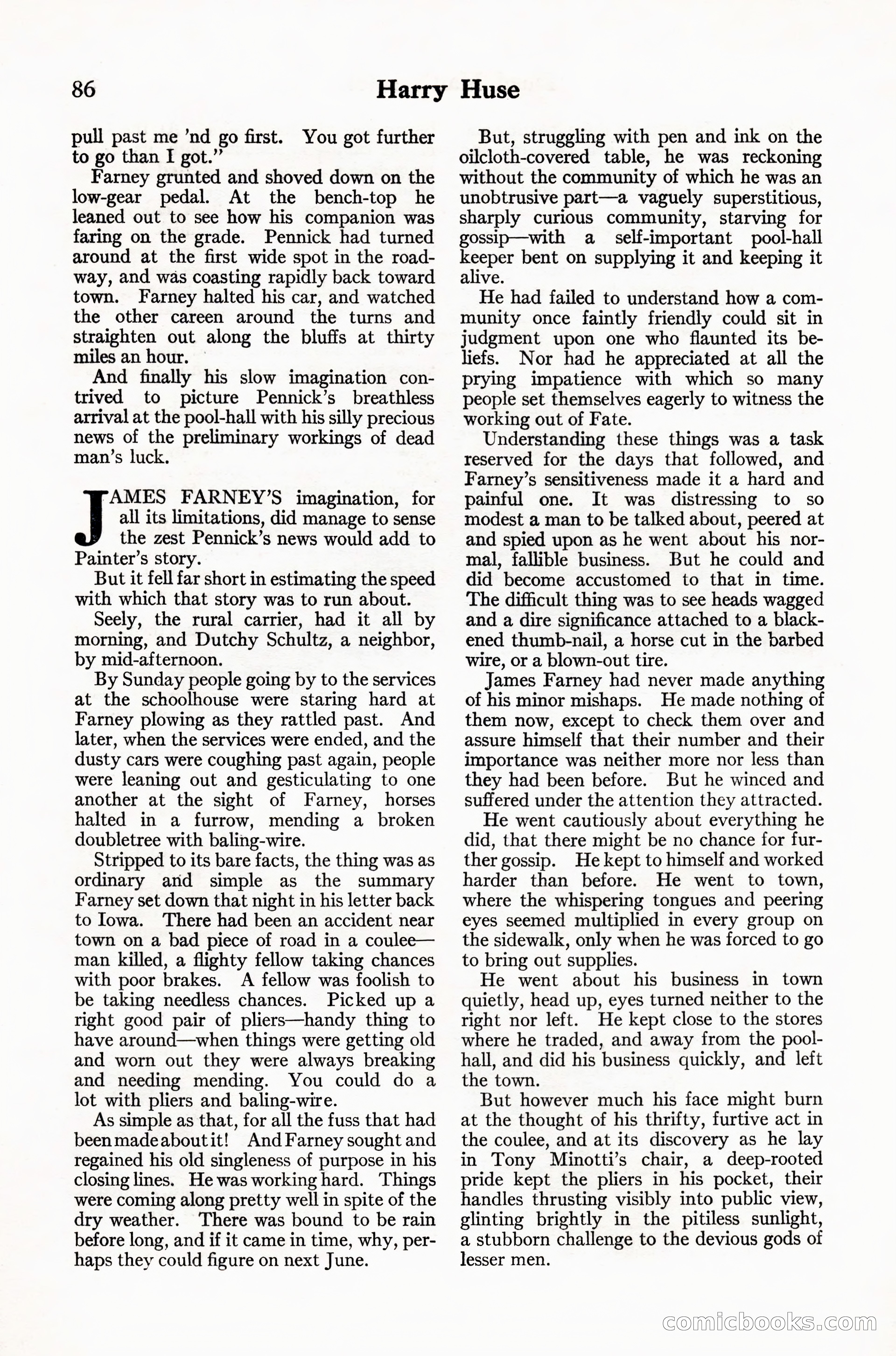
A restored page from Pulp Fiction, 1926. Page through the whole issue in the reader above.
📄 Transcribed text from this page (OCR, searchable)
Machine-transcribed from the original scan — historical spelling and the odd misread are preserved.
86 Harry Huse pull past me ’nd go first. to go than I got.” Farney grunted and shoved down on the low-gear pedal. At the bench-top he leaned out to see how his companion was faring on the grade. Pennick had turned around at the first wide spot in the road- way, and was coasting rapidly back toward town. Farney halted his car, and watched the other careen around the turns and straighten out along the bluffs at thirty miles an hour. And finally his slow imagination con- trived to picture Pennick’s breathless arrival at the pool-hall with his silly precious news of the preliminary workings of dead man’s luck. You got further all its limitations, did manage to sense the zest Pennick’s news would add to Painter’s story. But it fell far short in estimating the speed with which that story was to run about. Seely, the rural carrier, had it all by morning, and Dutchy Schultz, a neighbor, by mid-afternoon. By Sunday people going by to the services at the schoolhouse were staring hard at Farney plowing as they rattled past. And later, when the services were ended, and the dusty cars were coughing past again, people were leaning out and gesticulating to one another at the sight of Farney, horses halted in a furrow, mending a broken doubletree with baling-wire. Stripped to its bare facts, the thing was as ordinary ard simple as the summary Farney set down that night in his letter back to Iowa. ‘There had been an accident near town on a bad piece of road in a coulee— man killed, a flighty fellow taking chances with poor brakes. A fellow was foolish to be taking needless chances. Picked up a right good pair of pliers—handy thing to have around—when things were getting old and worn out they were always breaking and needing mending. You could do a lot with pliers and baling-wire. As simple as that, for all the fuss that had been madeaboutit! And Farney sought and regained his old singleness of purpose in his closing lines. He was working hard. Things were coming along pretty well in spite of the dry weather. There was bound to be rain before long, and if it came in time, why, per- haps they could figure on next June. yu FARNEY’S imagination, for But, struggling with pen and ink on the oilcloth-covered table, he was reckoning without the community of which he was an unobtrusive part—a vaguely superstitious, sharply curious community, starving for gossip—with a self-important pool-hall keeper bent on supplying it and keeping it alive. He had failed to understand how a com- munity once faintly friendly could sit in judgment upon one who flaunted its be- liefs. Nor had he appreciated at all the prying impatience with which so many people set themselves eagerly to witness the working out of Fate. Understanding these things was a task reserved for the days that followed, and Farney’s sensitiveness made it a hard and painful one. It was distressing to so modest a man to be talked about, peered at and spied upon as he went about his nor- mal, fallible business. But he could and did become accustomed to that in time. The difficult thing was to see heads wagged and a dire significance attached to a black- ened thumb-nail, a horse cut in the barbed wire, or a blown-out tire. James Farney had never made anything of his minor mishaps. He made nothing of them now, except to check them over and assure himself that their number and their importance was neither more nor less than they had been before. But he winced and suffered under the attention they attracted. He went cautiously about everything he did, that there might be no chance for fur- ther gossip. He kept to himself and worked harder than before. He went to town, where the whispering tongues and peering eyes seemed multiplied in every group on the sidewalk, only when he was forced to go to bring out supplies. He went about his business in town quietly, head up, eyes turned neither to the right nor left. He kept close to the stores where he traded, and away from the pool- hall, and did his business quickly, and left the town. But however much his face might burn at the thought of his thrifty, furtive act in the coulee, and at its discovery as he lay in Tony "Minotti’s chair, a deep-rooted pride kept the pliers in his pocket, their handles thrusting visibly into public view, glinting brightly in the pitiless sunlight, a stubborn challenge to the devious gods of lesser men. COmiclbooks.c© 5}