
Pulp Fiction, 1926 · page 93 of 232
Adventure Magazine Cover — page 93: what you’re looking at
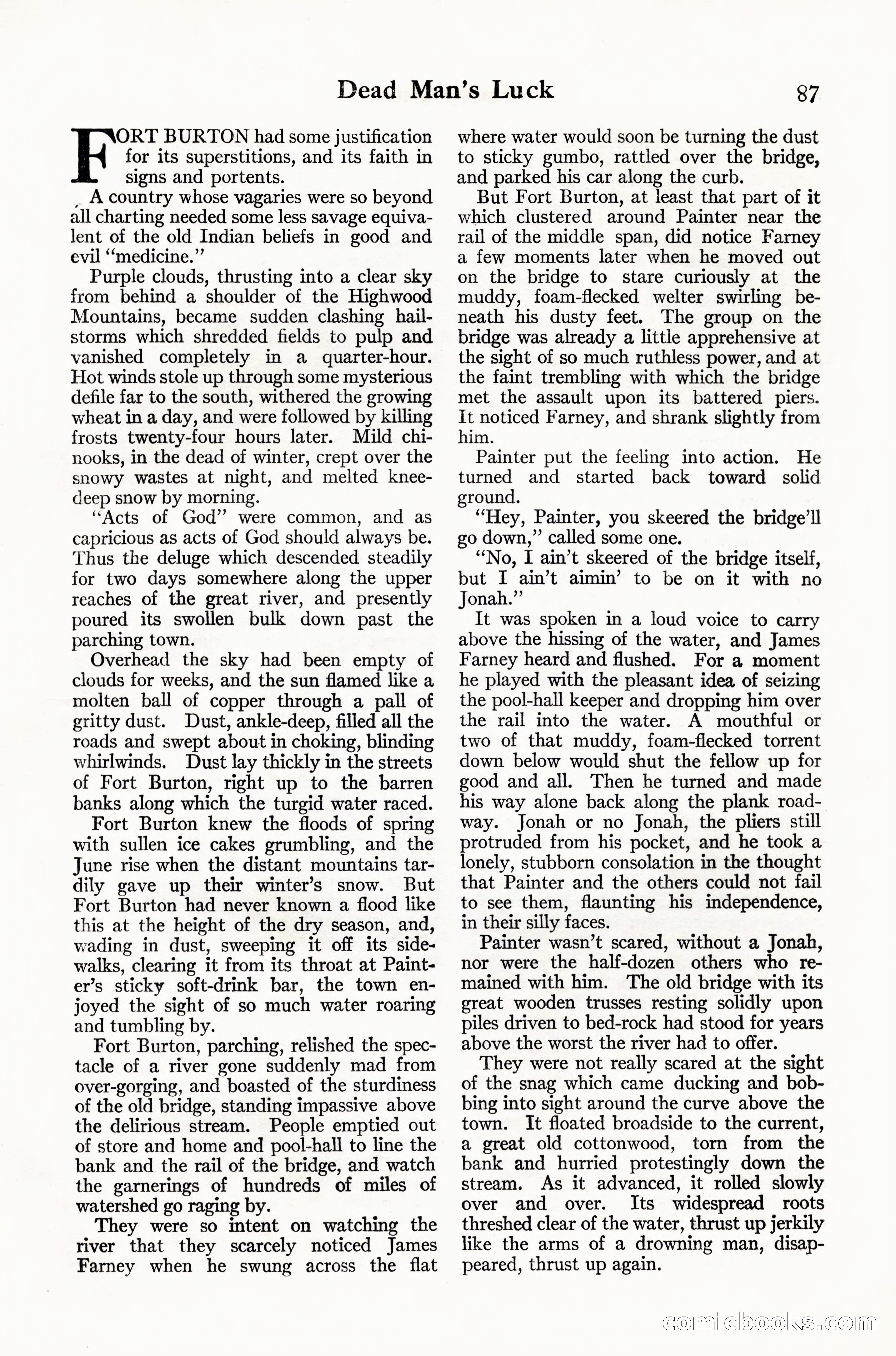
A restored page from Pulp Fiction, 1926. Page through the whole issue in the reader above.
📄 Transcribed text from this page (OCR, searchable)
Machine-transcribed from the original scan — historical spelling and the odd misread are preserved.
Dead Man’s Luck Q7 for its superstitions, and its faith in signs and portents. _ Acountry whose vagaries were so beyond all charting needed some less savage equiva- lent of the old Indian beliefs in good and evil “medicine.” Purple clouds, thrusting into a clear sky from behind a shoulder of the Highwood Mountains, became sudden clashing hail- storms which shredded fields to pulp and vanished completely in a quarter-hour. Hot winds stole up through some mysterious defile far to the south, withered the growing wheat in a day, and were followed by killing frosts twenty-four hours later. Mild chi- nooks, in the dead of winter, crept over the snowy wastes at night, and melted knee- deep snow by morning. “Acts of God’? were common, and as capricious as acts of God should always be. Thus the deluge which descended steadily for two days somewhere along the upper reaches of the great river, and presently poured its swollen bulk down past the parching town. Overhead the sky had been empty of clouds for weeks, and the sun flamed like a molten ball of copper through a pall of gritty dust. Dust, ankle-deep, filled all the roads and swept about in choking, blinding whirlwinds. Dust lay thickly in the streets of Fort Burton, right up to the barren banks along which the turgid water raced. Fort Burton knew the floods of spring with sullen ice cakes grumbling, and the June rise when the distant mountains tar- dily gave up their winter’s snow. But Fort Burton had never known a flood like this at the height of the dry season, and, wading in dust, sweeping it off its side- walks, clearing it from its throat at Paint- er’s sticky soft-drink bar, the town en- joyed the sight of so much water roaring and tumbling by. Fort Burton, parching, relished the spec- tacle of a river gone suddenly mad from over-gorging, and boasted of the sturdiness of the old bridge, standing impassive above the delirious stream. People emptied out of store and home and pool-hall to line the bank and the rail of the bridge, and watch the garnerings of hundreds of miles of watershed go raging by. They were so intent on watching the river that they scarcely noticed James Farney when he swung across the flat Pe: BURTON had some justification where water would soon be turning the dust to sticky gumbo, rattled over the bridge, and parked his car along the curb. But Fort Burton, at least that part of it which clustered around Painter near the rail of the middle span, did notice Farney a few moments later when he moved out on the bridge to stare curiously at the muddy, foam-flecked welter swirling be- neath his dusty feet. The group on the bridge was already a little apprehensive at the sight of so much ruthless power, and at the faint trembling with which the bridge met the assault upon its battered piers. It noticed Farney, and shrank slightly from him. Painter put the feeling into action. He turned and started back toward solid ground. “Hey, Painter, you skeered the bridge’ll go down,” called some one. “No, I ain’t skeered of the bridge itself, but I ain’t aimin’ to be on it with no Jonah.” It was spoken in a loud voice to carry above the hissing of the water, and James Farney heard and flushed. For a moment he played with the pleasant idea of seizing the pool-hall keeper and dropping him over the rail into the water. A mouthful or two of that muddy, foam-flecked torrent down below would shut the fellow up for good and all. Then he turned and made his way alone back along the plank road- way. Jonah or no Jonah, the pliers still protruded from his pocket, and he took a lonely, stubborn consolation in the thought that Painter and the others could not fail to see them, flaunting his independence, in their silly faces. Painter wasn’t scared, without a Jonah, nor were the half-dozen others who re- mained with him. The old bridge with its great wooden trusses resting solidly upon piles driven to bed-rock had stood for years above the worst the river had to offer. They were not really scared at the sight of the snag which came ducking and bob- bing into sight around the curve above the town. It floated broadside to the current, a great old cottonwood, torn from the bank and hurried protestingly down the stream. As it advanced, it rolled slowly over and over. Its widespread roots threshed clear of the water, thrust up jerkily like the arms of a drowning man, disap- peared, thrust up again. COmiclbooks.c©