
Pulp Fiction, 1926 · page 91 of 232
Adventure Magazine Cover — page 91: what you’re looking at
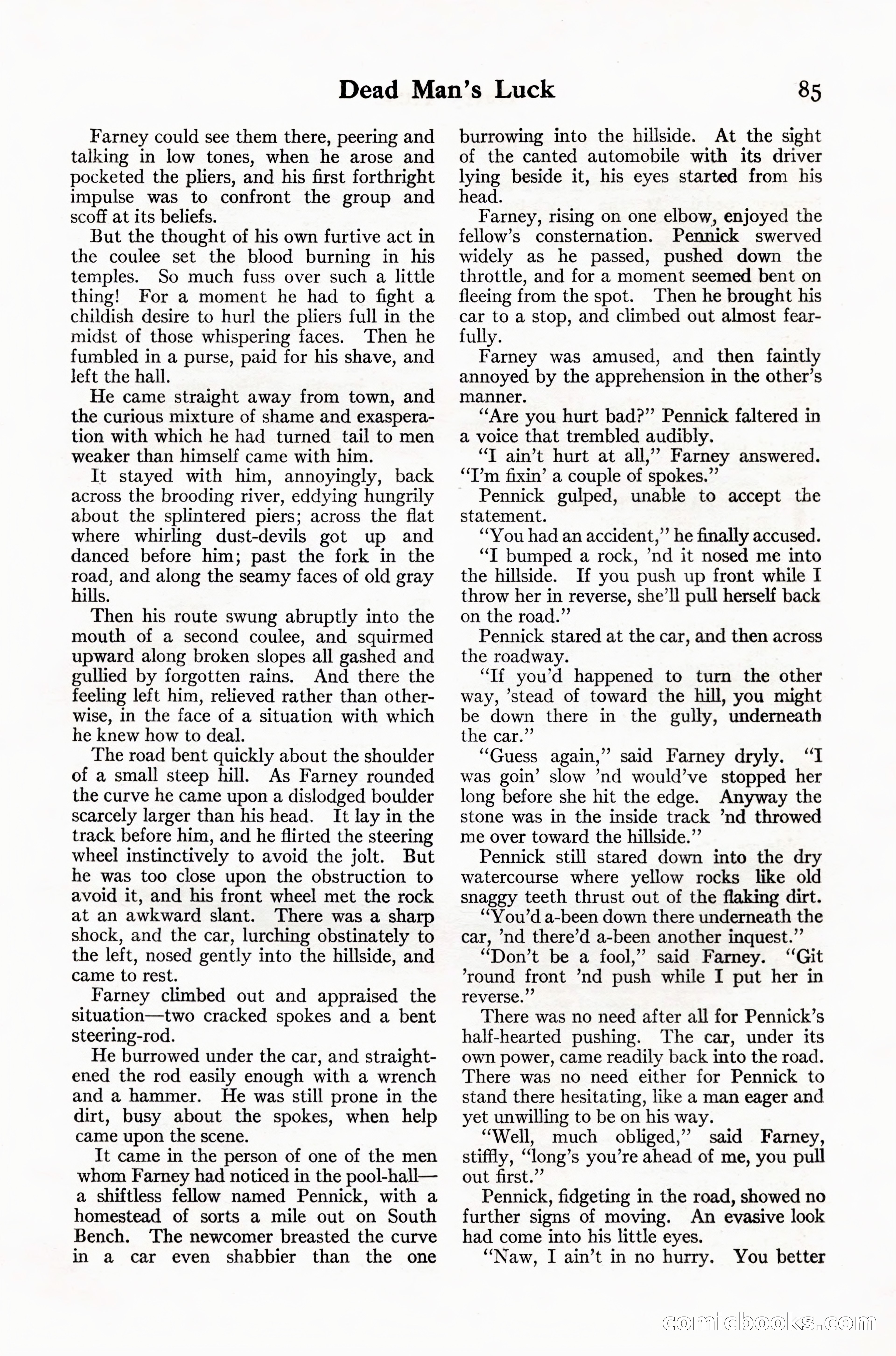
A restored page from Pulp Fiction, 1926. Page through the whole issue in the reader above.
📄 Transcribed text from this page (OCR, searchable)
Machine-transcribed from the original scan — historical spelling and the odd misread are preserved.
Dead Man’s Luck 85 Farney could see them there, peering and talking in low tones, when he arose and pocketed the pliers, and his first forthright impulse was to confront the group and scoff at its beliefs. But the thought of his own furtive act in the coulee set the blood burning in his temples. So much fuss over such a little thing! For a moment he had to fight a childish desire to hurl the pliers full in the midst of those whispering faces. ‘Then he fumbled in a purse, paid for his shave, and left the hall. He came straight away from town, and the curious mixture of shame and exaspera- tion with which he had turned tail to men weaker than himself came with him. It stayed with him, annoyingly, back across the brooding river, eddying hungrily about the splintered piers; across the flat where whirling dust-devils got up and danced before him; past the fork in the road, and along the seamy faces of old gray hills. Then his route swung abruptly into the mouth of a second coulee, and squirmed upward along broken slopes all gashed and gullied by forgotten rains. And there the feeling left him, relieved rather than other- wise, in the face of a situation with which he knew how to deal. The road bent quickly about the shoulder of a small steep hill. As Farney rounded the curve he came upon a dislodged boulder scarcely larger than his head. It lay in the track before him, and he flirted the steering wheel instinctively to avoid the jolt. But he was too close upon the obstruction to avoid it, and his front wheel met the rock at an awkward slant. There was a sharp shock, and the car, lurching obstinately to the left, nosed gently into the hillside, and came to rest. Farney climbed out and appraised the situation—two cracked spokes and a bent steering-rod. He burrowed under the car, and straight- ened the rod easily enough with a wrench and a hammer. He was still prone in the dirt, busy about the spokes, when help came upon the scene. It came in the person of one of the men whom Farney had noticed in the pool-hall— a shiftless fellow named Pennick, with a homestead of sorts a mile out on South Bench. The newcomer breasted the curve in a car even shabbier than the one burrowing into the hillside. At the sight of the canted automobile with its driver lying beside it, his eyes started from his head. Farney, rising on one elbow, enjoyed the fellow’s consternation. Pennick swerved widely as he passed, pushed down the throttle, and for a moment seemed bent on fleeing from the spot. Then he brought his car to a stop, and climbed out almost fear- fully. Farney was amused, and then faintly annoyed by the apprehension in the other’s manner. “Are you hurt bad?’ Pennick faltered in a voice that trembled audibly. “T ain’t hurt at all,” Farney answered. “I’m fixin’ a couple of spokes.” Pennick gulped, unable to accept the statement. “Vou had an accident,” he finally accused. “T bumped a rock, ’nd it nosed me into the hillside. If you push up front while I throw her in reverse, she’ll pull herself back on the road.” Pennick stared at the car, and then across the roadway. “If you’d happened to turn the other way, ’stead of toward the hill, you might be down there in the gully, underneath the car.” “Guess again,” said Farney dryly. “I was goin’ slow ’nd would’ve stopped her long before she hit the edge. Anyway the stone was in the inside track ’nd throwed me over toward the hillside.” Pennick still stared down into the dry watercourse where yellow rocks like old snaggy teeth thrust out of the flaking dirt. ‘‘You’d a-been down there underneath the car, ’nd there’d a-been another inquest.” “Don’t be a fool,” said Farney. ‘Git ‘round front ’nd push while I put her in reverse.” There was no need after all for Pennick’s half-hearted pushing. The car, under its own power, came readily back into the road. There was no need either for Pennick to stand there hesitating, like a man eager and yet unwilling to be on his way. “Well, much obliged,” said Farney, stiffly, “long’s you’re ahead of me, you pull out first.” Pennick, fidgeting in the road, showed no further signs of moving. An evasive look had come into his little eyes. “Naw, I ain’t in no hurry. You better COnmiclboooks.c©