
Pulp Fiction, 1926 · page 205 of 232
Adventure Magazine Cover — page 205: what you’re looking at
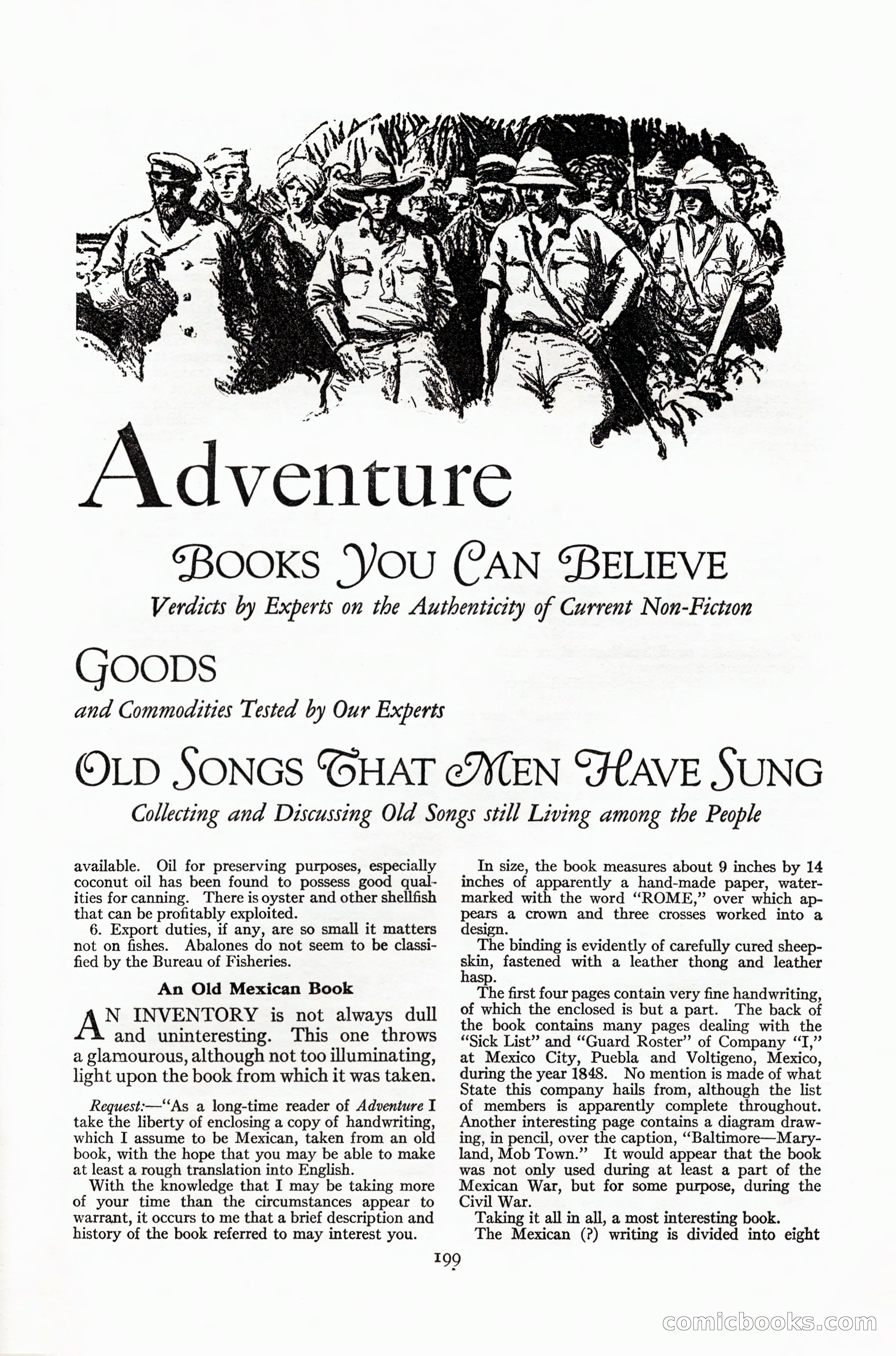
A restored page from Pulp Fiction, 1926. Page through the whole issue in the reader above.
📄 Transcribed text from this page (OCR, searchable)
Machine-transcribed from the original scan — historical spelling and the odd misread are preserved.
SBOOKS SVOU (AN “BELIEVE Verdicts by Experts on the Authenticity of Current Non-Fiction (GOODS and Commodities Tested by Our Experts OLD SONGS “6HAT eATEN SFLAVE SUNG Collecting and Discussing Old Songs still Living among the People available. Oil for preserving purposes, especially coconut oil has been found to possess good qual- ities for canning. There is oyster and other shellfish that can be profitably exploited. 6. Export duties, if any, are so small it matters not on fishes. Abalones do not seem to be classi- fied by the Bureau of Fisheries. An Old Mexican Book N INVENTORY is not always dull and uninteresting. This one throws a glamourous, although not too iJuminating, light upon the book from which it was taken. Request:—“‘As a long-time reader of Adventure I take the liberty of enclosing a copy of handwriting, which I assume to be Mexican, taken from an old book, with the hope that you may be able to make at least a rough translation into English. With the knowledge that I may be taking more of your time than the circumstances appear to warrant, it occurs to me that a brief description and history of the book referred to may interest you. In size, the book measures about 9 inches by 14 inches of apparently a hand-made paper, water- marked with the word “ROME,” over which ap- pears a crown and three crosses worked into a design. The binding is evidently of carefully cured sheep- a fastened with a leather thong and leather asp. The first four pages contain very fine handwriting, of which the enclosed is but a part. The back of the book contains many pages dealing with the “Sick List” and “Guard Roster” of Company “TI,” at Mexico City, Puebla and Voltigeno, Mexico, during the year 1848. No mention is made of what State this company hails from, although the list of members is apparently complete throughout. Another interesting page contains a diagram draw- ing, in pencil, over the caption, “‘Baltimore—Mary- land, Mob Town.” It would appear that the book was not only used during at least a part of the Mexican War, but for some purpose, during the Civil War. Taking it all in all, a most interesting book. The Mexican (?) writing is divided into eight 199 C© DOOK