
Pulp Fiction, 1926 · page 206 of 232
Adventure Magazine Cover — page 206: what you’re looking at
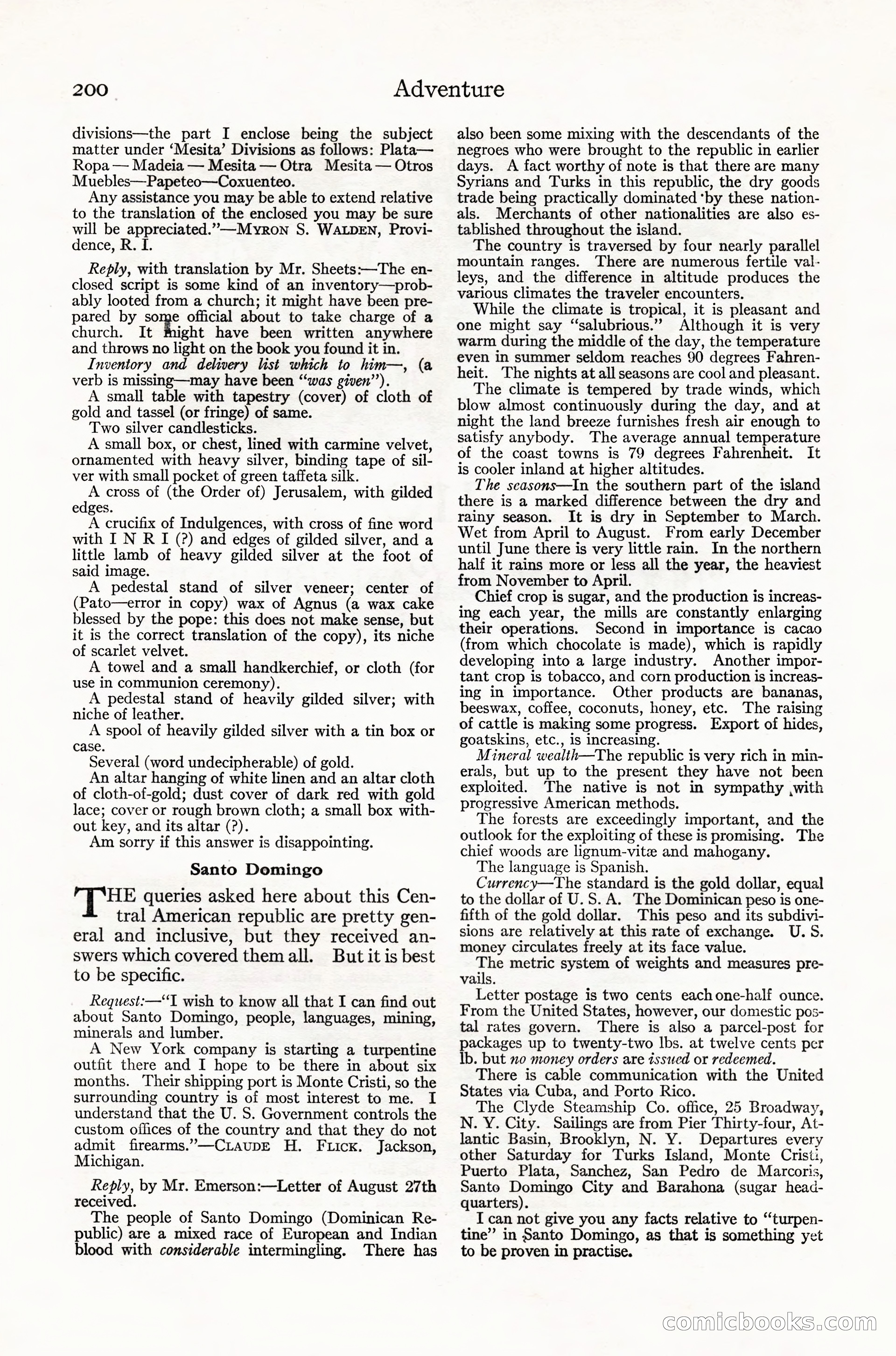
A restored page from Pulp Fiction, 1926. Page through the whole issue in the reader above.
📄 Transcribed text from this page (OCR, searchable)
Machine-transcribed from the original scan — historical spelling and the odd misread are preserved.
200 divisions—the part I enclose being the subject matter under ‘Mesita’ Divisions as follows: Plata— Ropa — Madeia — Mesita — Otra Mesita — Otros Muebles—Papeteo—Coxuenteo. Any assistance you may be able to extend relative to the translation of the enclosed you may be sure will be appreciated.” Myron S. WALDEN, Provi- dence, R. I. Reply, with translation by Mr. Sheets:—The en- closed script is some kind of an inventory—prob- ably looted from a church; it might have been pre- pared by some official about to take charge of a church. It tight have been written anywhere and throws no light on the book you found it in. Inventory and delivery list which to him—, (a verb is missing—may have been “was given’’). A small table with tapestry (cover) of cloth of gold and tassel (or fringe) of same. Two silver candlesticks. A small box, or chest, lined with carmine velvet, ornamented with heavy silver, binding tape of sil- ver with small pocket of green taffeta silk. A cross of (the Order of) Jerusalem, with gilded edges. A crucifix of Indulgences, with cross of fine word with I N RI (?) and edges of gilded silver, and a little lamb of heavy gilded silver at the foot of said image. A pedestal stand of silver veneer; center of (Pato—error in copy) wax of Agnus (a wax cake blessed by the pope: this does not make sense, but it is the correct translation of the copy), its niche of scarlet velvet. A towel and a small handkerchief, or cloth (for use In communion ceremony). A pedestal stand of heavily gilded silver; with niche of leather. A spool of heavily gilded silver with a tin box or case. Several (word undecipherable) of gold. An altar hanging of white linen and an altar cloth of cloth-of-gold; dust cover of dark red with gold lace; cover or rough brown cloth; a small box with- out key, and its altar (?). Am sorry if this answer is disappointing. Santo Domingo TH queries asked here about this Cen- tral American republic are pretty gen- eral and inclusive, but they received an- swers which covered themall. But it is best to be specific. Request:—“T wish to know all that I can find out about Santo Domingo, people, languages, mining, minerals and lumber. A New York company is starting a turpentine outfit there and I hope to be there in about six months. Their shipping port is Monte Cristi, so the surrounding country is of most interest to me. I understand that the U. S. Government controls the custom oflices of the country and that they do not admit firearms.”—CLAUDE H. Fick. Jackson, Michigan. Reply, by Mr. Emerson:—Letter of August 27th received. The people of Santo Domingo (Dominican Re- public) are a mixed race of European and Indian blood with considerable intermingling. There has Adventure also been some mixing with the descendants of the negroes who were brought to the republic in earlier days. A fact worthy of note is that there are many Syrians and Turks in this republic, the dry goods trade being practically dominated ‘by these nation- als. Merchants of other nationalities are also es- tablished throughout the island. The country is traversed by four nearly parallel mountain ranges. There are numerous fertile val- leys, and the difference in altitude produces the various climates the traveler encounters. While the climate is tropical, it is pleasant and one might say “salubrious.” Although it is very warm during the middle of the day, the temperature even in summer seldom reaches 90 degrees Fahren- heit. The nights at all seasons are cool and pleasant. The climate is tempered by trade winds, which blow almost continuously during the day, and at night the land breeze furnishes fresh air enough to satisfy anybody. The average annual temperature of the coast towns is 79 degrees Fahrenheit. It is cooler inland at higher altitudes. The scasons—In the southern part of the island there is a marked difference between the dry and rainy season. It is dry in September to March. Wet from April to August. From early December until June there is very little rain. In the northern half it rains more or less all the year, the heaviest from November to April. Chief crop is sugar, and the production is increas- ing each year, the mills are constantly enlarging their operations. Second in importance is cacao (from which chocolate is made), which is rapidly developing into a large industry. Another imporx- tant crop is tobacco, and corn production is increas- ing in importance. Other products are bananas, beeswax, coffee, coconuts, honey, etc. The raising of cattle is making some progress. Export of hides, goatskins, etc., 1s increasing. Mineral wealth—The republic is very rich in min- erals, but up to the present they have not been exploited. The native is not in sympathy ,with progressive American methods. The forests are exceedingly important, and the outlook for the exploiting of these is promising. The chief woods are lignum-vite and mahogany. The language is Spanish. Currency—The standard is the gold dollar, equal to the dollar of U.S. A. The Dominican peso is one- fifth of the gold dollar. This peso and its subdivi- sions are relatively at this rate of exchange. U.S. money circulates freely at its face value. ae metric system of weights and measures pre- vails Letter postage is two cents eachone-half ounce. From the United States, however, our domestic pos- tal rates govern. There is also a parcel-post for packages up to twenty-two lbs. at twelve cents per lb. but no money orders are issued or redeemed. There is cable communication with the United States via Cuba, and Porto Rico. The Clyde Steamship Co. office, 25 Broadway, N. Y. City. Sailings are from Pier Thirty-four, At- lantic Basin, Brooklyn, N. Y. Departures every other Saturday for Turks Island, Monte Cristi, Puerto Plata, Sanchez, San Pedro de Marcoris, Sante Domingo City and Barahona (sugar head- quarters). I can not give you any facts relative to “turpen- tine” in Santo Domingo, as that is something yet to be proven in practise. COnmiclboooks.C©