
Pulp Fiction, 1926 · page 203 of 232
Adventure Magazine Cover — page 203: what you’re looking at
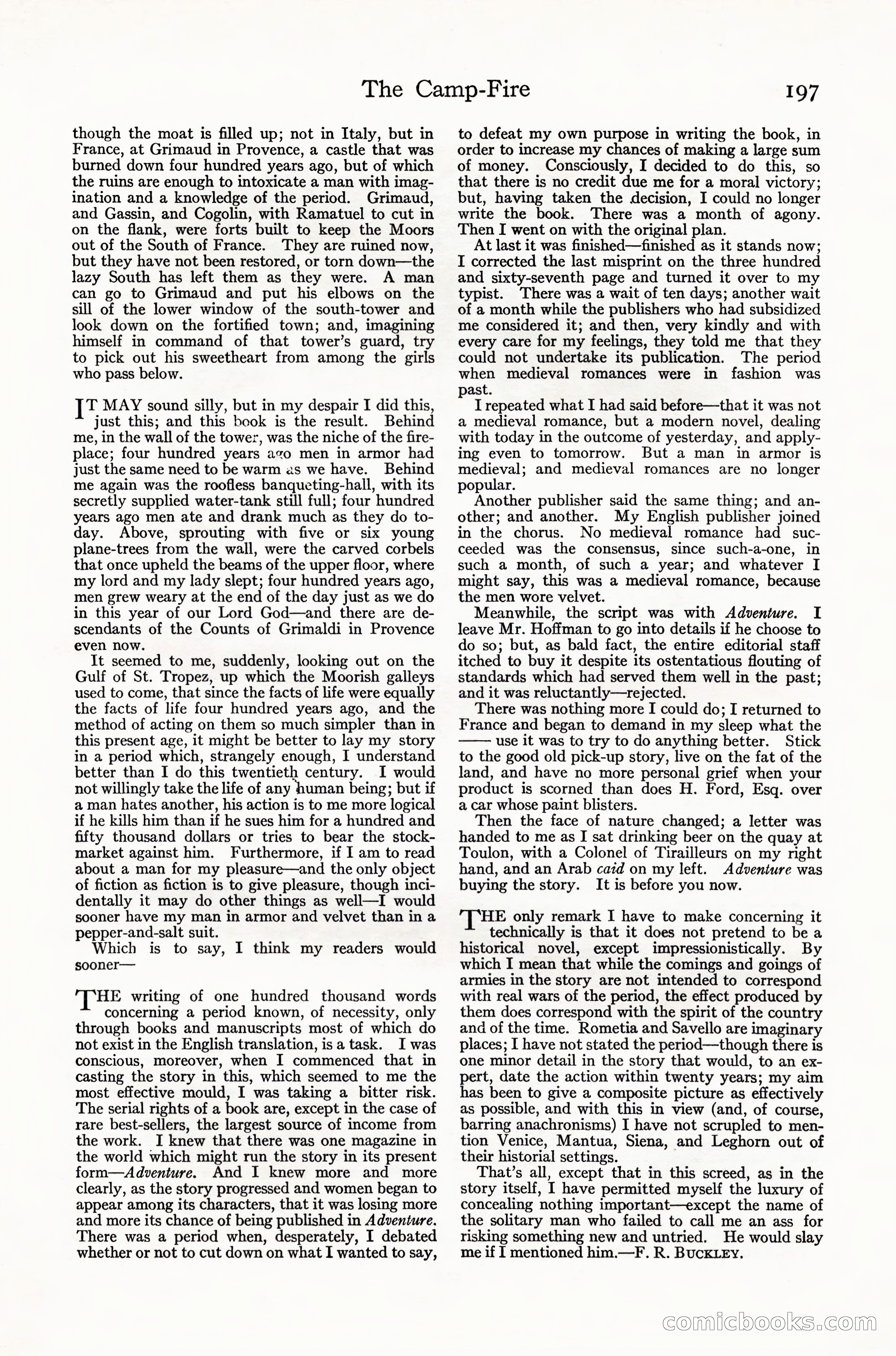
A restored page from Pulp Fiction, 1926. Page through the whole issue in the reader above.
📄 Transcribed text from this page (OCR, searchable)
Machine-transcribed from the original scan — historical spelling and the odd misread are preserved.
The Camp-Fire though the moat is filled up; not in Italy, but in France, at Grimaud in Provence, a castle that was burned down four hundred years ago, but of which the ruins are enough to intoxicate a man with imag- ination and a knowledge of the period. Grimaud, and Gassin, and Cogolin, with Ramatuel to cut in on the flank, were forts built to keep the Moors out of the South of France. They are ruined now, but they have not been restored, or torn down—the lazy South has left them as they were. A man can go to Grimaud and put his elbows on the sill of the lower window of the south-tower and look down on the fortified town; and, imagining himself in command of that tower’s guard, try to pick out his sweetheart from among the girls who pass below. [zt MAY sound silly, but in my despair I did this, just this; and this book is the result. Behind me, in the wall of the tower, was the niche of the fire- place; four hundred years azo men in armor had just the same need to be warm as we have. Behind me again was the roofless banqueting-hall, with its secretly supplied water-tank still full; four hundred years ago men ate and drank much as they do to- day. Above, sprouting with five or six young plane-trees from the wall, were the carved corbels that once upheld the beams of the upper floor, where my lord and my lady slept; four hundred years ago, men grew weary at the end of the day just as we do in this year of our Lord God—and there are de- scendants of the Counts of Grimaldi in Provence even now. It seemed to me, suddenly, looking out on the Gulf of St. Tropez, up which the Moorish galleys used to come, that since the facts of life were equally the facts of life four hundred years ago, and the method of acting on them so much simpler than in this present age, it might be better to lay my story in a period which, strangely enough, I understand better than I do this twentieth century. I would not willingly take the life of any human being; but if a man hates another, his action is to me more logical if he kills him than if he sues him for a hundred and fifty thousand dollars or tries to bear the stock- market against him. Furthermore, if I am to read about a man for my pleasure—and the only object of fiction as fiction is to give pleasure, though inci- dentally it may do other things as well—I would sooner have my man in armor and velvet than in a pepper-and-salt suit. Which is to say, I think my readers would sooner— HE writing of one hundred thousand words concerning a period known, of necessity, only through books and manuscripts most of which do not exist in the English translation, isa task. Iwas conscious, moreover, when I commenced that in casting the story in this, which seemed to me the most effective mould, I was taking a bitter risk. The serial rights of a book are, except in the case of rare best-sellers, the largest source of income from the work. I knew that there was one magazine in the world which might run the story in its present form—Adventure. And I knew more and more clearly, as the story progressed and women began to appear among its characters, that it was losing more and more its chance of being published in Adventure. There was a period when, desperately, I debated whether or not to cut down on what I wanted to say, 197 to defeat my own purpose in writing the book, in order to increase my chances of making a large sum of money. Consciously, I decided to do this, so that there is no credit due me for a moral victory; but, having taken the decision, I could no longer write the book. There was a month of agony. Then I went on with the original plan. At last it was finished—finished as it stands now; I corrected the last misprint on the three hundred and sixty-seventh page and turned it over to my typist. There was a wait of ten days; another wait of a month while the publishers who had subsidized me considered it; and then, very kindly and with every care for my feelings, they told me that they could not undertake its publication. The period when medieval romances were in fashion was past. I repeated what I had said before—that it was not a medieval romance, but a modern novel, dealing with today in the outcome of yesterday, and apply- ing even to tomorrow. But a man in armor is medieval; and medieval romances are no longer popular. Another publisher said the same thing; and an- other; and another. My English publisher joined in the chorus. No medieval romance had _ suc- ceeded was the consensus, since such-a-one, in such a month, of such a year; and whatever I might say, this was a medieval romance, because the men wore velvet. Meanwhile, the script was with Adventure. I leave Mr. Hoffman to go into details if he choose to do so; but, as bald fact, the entire editorial staff itched to buy it despite its ostentatious flouting of standards which had served them well in the past; and it was reluctantly—rejected. There was nothing more I could do; I returned to France and began to demand in my sleep what the use it was to try to do anything better. Stick to the good old pick-up story, live on the fat of the land, and have no more personal grief when your product is scorned than does H. Ford, Esq. over a car whose paint blisters. Then the face of nature changed; a letter was handed to me as I sat drinking beer on the quay at Toulon, with a Colonel of Tirailleurs on my right hand, and an Arab cazd on my left. Adventure was buying the story. It is before you now. ‘THE only remark I have to make concerning it technically is that it does not pretend to be a historical novel, except impressionistically. By which I mean that while the comings and goings of armies in the story are not intended to correspond with real wars of the period, the effect produced by them does correspond with the spirit of the country and of the time. Rometia and Savello are imaginary places; I have not stated the period—though there is one minor detail in the story that would, to an ex- pert, date the action within twenty years; my aim has been to give a composite picture as effectively as possible, and with this in view (and, of course, barring anachronisms) I have not scrupled to men- tion Venice, Mantua, Siena, and Leghorn out of their historial settings. That’s all, except that in this screed, as in the story itself, I have permitted myself the luxury of concealing nothing important—except the name of the solitary man who failed to call me an ass for risking something new and untried. He would slay me if I mentioned him.—F. R. BUCKLEY. COnmclbooolkks.c©