
Pulp Fiction, 1926 · page 202 of 232
Adventure Magazine Cover — page 202: what you’re looking at
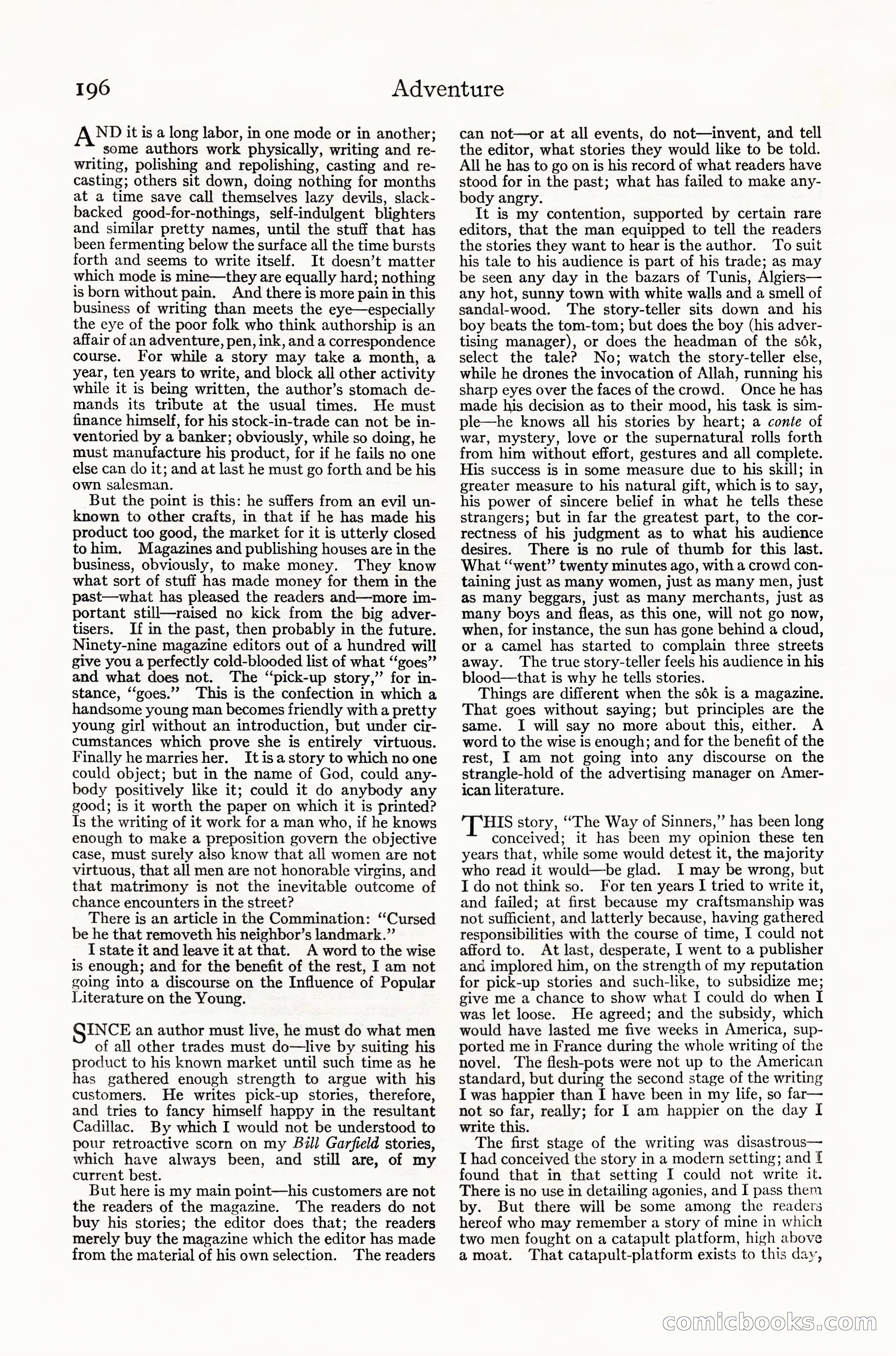
A restored page from Pulp Fiction, 1926. Page through the whole issue in the reader above.
📄 Transcribed text from this page (OCR, searchable)
Machine-transcribed from the original scan — historical spelling and the odd misread are preserved.
196 ANP it is a long labor, in one mode or in another; some authors work physically, writing and re- writing, polishing and repolishing, casting and re- casting; others sit down, doing nothing for months at a time save call themselves lazy devils, slack- backed good-for-nothings, self-indulgent blighters and similar pretty names, until the stuff that has been fermenting below the surface all the time bursts forth and seems to write itself. It doesn’t matter which mode is mine—they are equally hard; nothing is born without pain. And there is more pain in this business of writing than meets the eye—especially the eye of the poor folk who think authorship is an affair of an adventure, pen, ink, and a correspondence course. For while a story may take a month, a year, ten years to write, and block all other activity while it is being written, the author’s stomach de- mands its tribute at the usual times. He must finance himself, for his stock-in-trade can not be in- ventoried by a banker; obviously, while so doing, he must manufacture his product, for if he fails no one else can do it; and at last he must go forth and be his own salesman. But the point is this: he suffers from an evil un- known to other crafts, in that if he has made his product too good, the market for it is utterly closed tohim. Magazines and publishing houses are in the business, obviously, to make money. They know what sort of stuff has made money for them in the past—what has pleased the readers and—more im- portant still—raised no kick from the big adver- tisers. If in the past, then probably in the future. Ninety-nine magazine editors out of a hundred will give you a perfectly cold-blooded list of what “‘goes”’ and what does not. The “pick-up story,” for in- stance, “‘goes.”” This is the confection in which a handsome young man becomes friendly with a pretty young girl without an introduction, but under cir- cumstances which prove she is entirely virtuous. Finally he marries her. Itisastory to which no one could object; but in the name of God, could any- body positively like it; could it do anybody any good; is it worth the paper on which it is printed? Is the writing of it work for a man who, if he knows enough to make a preposition govern the objective case, must surely also know that all women are not virtuous, that all men are not honorable virgins, and that matrimony is not the inevitable outcome of chance encounters in the street? There is an article in the Commination: “Cursed be he that removeth his neighbor’s landmark.” I state it and leave it at that. A word to the wise is enough; and for the benefit of the rest, I am not going into a discourse on the Influence of Popular Literature on the Young. SINCE an author must live, he must do what men of all other trades must do—live by suiting his product to his known market until such time as he has gathered enough strength to argue with his customers. He writes pick-up stories, therefore, and tries to fancy himself happy in the resultant Cadillac. By which I would not be understood to pour retroactive scorn on my Bull Garfield stories, which have always been, and still are, of my current best. But here is my main point—his customers are not the readers of the magazine. The readers do not buy his stories; the editor does that; the readers merely buy the magazine which the editor has made from the material of his own selection. The readers Adventure can not—or at all events, do not—invent, and tell the editor, what stories they would like to be told. All he has to go on is his record of what readers have stood for in the past; what has failed to make any- body angry. It is my contention, supported by certain rare editors, that the man equipped to tell the readers the stories they want to hear is the author. To suit his tale to his audience is part of his trade; as may be seen any day in the bazars of Tunis, Algiers— any hot, sunny town with white walls and a smell of sandal-wood. ‘The story-teller sits down and his boy beats the tom-tom; but does the boy (his adver- tising manager), or does the headman of the sdk, select the tale? No; watch the story-teller else, while he drones the invocation of Allah, running his sharp eyes over the faces of the crowd. Once he has made his decision as to their mood, his task is sim- ple—he knows all his stories by heart; a conte of war, mystery, love or the supernatural rolls forth from him without effort, gestures and all complete. His success is in some measure due to his skill; in greater measure to his natural gift, which is to say, his power of sincere belief in what he tells these strangers; but in far the greatest part, to the cor- rectness of his judgment as to what his audience desires. There is no rule of thumb for this last. What ‘“‘went”’ twenty minutes ago, with a crowd con- taining just as many women, just as many men, just as many beggars, just as many merchants, just as many boys and fleas, as this one, will not go now, when, for instance, the sun has gone behind a cloud, or a camel has started to complain three streets away. The true story-teller feels his audience in his blood—that is why he tells stories. Things are different when the sok is a magazine. That goes without saying; but principles are the same. I will say no more about this, either. A word to the wise is enough; and for the benefit of the rest, I am not going into any discourse on the strangle-hold of the advertising manager on Amer- ican literature. ‘THIS story, ‘The Way of Sinners,’’ has been long conceived; it has been my opinion these ten years that, while some would detest it, the majority who read it would—be glad. I may be wrong, but I do not think so. For ten years I tried to write it, and failed; at first because my craftsmanship was not sufficient, and latterly because, having gathered responsibilities with the course of time, I could not afford to. At last, desperate, I went to a publisher and implored him, on the strength of my reputation for pick-up stories and such-like, to subsidize me; give me a chance to show what I could do when I was let loose. He agreed; and the subsidy, which would have lasted me five weeks in America, sup- ported me in France during the whole writing of the novel. The flesh-pots were not up to the American standard, but during the second stage of the writing I was happier than I have been in my life, so far— not so far, really; for I am happier on the day I write this. The first stage of the writing was disastrous— I had conceived the story in a modern setting; and f found that in that setting I could not write it. There is no use in detailing agonies, and I pass them by. But there will be some among the readers hereof who may remember a story of mine in which two men fought on a catapult platform, high above amoat. That catapult-platform exists to this day, MICLOOOKS C©