
Pulp Fiction, 1926 · page 201 of 232
Adventure Magazine Cover — page 201: what you’re looking at
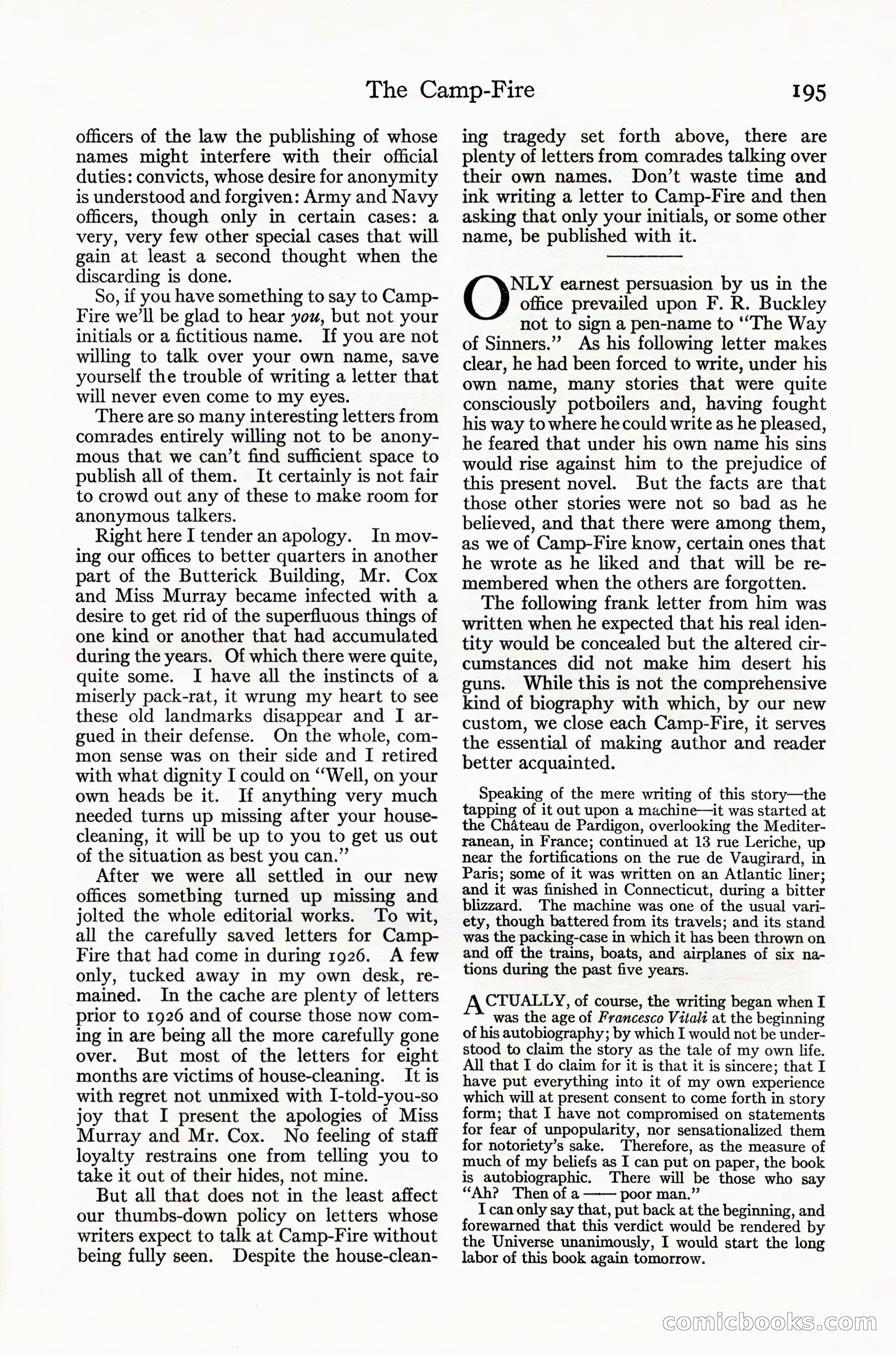
A restored page from Pulp Fiction, 1926. Page through the whole issue in the reader above.
📄 Transcribed text from this page (OCR, searchable)
Machine-transcribed from the original scan — historical spelling and the odd misread are preserved.
The Camp-Fire officers of the law the publishing of whose names might interfere with their official duties: convicts, whose desire for anonymity is understood and forgiven: Army and Navy officers, though only in certain cases: a very, very few other special cases that will gain at least a second thought when the discarding is done. So, if you have something to say to Camp- Fire we'll be glad to hear you, but not your initials or a fictitious name. If you are not willing to talk over your own name, save yourself the trouble of writing a letter that will never even come to my eyes. There are so many interesting letters from comrades entirely willing not to be anony- mous that we can’t find sufficient space to publish all of them. It certainly is not fair to crowd out any of these to make room for anonymous talkers. Right here I tender an apology. In mov- ing our offices to better quarters in another part of the Butterick Building, Mr. Cox and Miss Murray became infected with a desire to get rid of the superfluous things of one kind or another that had accumulated during the years. Of which there were quite, quite some. I have all the instincts of a miserly pack-rat, it wrung my heart to see these old landmarks disappear and I ar- gued in their defense. On the whole, com- mon sense was on their side and I retired with what dignity I could on “Well, on your own heads be it. If anything very much needed turns up missing after your house- cleaning, it will be up to you to get us out of the situation as best you can.” After we were all settled in our new offices something turned up missing and jolted the whole editorial works. To wit, all the carefully saved letters for Camp- Fire that had come in during 1926. A few only, tucked away in my own desk, re- mained. In the cache are plenty of letters prior to 1926 and of course those now com- ing in are being all the more carefully gone over. But most of the letters for eight months are victims of house-cleaning. It is with regret not unmixed with I-told-you-so joy that I present the apologies of Miss Murray and Mr. Cox. No feeling of staff loyalty restrains one from telling you to take it out of their hides, not mine. But all that does not in the least affect our thumbs-down policy on letters whose writers expect to talk at Camp-Fire without being fully seen. Despite the house-clean- 195 ing tragedy set forth above, there are plenty of letters from comrades talking over their own names. Don’t waste time and ink writing a letter to Camp-Fire and then asking that only your initials, or some other name, be published with it. NLY earnest persuasion by us in the office prevailed upon F. R. Buckley not to sign a pen-name to ‘‘The Way of Sinners.” As his following letter makes clear, he had been forced to write, under his Own name, many stories that were quite consciously potboilers and, having fought his way to where he could write as he pleased, he feared that under his own name his sins would rise against him to the prejudice of this present novel. But the facts are that those other stories were not so bad as he believed, and that there were among them, as we of Camp-Fire know, certain ones that he wrote as he liked and that will be re- membered when the others are forgotten. The following frank letter from him was written when he expected that his real iden- tity would be concealed but the altered cir- cumstances did not make him desert his guns. While this is not the comprehensive kind of biography with which, by our new custom, we close each Camp-Fire, it serves the essential of making author and reader better acquainted. Speaking of the mere writing of this story—the tapping of it out upon a machine—it was started at the Chateau de Pardigon, overlooking the Mediter- ranean, in France; continued at 13 rue Leriche, up near the fortifications on the rue de Vaugirard, in Paris; some of it was written on an Atlantic liner; and it was finished in Connecticut, during a bitter blizzard. The machine was one of the usual vari- ety, though battered from its travels; and its stand was the packing-case in which it has been thrown on and off the trains, boats, and airplanes of six na- tions during the past five years. CTUALLY, of course, the writing began when I was the age of Francesco Vitali at the beginning of his autobiography; by which I would not be under- stood to claim the story as the tale of my own life. All that I do claim for it is that it is sincere; that I have put everything into it of my own experience which will at present consent to come forth in story form; that I have not compromised on statements for fear of unpopularity, nor sensationalized them for notoriety’s sake. Therefore, as the measure of much of my beliefs as I can put on paper, the book is autobiographic. There will be those who say “Ah? Then of a poor man.”’ I can only say that, put back at the beginning, and forewarned that this verdict would be rendered by the Universe unanimously, I would start the long labor of this book again tomorrow. COnmiclboooks.c©