
Pulp Fiction, 1926 · page 200 of 232
Adventure Magazine Cover — page 200: what you’re looking at
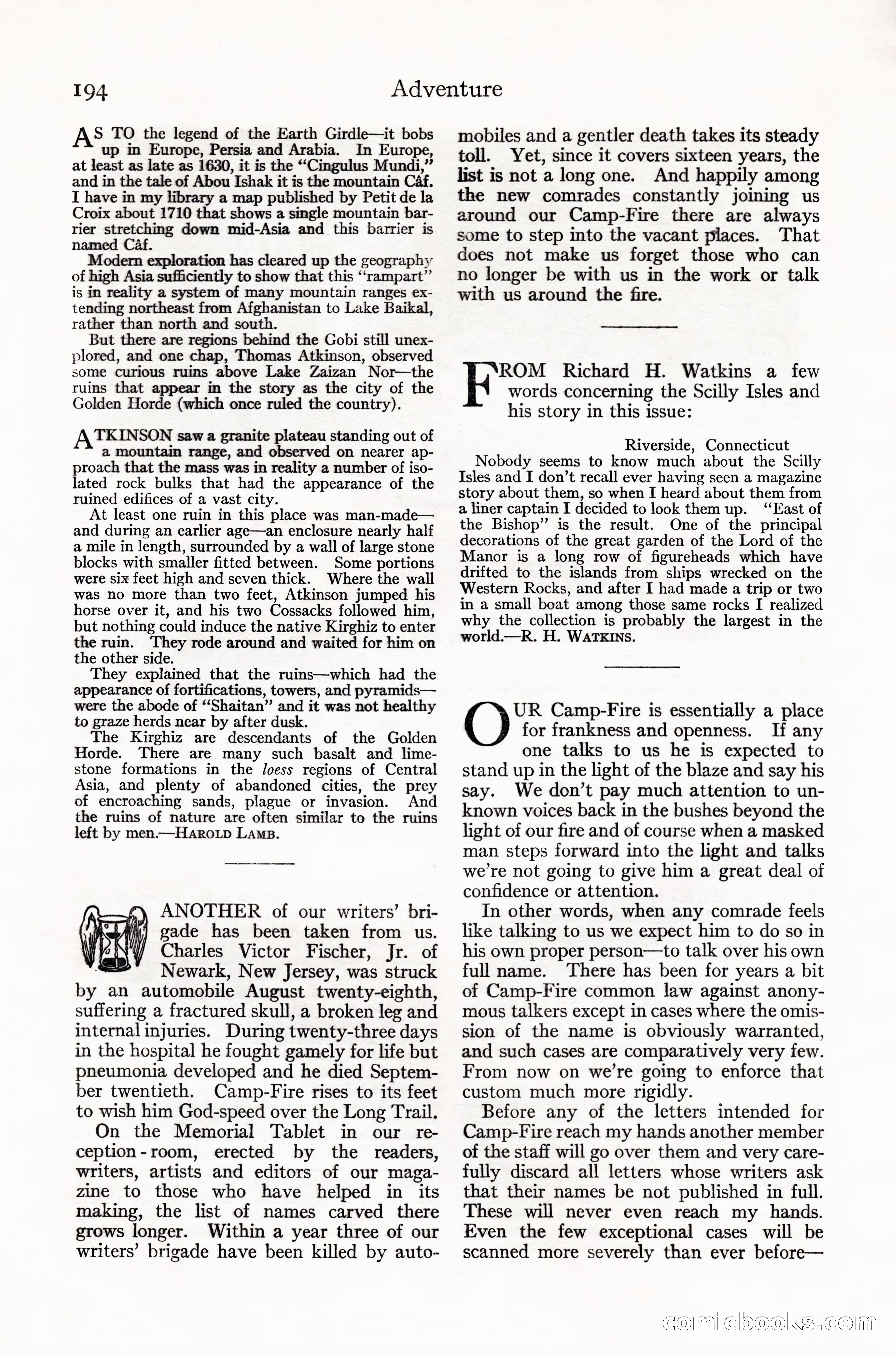
A restored page from Pulp Fiction, 1926. Page through the whole issue in the reader above.
📄 Transcribed text from this page (OCR, searchable)
Machine-transcribed from the original scan — historical spelling and the odd misread are preserved.
194 AS TO the legend of the Earth Girdle—it bobs up in Europe, Persia and Arabia. In Europe, at least as late as 1630, it is the “‘Cingulus Mundi,” and in the tale of Abou Ishak it is the mountain Caf. I have in my library a map published by Petit de la Croix about 1710 that shows a single mountain bar- rier stretching down mid-Asia and this barrier is named Caf. Modern exploration has cleared up the geography of high Asia sufficiently to show that this ‘“‘rampart”’ is in reality a system of many mountain ranges ex- tending northeast from Afghanistan to Lake Baikal, rather than north and south. But there are regions behind the Gobi still unex- plored, and one chap, Thomas Atkinson, observed some curious ruins above Lake Zaizan Nor—the ruins that a in the story as the city of the Golden Horde (which once ruled the country). ATKIN SON saw a granite plateau standing out of a mountain range, and observed on nearer ap- proach that the mass was in reality a number of iso- lated rock bulks that had the appearance of the ruined edifices of a vast city. At least one ruin in this place was man-made— and during an earlier age—an enclosure nearly half a mile in length, surrounded by a wall of large stone blocks with smaller fitted between. Some portions were six feet high and seven thick. Where the wall was no more than two feet, Atkinson jumped his horse over it, and his two Cossacks followed him, but nothing could induce the native Kirghiz to enter the ruin. They rode around and waited for him on the other side. They explained that the ruins—which had the appearance of fortifications, towers, and pyramids— were the abode of ‘‘Shaitan”’ and it was not healthy to graze herds near by after dusk. The Kirghiz are descendants of the Golden Horde. There are many such basalt and lime- stone formations in the loess regions of Central Asia, and plenty of abandoned cities, the prey of encroaching sands, plague or invasion. And the ruins of nature are often similar to the ruins left by men.—Haro.p Lams. —_—-—-- = ANOTHER of our writers’ bri- gade has been taken from us. Charles Victor Fischer, Jr. of Newark, New Jersey, was struck ra an automobile August twenty-eighth, suffering a fractured skull, a broken leg and internal injuries. During twenty-three days in the hospital he fought gamely for life but pneumonia developed and he died Septem- ber twentieth. Camp-Fire rises to its feet to wish him God-speed over the Long Trail. On the Memorial Tablet in our re- ception-room, erected by the readers, writers, artists and editors of our maga- zine to those who have helped in its making, the list of names carved there grows longer. Within a year three of our writers’ brigade have been killed by auto- Adventure mobiles and a gentler death takes its steady toll. Yet, since it covers sixteen years, the list is not a long one. And happily among the new comrades constantly joining us around our Camp-Fire there are always some to step into the vacant places. That does not make us forget those who can no longer be with us in the work or talk with us around the fire. ROM Richard H. Watkins a few words concerning the Scilly Isles and his story in this issue: Riverside, Connecticut Nobody seems to know much about the Scilly Isles and I don’t recall ever having seen a magazine story about them, so when I heard about them from a liner captain I decided to look them up. ‘‘East of the Bishop” is the result. One of the principal decorations of the great garden of the Lord of the Manor is a long row of figureheads which have drifted to the islands from ships wrecked on the Western Rocks, and after I had made a trip or two in a small boat among those same rocks I realized why the collection is probably the largest in the world.—R. H. WATKINS. UR Camp-Fire is essentially a place for frankness and openness. If any one talks to us he is expected to stand up in the light of the blaze and say his say. We don’t pay much attention to un- known voices back in the bushes beyond the light of our fire and of course when a masked man steps forward into the light and talks we're not going to give him a great deal of confidence or attention. In other words, when any comrade feels like talking to us we expect him to do so in his own proper person—to talk over his own full name. ‘There has been for years a bit of Camp-Fire common law against anony- mous talkers except in cases where the omis- sion of the name is obviously warranted, and such cases are comparatively very few. From now on we’re going to enforce that custom much more rigidly. Before any of the letters intended for Camp-Fire reach my hands another member of the staff will go over them and very care- fully discard all letters whose writers ask that their names be not published in full. These will never even reach my hands. Even the few exceptional cases will be scanned more severely than ever before— COmiclbooks.c©