
Pulp Fiction, 1926 · page 86 of 212
Adventure Magazine Cover — page 86: what you’re looking at
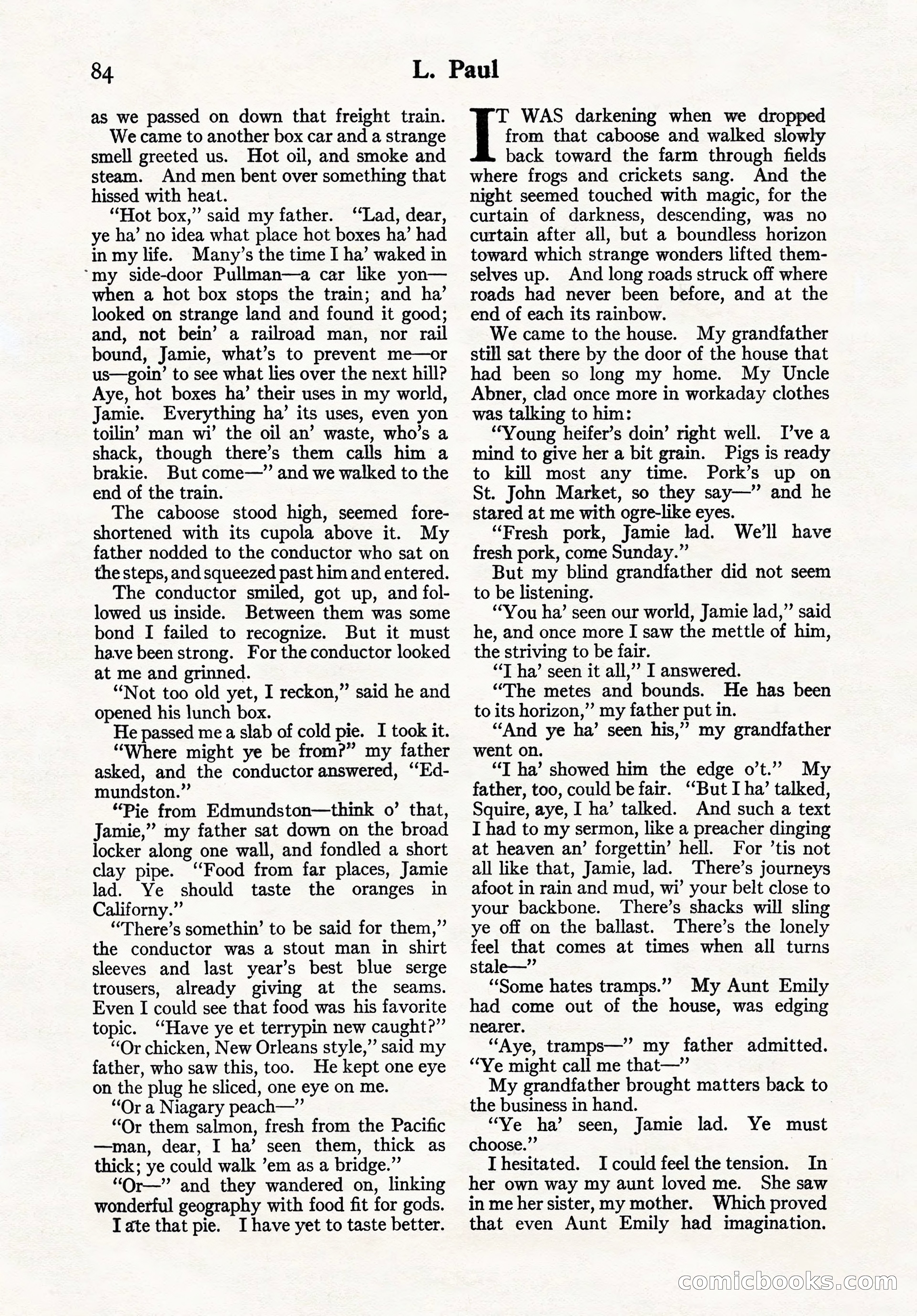
A restored page from Pulp Fiction, 1926. Page through the whole issue in the reader above.
📄 Transcribed text from this page (OCR, searchable)
Machine-transcribed from the original scan — historical spelling and the odd misread are preserved.
84 as we passed on down that freight train. We came to another box car and a strange smell greeted us. Hot oil, and smoke and steam. And men bent over something that hissed with heat. “Hot box,” said my father. ‘‘Lad, dear, ye ha’ no idea what place hot boxes ha’ had in my life. Many’s the time I ha’ waked in “my side-door Pullman—a car like yon— when a hot box stops the train; and ha’ looked on strange land and found it good; and, not bein’ a railroad man, nor rail bound, Jamie, what’s to prevent me—or us—goin’ to see what lies over the next hill? Aye, hot boxes ha’ their uses in my world, Jamie. Everything ha’ its uses, even yon toilin’ man wi’ the oil an’ waste, who’s a shack, though there’s them calls him a brakie. But come—” and we walked to the end of the train. The caboose stood high, seemed fore- shortened with its cupola above it. My father nodded to the conductor who sat on the steps, and squeezed past him and entered. The conductor smiled, got up, and fol- lowed us inside. Between them was some bond I failed to recognize. But it must have been strong. For the conductor looked at me and grinned. “Not too old yet, I reckon,” said he and opened his lunch box. He passed mea slab of cold pie. I took it. “Where might ye be from?” my father asked, and the conductor answered, ‘Ed- mundston.” ‘Pie from Edmundston—think o’ that, Jamie,” my father sat down on the broad locker along one wall, and fondled a short clay pipe. “Food from far places, Jamie lad. Ye should taste the oranges in Californy.”’ ‘“‘There’s somethin’ to be said for them,” the conductor was a stout man in shirt sleeves and last year’s best blue serge trousers, already giving at the seams. Even I could see that food was his favorite topic. ‘Have ye et terrypin new caught?” “Or chicken, New Orleans style,” said my father, who saw this, too. He kept one eye on the plug he sliced, one eye on me. “Or a Niagary peach—” “Or them salmon, fresh from the Pacific —man, dear, I ha’ seen them, thick as thick; ye could walk ’em as a bridge.” “Or—’’ and they wandered on, linking wonderful geography with food fit for gods. I ate that pie. I have yet to taste better. L. Paul from that caboose and walked slowly back toward the farm through fields where frogs and crickets sang. And the night seemed touched with magic, for the curtain of darkness, descending, was no curtain after all, but a boundless horizon toward which strange wonders lifted them- selves up. And long roads struck off where roads had never been before, and at the end of each its rainbow. We came to the house. My grandfather still sat there by the door of the house that had been so long my home. My Uncle Abner, clad once more in workaday clothes was talking to him: “Young heifer’s doin’ right well. I’vea mind to give her a bit grain. Pigs is ready to kill most any time. Pork’s up on St. John Market, so they say—” and he stared at me with ogre-like eyes. “Fresh pork, Jamie lad. We'll have fresh pork, come Sunday.” But my blind grandfather did not seem to be listening. ‘You ha’ seen our world, Jamie lad,” said he, and once more I saw the mettle of him, the striving to be fair. “T ha’ seen it all,” I answered. “The metes and bounds. He has been to its horizon,”’ my father put in. “And ye ha’ seen his,” my grandfather went on. “T ha’ showed him the edge o’t.” My father, too, could be fair. ‘But I ha’ talked, Squire, aye, I ha’ talked. And such a text I had to my sermon, like a preacher dinging at heaven an’ forgettin’ hell. For ’tis not all like that, Jamie, lad. There’s journeys afoot in rain and mud, wi’ your belt close to your backbone. ‘There’s shacks will sling ye off on the ballast. There’s the lonely feel that comes at times when all turns stale—” “Some hates tramps.” My Aunt Emily had come out of the house, was edging nearer. “Aye, tramps—” my father admitted. “Ye might call me that—” My grandfather brought matters back to the business in hand. 7 “Ve ha’ seen, Jamie lad. Ye must choose.” I hesitated. Icould feel the tension. In her own way my aunt loved me. She saw in me her sister, my mother. Which proved that even Aunt Emily had imagination. EF WAS darkening when we dropped COMIC ooo Cc SS (©