
Pulp Fiction, 1926 · page 85 of 212
Adventure Magazine Cover — page 85: what you’re looking at
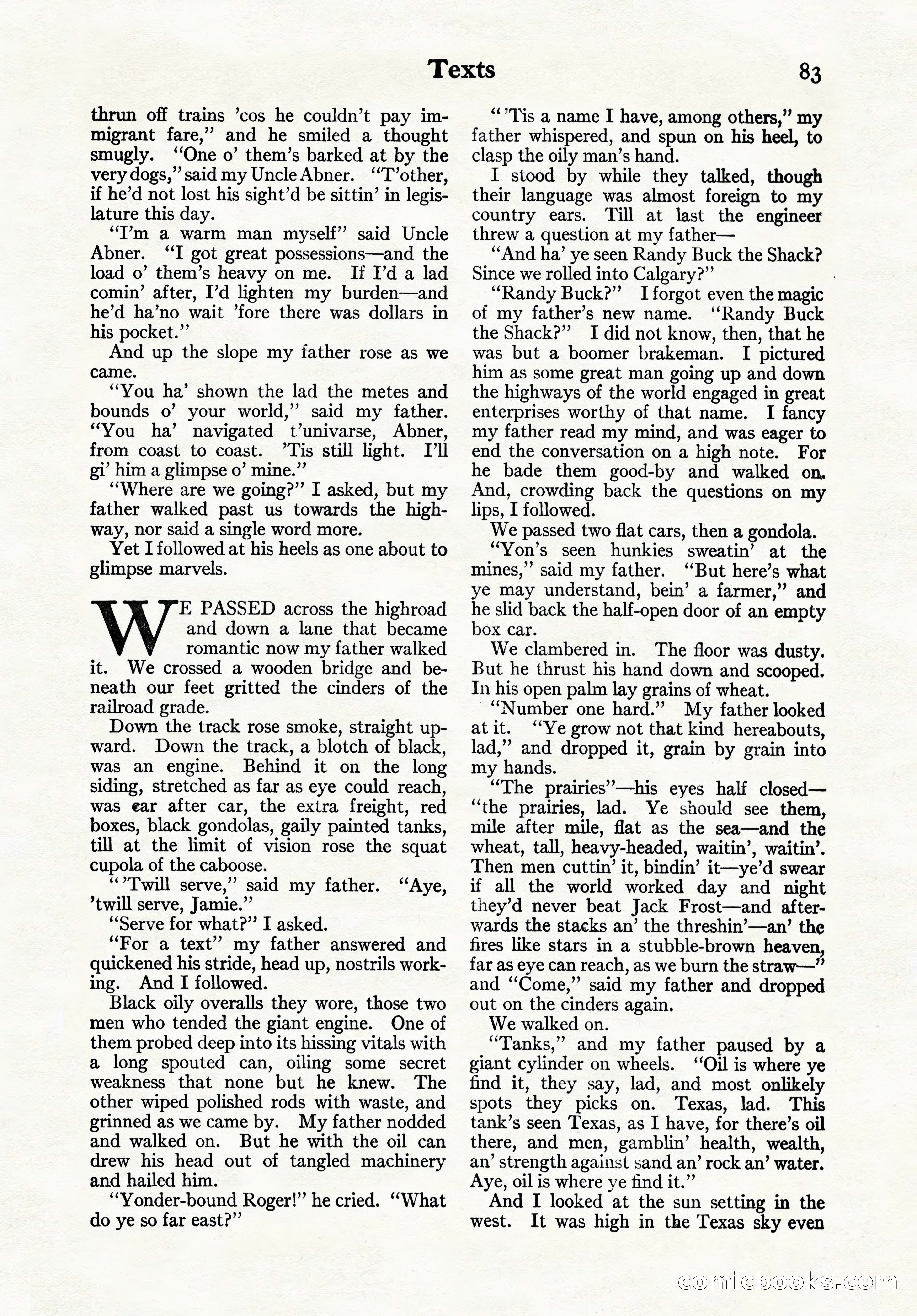
A restored page from Pulp Fiction, 1926. Page through the whole issue in the reader above.
📄 Transcribed text from this page (OCR, searchable)
Machine-transcribed from the original scan — historical spelling and the odd misread are preserved.
Texts thrun off trains ’cos he couldn’t pay im- migrant fare,’’ and he smiled a thought smugly. ‘One o’ them’s barked at by the very dogs,” said my Uncle Abner. ‘“T’other, if he’d not lost his sight’d be sittin’ in legis- lature this day. “T’m a warm man myself” said Uncle Abner. “TI got great possessions—and the load o’ them’s heavy on me. If I’d a lad comin’ after, I’d lighten my burden—and he’d ha’no wait ‘fore there was dollars in his pocket.” And up the slope my father rose as we came. ‘You ha’ shown the lad the metes and bounds o’ your world,’ said my father. “You ha’ navigated t’univarse, Abner, from coast to coast. ’Tis still light. I'll gi’ him a glimpse 0’ mine.” “Where are we going?” I asked, but my father walked past us towards the high- way, nor said a single word more. Yet I followed at his heels as one about to glimpse marvels. E PASSED across the highroad and down a lane that became romantic now my father walked it. We crossed a wooden bridge and be- neath our feet gritted the cinders of the railroad grade. Down the track rose smoke, straight up- ward. Down the track, a blotch of black, was an engine. Behind it on the long siding, stretched as far as eye could reach, was ear after car, the extra freight, red boxes, black gondolas, gaily painted tanks, till at the limit of vision rose the squat cupola of the caboose. ‘Twill serve,”’ said my father. *twill serve, Jamie.”’ ‘Serve for what?” I asked. “For a text” my father answered and quickened his stride, head up, nostrils work- ing. And I followed. Black oily overalls they wore, those two men who tended the giant engine. One of them probed deep into its hissing vitals with a long spouted can, oiling some secret weakness that none but he knew. The other wiped polished rods with waste, and grinned as we came by. My father nodded and walked on. But he with the oil can drew his head out of tangled machinery and hailed him. ‘“‘Yonder-bound Roger!” he cried. ‘What do ye so far east?” “Aye, 83 “Tis a name I have, among others,” my father whispered, and spun on his heel, to clasp the oily man’s hand. I stood by while they talked, though their language was almost foreign to my country ears. Till at last the engineer threw a question at my father— ‘‘And ha’ ye seen Randy Buck the Shack? Since we rolled into Calgary?” “Randy Buck?” of my father’s new name. ‘Randy Buck the Shack?” I did not know, then, that he was but a boomer brakeman. I pictured him as some great man going up and down the highways of the world engaged in great enterprises worthy of that name. I fancy my father read my mind, and was eager to end the conversation on a high note. For he bade them good-by and walked on. And, crowding back the questions on my lips, I followed. We passed two flat cars, then a gondola. “Yon’s seen hunkies sweatin’ at the mines,” said my father. ‘But here’s what ye may understand, bein’ a farmer,” and he slid back the half-open door of an empty box car. We clambered in. The floor was dusty. But he thrust his hand down and scooped. In his open palm lay grains of wheat. _ “Number one hard.” atit. “Ye grow not that kind hereabouts, lad,” and dropped it, grain by grain into my hands. “The prairies’”—his eyes half closed— “the prairies, lad. Ye should see them, mile after mile, flat as the sea—and the wheat, tall, heavy-headed, waitin’, waitin’. Then men cuttin’ it, bindin’ it—ye’d swear if all the world worked day and night they’d never beat Jack Frost—and after- wards the stacks an’ the threshin’—an’ the fires like stars in a stubble-brown heaven, far as eye can reach, as we burn the straw—”’ and “Come,” said my father and dropped out on the cinders again. We walked on. “Tanks,” and my father paused by a giant cylinder on wheels. ‘Oil is where ye find it, they say, lad, and most onlikely spots they picks on. Texas, lad. This tank’s seen Texas, as I have, for there’s oil there, and men, gamblin’ health, wealth, an’ strength against sand an’ rock an’ water. Aye, oil is where ye find it.” And I looked at the sun setting in the west. It was high in the Texas sky even COMIC OOOe I forgot even the magic My father looked S C@