
Pulp Fiction, 1926 · page 87 of 212
Adventure Magazine Cover — page 87: what you’re looking at
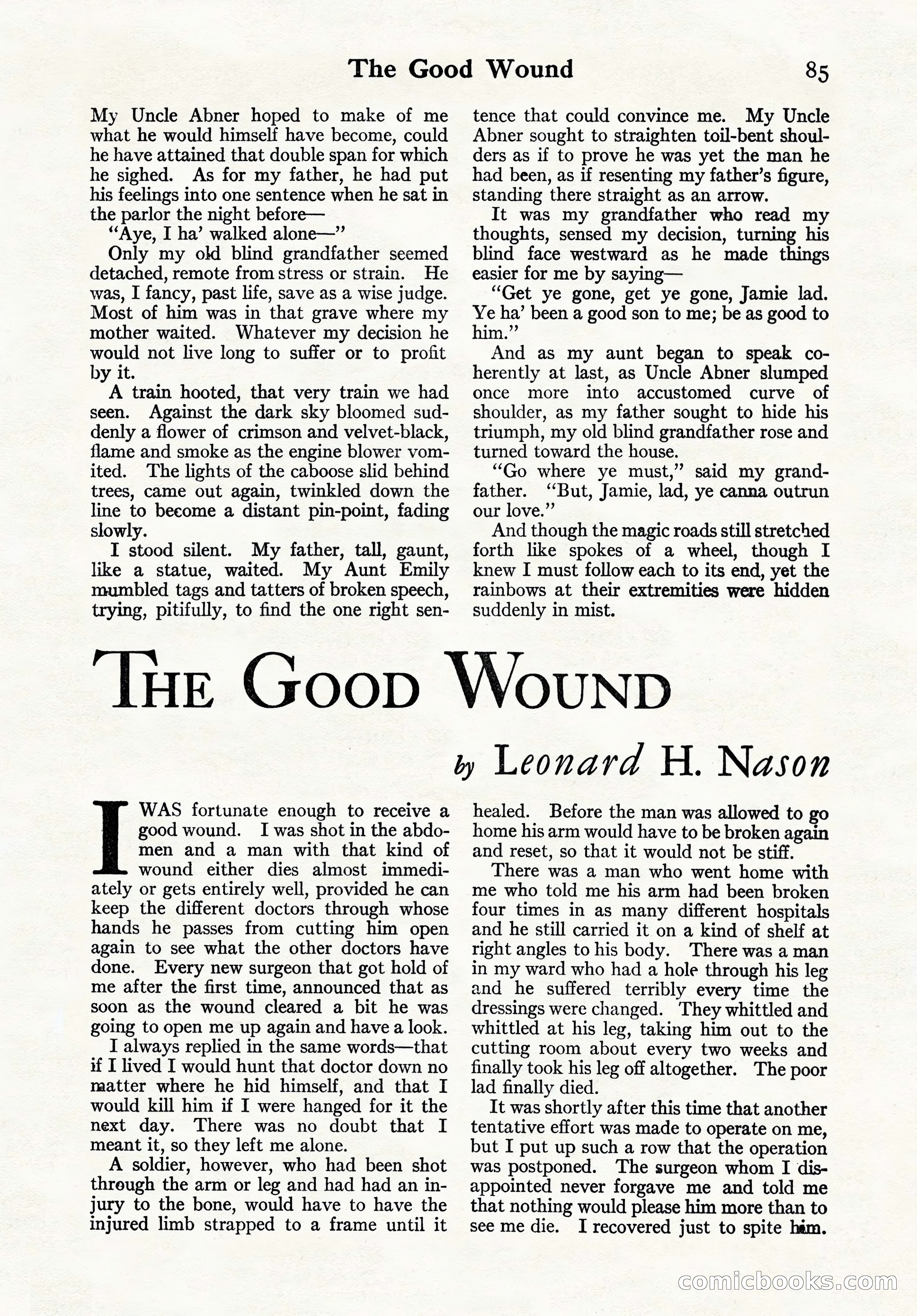
A restored page from Pulp Fiction, 1926. Page through the whole issue in the reader above.
📄 Transcribed text from this page (OCR, searchable)
Machine-transcribed from the original scan — historical spelling and the odd misread are preserved.
The Good Wound My Uncle Abner hoped to make of me what he would himself have become, could he have attained that double span for which he sighed. As for my father, he had put his feelings into one sentence when he sat in the parlor the night before— “Aye, I ha’ walked alone—’”’ Only my old blind grandfather seemed detached, remote from stress or strain. He was, I fancy, past life, save as a wise judge. Most of him was in that grave where my mother waited. Whatever my decision he would not live long to suffer or to profit by it. A train hooted, that very train we had seen. Against the dark sky bloomed sud- denly a flower of crimson and velvet-black, flame and smoke as the engine blower vom- ited. The lights of the caboose slid behind trees, came out again, twinkled down the line to become a distant pin-point, fading slowly. I stood silent. My father, tall, gaunt, like a statue, waited. My Aunt Emily mumbled tags and tatters of broken speech, trying, pitifully, to find the one right sen- 85 tence that could convince me. My Uncle Abner sought to straighten toil-bent shoul- ders as if to prove he was yet the man he had been, as if resenting my father’s figure, standing there straight as an arrow. It was my grandfather who read my thoughts, sensed my decision, turning his blind face westward as he made things easier for me by saying— “Get ye gone, get ye gone, Jamie lad. Ye ha’ been a good son to me; be as good to him.” And as my aunt began to speak co- herently at last, as Uncle Abner slumped once more into accustomed curve of shoulder, as my father sought to hide his triumph, my old blind grandfather rose and turned toward the house. “Go where ye must,” said my grand- father. “But, Jamie, lad, ye canna outrun our love.” And though the magic roads still stretched forth like spokes of a wheel, though I knew I must follow each to its end, yet the rainbows at their extremities were hidden suddenly in mist. “lHE Goop WounpD WAS fortunate enough to receive a good wound. I was shot in the abdo- men and a man with that kind of wound either dies almost immedi- ately or gets entirely well, provided he can keep the different doctors through whose hands he passes from cutting him open again to see what the other doctors have done. Every new surgeon that got hold of me after the first time, announced that as soon as the wound cleared a bit he was going to open me up again and have a look. I always replied in the same words—that #f I lived I would hunt that doctor down no matter where he hid himself, and that I would kill him if I were hanged for it the next day. There was no doubt that I meant it, so they left me alone. A soldier, however, who had been shot threugh the arm or leg and had had an in- jury to the bone, would have to have the injured limb strapped to a frame until it wy Leonard H. Nason healed. Before the man was allowed to go home his arm would have to be broken again and reset, so that it would not be stiff. There was a man who went home with me who told me his arm had been broken four times in as many different hospitals and he still carried it on a kind of shelf at right angles to his body. There was a man in my ward who had a hole through his leg and he suffered terribly every time the dressings were changed. They whittled and whittled at his leg, taking him out to the cutting room about every two weeks and finally took his leg off altogether. The poor lad finally died. It was shortly after this time that another tentative effort was made to operate on me, but I put up such a row that the operation was postponed. The surgeon whom I dis- appointed never forgave me and told me that nothing would please him more than to see me die. I recovered just to spite him. COmiclbooks (C@