
Pulp Fiction, 1926 · page 84 of 212
Adventure Magazine Cover — page 84: what you’re looking at
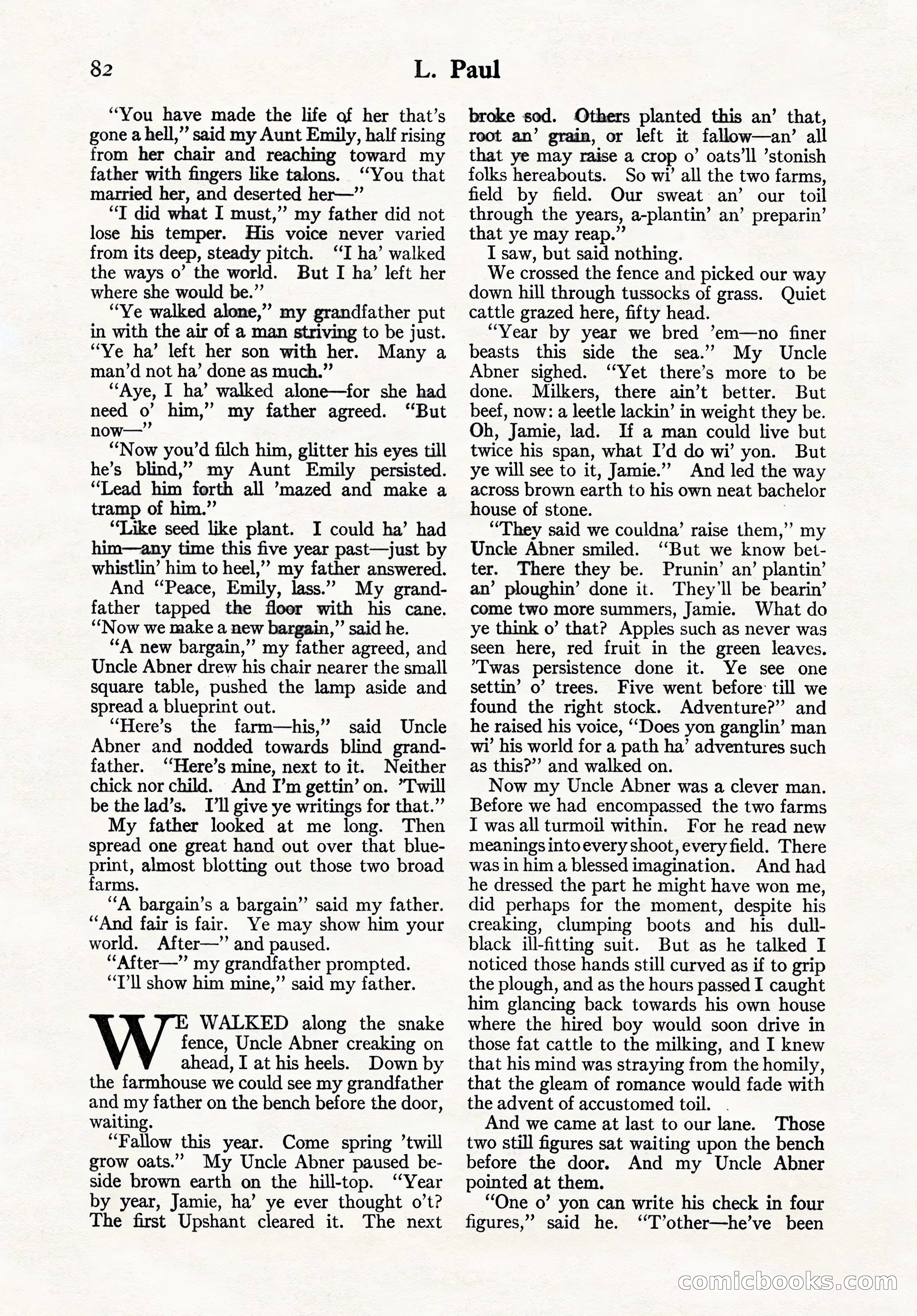
A restored page from Pulp Fiction, 1926. Page through the whole issue in the reader above.
📄 Transcribed text from this page (OCR, searchable)
Machine-transcribed from the original scan — historical spelling and the odd misread are preserved.
82 “You have made the life of her that’s gone a hell,” said my Aunt Emily, half rising from her chair and reaching toward my father with fingers like talons. ‘You that married her, and deserted her—” “T did what I must,” my father did not lose his temper. His voice never varied from its deep, steady pitch. “TI ha’ walked the ways o’ the world. But I ha’ left her where she would be.”’ “Ye walked alone,” my grandfather put in with the air of a man striving to be just. “Ye ha’ left her son with her. Many a man’d not ha’ done as much.” ‘Aye, I ha’ walked alone—for she had need o’ him,” my father agreed. “But now—” “Now you'd filch him, glitter his eyes till he’s blind,” my Aunt Emily persisted. “Lead him forth all ’mazed and make a tramp of him.” “Like seed like plant. I could ha’ had him—any time this five year past—just by whistlin’ him to heel,’’ my father answered. And ‘Peace, Emily, lass.” My grand- father tapped the floor with his cane. ‘‘Now we make a new bargain,”’ said he. ‘“‘A new bargain,” my father agreed, and Uncle Abner drew his chair nearer the small square table, pushed the lamp aside and spread a blueprint out. “Here’s the farm—his,’ said Uncle Abner and nodded towards blind grand- father. ‘‘Here’s mine, next to it. Neither chick nor child. And I’m gettin’ on. ’T will be the lad’s. I'll give ye writings for that.” My father looked at me long. Then spread one great hand out over that blue- print, almost blotting out those two broad farms. ‘A bargain’s a bargain” said my father. “And fair is fair. Ye may show him your world. After—’’ and paused. ‘‘After—” my grandfather prompted. “T’ll show him mine,”’ said my father. WALKED along the snake fence, Uncle Abner creaking on : ahead, I at his heels. Down by the farmhouse we could see my grandfather and my father on the bench before the door, waiting. ‘Fallow this year. Come spring ’twill grow oats.’’ My Uncle Abner paused be- side brown earth on the hill-top. “Year by year, Jamie, ha’ ye ever thought o’t? The first Upshant cleared it. The next L. Paul broke sod. Others planted this an’ that, root an’ grain, or left it fallow—an’ all that ye may raise a crop o’ oats’ll ’stonish folks hereabouts. So wi’ all the two farms, field by field. Our sweat an’ our toil through the years, a-plantin’ an’ preparin’ that ye may reap.” I saw, but said nothing. We crossed the fence and picked our way down hill through tussocks of grass. Quiet cattle grazed here, fifty head. “Year by year we bred ’em—no finer beasts this side the sea.’”” My Uncle Abner sighed. ‘Yet there’s more to be done. Milkers, there ain’t better. But beef, now: a leetle lackin’ in weight they be. Oh, Jamie, lad. If a man could live but twice his span, what I’d do wi’ yon. But ye will see to it, Jamie.’’ And led the way across brown earth to his own neat bachelor house of stone. : ‘They said we couldna’ raise them,” my Uncle Abner smiled. ‘But we know bet- ter. There they be. Prunin’ an’ plantin’ an’ ploughin’ done it. They'll be bearin’ come two more summers, Jamie. What do ye think o’ that? Apples such as never was seen here, red fruit in the green leaves. "T'was persistence done it. Ye see one settin’ o’ trees. Five went before till we found the right stock. Adventure?” and he raised his voice, ‘‘Does yon ganglin’ man wi his world for a path ha’ adventures such as this?”’ and walked on. Now my Uncle Abner was a clever man. Before we had encompassed the two farms I was all turmoil within. For he read new meanings intoevery shoot, every field. There was in him a blessed imagination. And had he dressed the part he might have won me, did perhaps for the moment, despite his creaking, clumping boots and his dull- black ill-fitting suit. But as he talked I noticed those hands still curved as if to grip the plough, and as the hours passed I caught him glancing back towards his own house where the hired boy would soon drive in those fat cattle to the milking, and I knew that his mind was straying from the homily, that the gleam of romance would fade with the advent of accustomed toil. . And we came at last to our lane. Those two still figures sat waiting upon the bench before the door. And my Uncle Abner pointed at them. “One o’ yon can write his check in four figures,”’ said he. ‘*T’other—he’ve been cComiclbooks C@