
Pulp Fiction, 1926 · page 198 of 212
Adventure Magazine Cover — page 198: what you’re looking at
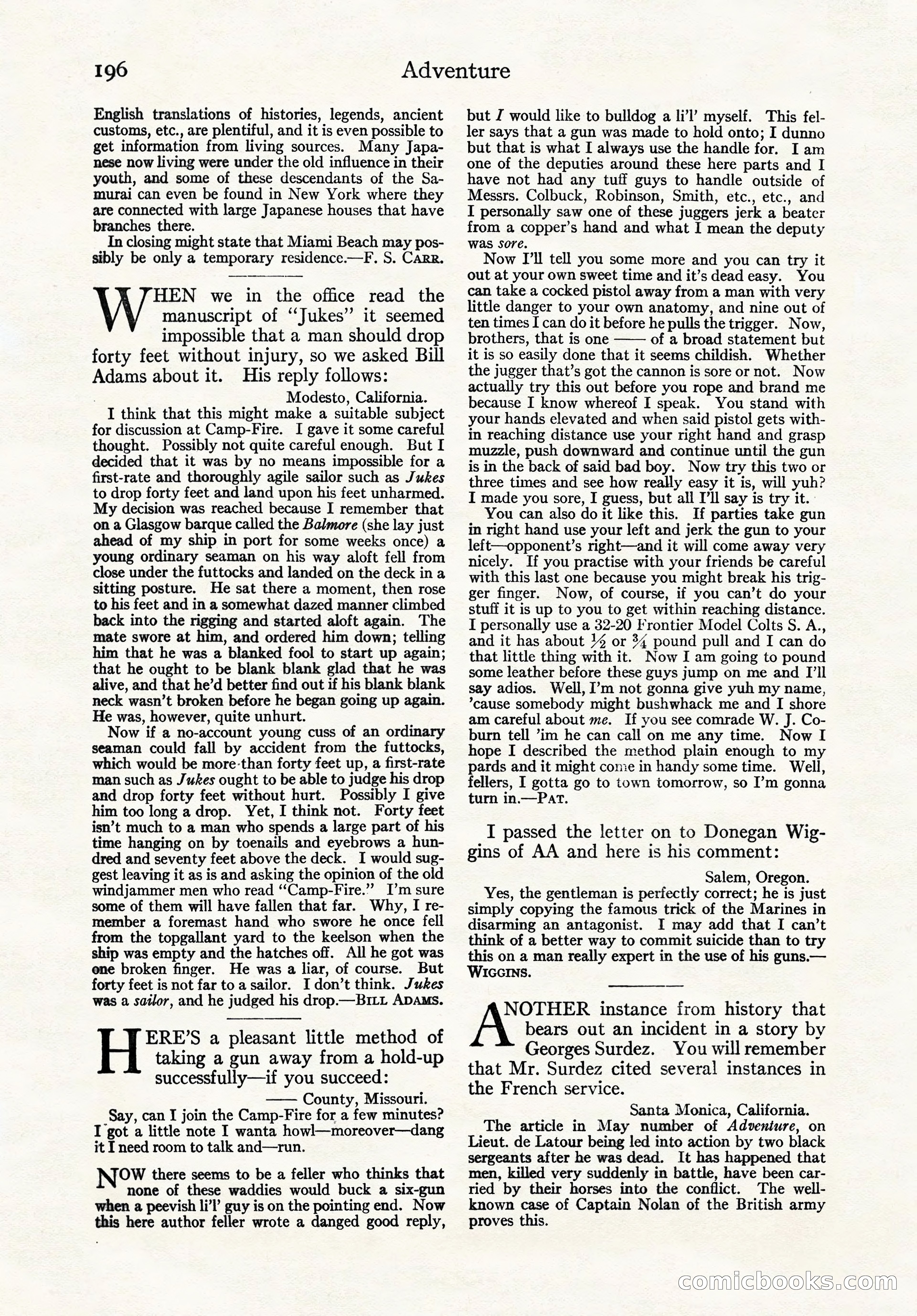
A restored page from Pulp Fiction, 1926. Page through the whole issue in the reader above.
📄 Transcribed text from this page (OCR, searchable)
Machine-transcribed from the original scan — historical spelling and the odd misread are preserved.
196 English translations of histories, legends, ancient customs, etc., are plentiful, and it is even possible to get information from living sources. Many Japa- nese now living were under the old influence in their youth, and some of these descendants of the Sa- murai can even be found in New York where they are connected with large Japanese houses that have branches there. In closing might state that Miami Beach may pos- sibly be only a temporary residence.—F. S. Carr. HEN we in the office read the manuscript of “Jukes” it seemed impossible that a man should drop forty feet without injury, so we asked Bill Adams about it. His reply follows: . Modesto, California. I think that this might make a suitable subject for discussion at Camp-Fire. I gave it some careful thought. Possibly not quite careful enough. But I decided that it was by no means impossible for a first-rate and thoroughly agile sailor such as Jukes to drop forty feet and land upon his feet unharmed. My decision was reached because I remember that on a Glasgow barque called the Balmore (she lay just ahead of my ship in port for some weeks once) a young ordinary seaman on his way aloft fell from close under the futtocks and landed on the deck in a sitting posture. He sat there a moment, then rose to his feet and in a somewhat dazed manner climbed back into the rigging and started aloft again. The mate swore at him, and ordered him down; telling him that he was a blanked fool to start up again; that he ought to be blank blank glad that he was alive, and that he’d better find out if his blank blank neck wasn’t broken before he began going up again. He was, however, quite unhurt. Now if a no-account young cuss of an ordinary seaman could fall by accident from the futtocks, which would be more-than forty feet up, a first-rate man such as Jukes ought to be able to judge his drop and drop forty feet without hurt. Possibly I give him too long a drop. Yet, I think not. Forty feet isn’t much to a man who spends a large part of his time hanging on by toenails and eyebrows a hun- dred and seventy feet above the deck. I would sug- gest leaving it as is and asking the opinion of the old windjammer men who read ‘“‘Camp-Fire.” I’m sure some of them will have fallen that far. Why, I re- member a foremast hand who swore he once fell from the topgallant yard to the keelson when the ship was empty and the hatches off. All he got was ene broken finger. He was a liar, of course. But forty feet is not far toa sailor. I don’t think. Jukes was a sailor, and he judged his drop.—BiLL ADAMS. ERE’S a pleasant little method of taking a gun away from a hold-up successfully—if you succeed: —— County, Missouri. Say, can I join the Camp-Fire for a few minutes? I got a little note I wanta howl—moreover—dang it I need room to talk and—run. Now there seems to be a feller who thinks that none of these waddies would buck a six-gun when a peevish li’l’ guy is on the pointing end. Now this here author feller wrote a danged good reply, Adventure but Z would like to bulldog a li’l’ myself. This fel- ler says that a gun was made to hold onto; I dunno but that is what I always use the handle for. I am one of the deputies around these here parts and I have not had any tuff guys to handle outside of Messrs. Colbuck, Robinson, Smith, etc., etc., and I personally saw one of these juggers jerk a beater from a copper’s hand and what I mean the deputy was sore. Now I'll tell you some more and you can try it out at your own sweet time and it’s dead easy. You can take a cocked pistol away from a man with very little danger to your own anatomy, and nine out of ten times I can do it before he pulls the trigger. Now, brothers, that is one of a broad statement but it is so easily done that it seems childish. Whether the jugger that’s got the cannon is sore or not. Now actually try this out before you rope and brand me because I know whereof I speak. You stand with your hands elevated and when said pistol gets with- in reaching distance use your right hand and grasp muzzle, push downward and continue until the gun is in the back of said bad boy. Now try this two or three times and see how really easy it is, will yuh? I made you sore, I guess, but all I’ll say is try it. You can also do it like this. If parties take gun in right hand use your left and jerk the gun to your left—opponent’s right—and it will come away very nicely. If you practise with your friends be careful with this last one because you might break his trig- ger finger. Now, of course, if you can’t do your stuff it is up to you to get within reaching distance. I personally use a 32-20 Frontier Model Colts S. A., and it has about 14 or 34 pound pull and I can do that little thing with it. Now I am going to pound some leather before these guys jump on me and I'll say adios. Well, I’m not gonna give yuh my name, ’cause somebody might bushwhack me and I shore am careful about me. If you see comrade W. J. Co- burn tell ’im he can call on me any time. Now I hope I described the method plain enough to my pards and it might come in handy some time. Well, fellers, I gotta go to town tomorrow, so I’m gonna turn in.—PAt. I passed the letter on to Donegan Wig- gins of AA and here is his comment: Salem, Oregon. Yes, the gentleman is perfectly correct; he is just simply copying the famous trick of the Marines in disarming an antagonist. I may add that I can’t think of a better way to commit suicide than to try this on a man really expert in the use of his guns.— WIGGINS. NOTHER instance from history that bears out an incident in a story by Georges Surdez. You will remember that Mr. Surdez cited several instances in the French service. Santa Monica, California. The article in May number of Adveniure, on Lieut. de Latour being led into action by two black sergeants after he was dead. It has happened that men, killed very suddenly in battle, have been car- ried by their horses into the conflict. The well- known case of Captain Nolan of the British army proves this. NOOK (©