
Pulp Fiction, 1926 · page 199 of 212
Adventure Magazine Cover — page 199: what you’re looking at
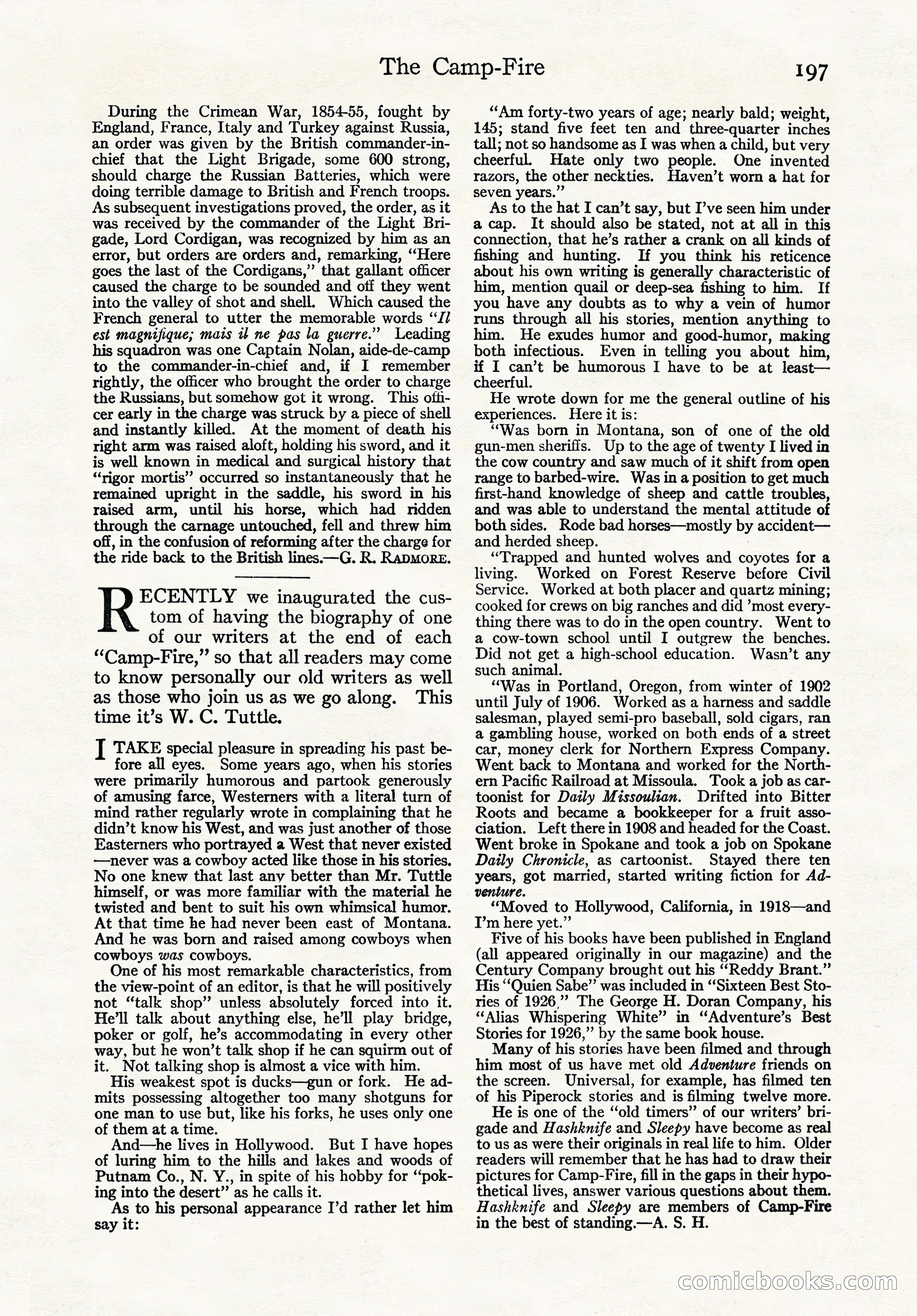
A restored page from Pulp Fiction, 1926. Page through the whole issue in the reader above.
📄 Transcribed text from this page (OCR, searchable)
Machine-transcribed from the original scan — historical spelling and the odd misread are preserved.
The Camp-Fire During the Crimean War, 1854-55, fought by England, France, Italy and Turkey against Russia, an order was given by the British commander-in- chief that the Light Brigade, some 600 strong, should charge the Russian Batteries, which were doing terrible damage to British and French troops. As subsequent investigations proved, the order, as it was received by the commander of the Light Bri- gade, Lord Cordigan, was recognized by him as an error, but orders are orders and, remarking, ‘Here goes the last of the Cordigans,”’ that gallant officer caused the charge to be sounded and off they went into the valley of shot and shell. Which caused the French general to utter the memorable words “J est magnifique; mats il ne pas la guerre.” Leading is squadron was one Captain Nolan, aide-de-camp to the commander-in-chief and, if I remember rightly, the officer who brought the order to charge the Russians, but somehow got it wrong. This offi- cer early in the charge was struck by a piece of shell and instantly killed. At the moment of death his right arm was raised aloft, holding his sword, and it is well known in medical and surgical history that “rigor mortis’”’ occurred so instantaneously that he remained upright in the saddle, his sword in his raised arm, until his horse, which had ridden through the carnage untouched, fell and threw him off, in the confusion of reforming after the charge for the ride back to the British lines —G. R. RapMorE. ECENTLY we inaugurated the cus- tom of having the biography of one of our writers at the end of each “Camp-Fire,” so that all readers may come to know personally our old writers as well as those who join us as we go along. This time it’s W. C. Tuttle. ] TAKE special pleasure in spreading his past be- fore all eyes. Some years ago, when his stories were primarily humorous and partook generously of amusing farce, Westerners with a literal turn of mind rather regularly wrote in complaining that he didn’t know his West, and was just another of those Easterners who portrayed a West that never existed —never was a cowboy acted like those in his stories. No one knew that last any better than Mr. Tuttle himself, or was more familiar with the material he twisted and bent to suit his own whimsical humor. At that time he had never been east of Montana. And he was born and raised among cowboys when cowboys was cowboys. One of his most remarkable characteristics, from the view-point of an editor, is that he will positively not “talk shop” unless absolutely forced into it. He’ll talk about anything else, he’ll play bridge, poker or golf, he’s accommodating in every other way, but he won’t talk shop if he can squirm out of it. Not talking shop is almost a vice with him. His weakest spot is ducks—gun or fork. He ad- mits possessing altogether too many shotguns for one man to use but, like his forks, he uses only one of them at a time. And—he lives in Hollywood. But I have hopes of luring him to the hills and lakes and woods of Putnam Co., N. Y., in spite of his hobby for “‘pok- ing into the desert”’ as he calls it. As to his personal appearance I’d rather let him say it: 197 “Am forty-two years of age; nearly bald; weight, 145; stand five feet ten and three-quarter inches tall; not so handsome as I was when a child, but very cheerful. Hate only two people. One invented razors, the other neckties. Haven’t worn a hat for seven years.” As to the hat I can’t say, but I’ve seen him under a cap. It should also be stated, not at all in this connection, that he’s rather a crank on all kinds of fishing and hunting. If you think his reticence about his own writing is generally characteristic of him, mention quail or deep-sea fishing to him. If you have any doubts as to why a vein of humor runs through all his stories, mention anything to him. He exudes humor and good-humor, making both infectious. Even in telling you about him, if I can’t be humorous I have to be at least— cheerful. He wrote down for me the general outline of his experiences. Here it is: ‘“‘Was born in Montana, son of one of the old gun-men sheriffs. Up to the age of twenty I lived in the cow country and saw much of it shift from open range to barbed-wire. Was in a position to get much first-hand knowledge of sheep and cattle troubles, and was able to understand the mental attitude of both sides. Rode bad horses—mostly by accident— and herded sheep. . “Trapped and hunted wolves and coyotes for a living. Worked on Forest Reserve before Civil Service. Worked at both placer and quartz mining; cooked for crews on big ranches and did ’most every- thing there was to do in the open country. Went to a cow-town school until I outgrew the benches. Did not get a high-school education. Wasn’t any such animal. ‘‘Was in Portland, Oregon, from winter of 1902 until July of 1906. Worked as a harness and saddle salesman, played semi-pro baseball, sold cigars, ran a gambling house, worked on both ends of a street car, money clerk for Northern Express Company. Went back to Montana and worked for the North- ern Pacific Railroad at Missoula. Took a job as car- toonist for Daily Missoulian. Drifted into Bitter Roots and became a bookkeeper for a fruit asso- ciation. Left there in 1908 and headed for the Coast. Went broke in Spokane and took a job on Spokane Daily Chronicle, as cartoonist. Stayed there ten years, got married, started writing fiction for Ad- venture. “Moved to Hollywood, California, in 1918—and I’m here yet.” Five of his books have been published in England (all appeared originally in our magazine) and the Century Company brought out his “Reddy Brant.” His ‘‘Quien Sabe”’ was included in “Sixteen Best Sto- ries of 1926,” The George H. Doran Company, his ‘““Alias Whispering White” in “Adventure’s Best Stories for 1926,”’ by the same book house. Many of his stories have been filmed and through him most of us have met old Adventure friends on the screen. Universal, for example, has filmed ten of his Piperock stories and is filming twelve more. He is one of the “old timers” of our writers’ bri- gade and Hashknife and Sleepy have become as real to us as were their originals in real life to him. Older readers will remember that he has had to draw their pictures for Camp-Fire, fill in the gaps in their hypo- thetical lives, answer various questions about them. Hashknife and Sleepy are members of Camp-Fire in the best of standing.—A. S. H. DOOLK (C@