
Pulp Fiction, 1926 · page 197 of 212
Adventure Magazine Cover — page 197: what you’re looking at
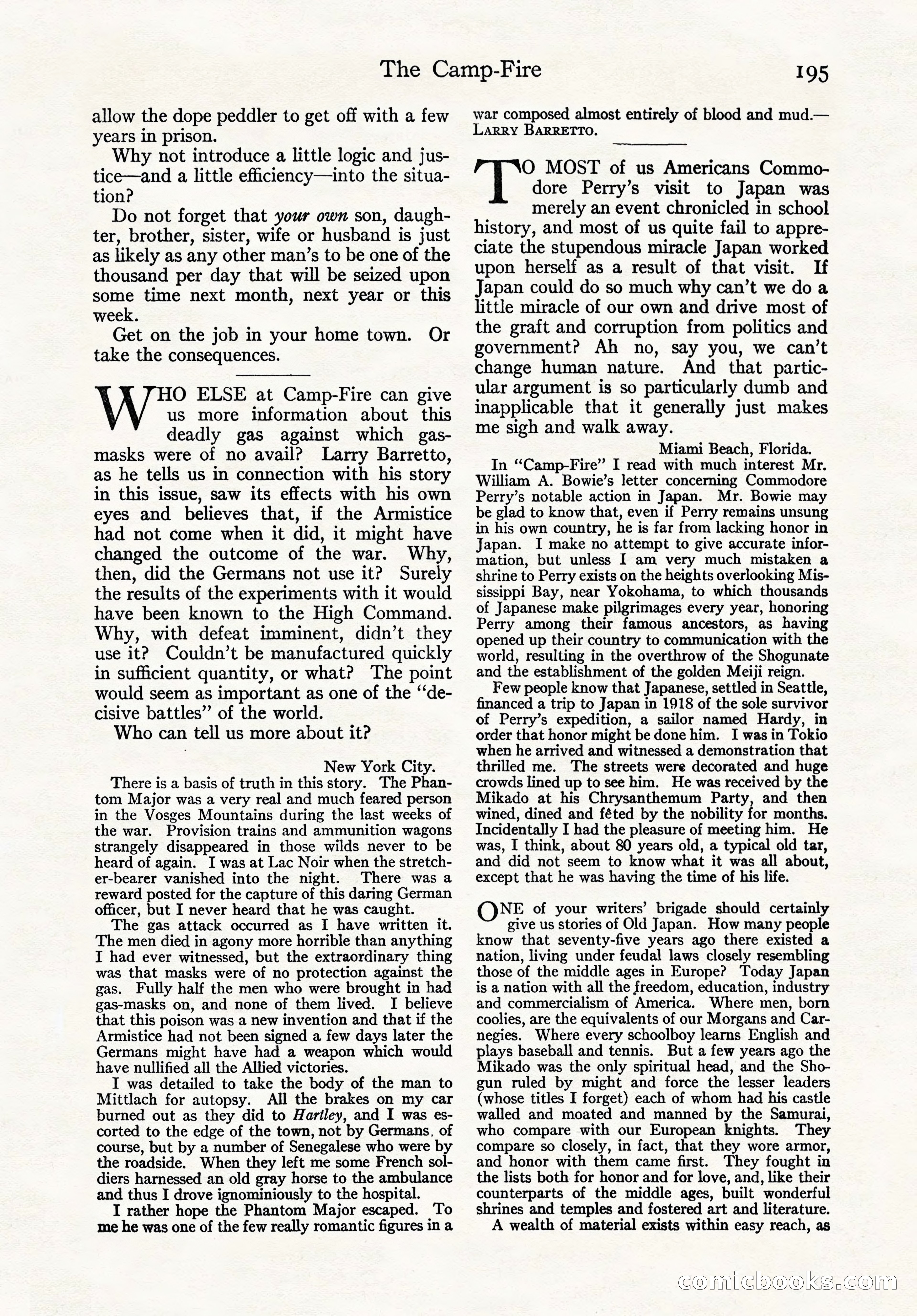
A restored page from Pulp Fiction, 1926. Page through the whole issue in the reader above.
📄 Transcribed text from this page (OCR, searchable)
Machine-transcribed from the original scan — historical spelling and the odd misread are preserved.
The Camp-Fire allow the dope peddler to get off with a few years in prison. Why not introduce a little logic and jus- tice—and a little efficiency—into the situa- tion? Do not forget that your own son, daugh- ter, brother, sister, wife or husband is just as likely as any other man’s to be one of the thousand per day that will be seized upon some time next month, next year or this week. Get on the job in your home town. Or take the consequences. HO ELSE at Camp-Fire can give us more information about this deadly gas against which gas- masks were of no avail? Larry Barretto, as he tells us in connection with his story in this issue, saw its effects with his own eyes and believes that, if the Armistice had not come when it did, it might have changed the outcome of the war. Why, then, did the Germans not use it? Surely the results of the experiments with it would have been known to the High Command. Why, with defeat imminent, didn’t they use it? Couldn’t be manufactured quickly in sufficient quantity, or what? The point would seem as important as one of the “‘de- cisive battles” of the world. Who can tell us more about it? New York City. There is a basis of truth in this story. The Phan- tom Major was a very real and much feared person in the Vosges Mountains during the last weeks of the war. Provision trains and ammunition wagons strangely disappeared in those wilds never to be heard of again. I was at Lac Noir when the stretch- er-bearer vanished into the night. There was a reward posted for the capture of this daring German officer, but I never heard that he was caught. The gas attack occurred as I have written it. The men died in agony more horrible than anything I had ever witnessed, but the extraordinary thing was that masks were of no protection against the gas. Fully half the men who were brought in had gas-masks on, and none of them lived. I believe that this poison was a new invention and that if the Armistice had not been signed a few days later the Germans might have had a weapon which would have nullified all the Allied victories. I was detailed to take the body of the man to Mittlach for autopsy. All the brakes on my car burned out as they did to Hartley, and I was es- corted to the edge of the town, not by Germans, of course, but by a number of Senegalese who were by the roadside. When they left me some French sol- diers harnessed an old gray horse to the ambulance and thus I drove ignominiously to the hospital. I rather hope the Phantom Major escaped. To me he was one of the few really romantic figures in a 195 war composed almost entirely of blood and mud.— Larry BARRETTO. O MOST of us Americans Commo- dore Perry’s visit to Japan was merely an event chronicled in school history, and most of us quite fail to appre- ciate the stupendous miracle Japan worked upon herself as a result of that visit. If Japan could do so much why can’t we do a little miracle of our own and drive most of the graft and corruption from politics and government? Ah no, say you, we can’t change human nature. And that partic- ular argument is so particularly dumb and inapplicable that it generally just makes me sigh and walk away. Miami Beach, Florida. In “Camp-Fire” I read with much interest Mr. William A. Bowie’s letter concerning Commodore Perry’s notable action in Japan. Mr. Bowie may be glad to know that, even if Perry remains unsung in his own country, he is far from lacking honor in Japan. I make no attempt to give accurate infor- mation, but unless I am very much mistaken a shrine to Perry exists on the heights overlooking Mis- sissippi Bay, near Yokohama, to which thousands of Japanese make pilgrimages every year, honoring Perry among their famous ancestors, as having opened up their country to communication with the world, resulting in the overthrow of the Shogunate and the establishment of the golden Meiji reign. Few people know that Japanese, settled in Seattle, financed a trip to Japan in 1918 of the sole survivor of Perry’s expedition, a sailor named Hardy, in order that honor might be done him. I was in Tokio when he arrived and witnessed a demonstration that thrilled me. The streets were decorated and huge crowds lined up to see him. He was received by the Mikado at his Chrysanthemum Party, and then wined, dined and féted by the nobility for months. Incidentally I had the pleasure of meeting him. He was, I think, about 80 years old, a typical old tar, and did not seem to know what it was all about, except that he was having the time of his life. NE of your writers’ brigade should certainly give us stories of Old Japan. How many people know that seventy-five years ago there existed a nation, living under feudal laws closely resembling those of the middle ages in Europe? Today Japan is a nation with all the freedom, education, industry and commercialism of America. Where men, born coolies, are the equivalents of our Morgans and Car- negies. Where every schoolboy learns English and plays baseball and tennis. But a few years ago the Mikado was the only spiritual head, and the Sho- gun ruled by might and force the lesser leaders (whose titles I forget) each of whom had his castle walled and moated and manned by the Samurai, who compare with our European knights. They compare so closely, in fact, that they wore armor, and honor with them came first. They fought in the lists both for honor and for love, and, like their counterparts of the middle ages, built wonderful shrines and temples and fostered art and literature. A wealth of material exists within easy reach, as MICLOOO© SS (C@