
Pulp Fiction, 1926 · page 196 of 212
Adventure Magazine Cover — page 196: what you’re looking at
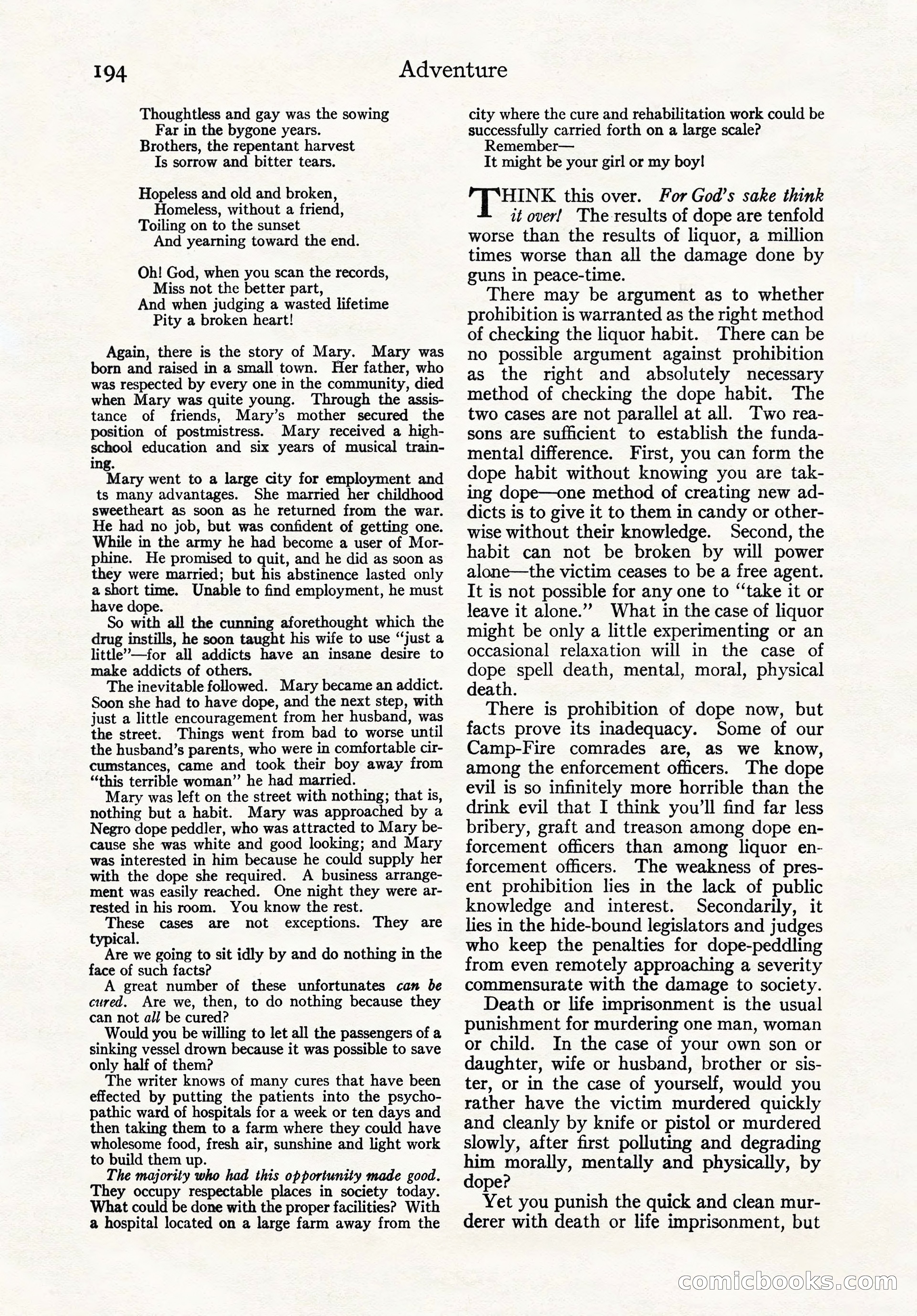
A restored page from Pulp Fiction, 1926. Page through the whole issue in the reader above.
📄 Transcribed text from this page (OCR, searchable)
Machine-transcribed from the original scan — historical spelling and the odd misread are preserved.
194 Thoughtless and gay was the sowing Far in the bygone years. Brothers, the repentant harvest Is sorrow and bitter tears. Hopeless and old and broken, Homeless, without a friend, Toiling on to the sunset And yearning toward the end. Oh! God, when you scan the records, Miss not the better part, And when judging a wasted lifetime Pity a broken heart! Again, there is the story of Mary. Mary was born and raised in a small town. Her father, who was respected by every one in the community, died when Mary was quite young. Through the assis- tance of friends, Mary’s mother secured the position of postmistress. Mary received a high- school education and six years of musical train- ing. Mary went to a large city for employment and ts many advantages. She married her childhood sweetheart as soon as he returned from the war. He had no job, but was confident of getting one. While in the army he had become a user of Mor- phine. He promised to quit, and he did as soon as they were married; but his abstinence lasted only a short time. Unable to find employment, he must have dope. So with all the cunning aforethought which the drug instills, he soon taught his wife to use “just a little’—for all addicts have an insane desire to make addicts of others. The inevitable followed. Mary became an addict. Soon she had to have dope, and the next step, with just a little encouragement from her husband, was the street. Things went from bad to worse until the husband’s parents, who were in comfortable cir- cumstances, came and took their boy away from “this terrible woman’ he had married. Mary was left on the street with nothing; that is, nothing but a habit. Mary was approached by a Negro dope peddler, who was attracted to Mary be- cause she was white and good looking; and Mary was interested in him because he could supply her with the dope she required. A business arrange- ment was easily reached. One night they were ar- rested in his room. You know the rest. These cases are not exceptions. They are typical. Are we going to sit idly by and do nothing in the face of such facts? A great number of these unfortunates can be cured. Are we, then, to do nothing because they can not all be cured? Would you be willing to let all the passengers of a sinking vessel drown because it was possible to save only half of them? The writer knows of many cures that have been effected by putting the patients into the psycho- pathic ward of hospitals for a week or ten days and then taking them to a farm where they could have wholesome food, fresh air, sunshine and light work to build them up. The majority who had this opportunity made good. They occupy respectable places in society today. What could be done with the proper facilities? With a hospital located on a large farm away from the Adventure city where the cure and rehabilitation work could be successfully carried forth on a large scale? Remember— It might be your girl or my boy! HINK this over. For God’s sake think it over! The results of dope are tenfold worse than the results of liquor, a million times worse than all the damage done by guns in peace-time. There may be argument as to whether prohibition is warranted as the right method of checking the liquor habit. There can be no possible argument against prohibition as the right and absolutely necessary method of checking the dope habit. The two cases are not parallel at all. Two rea- sons are sufficient to establish the funda- mental difference. First, you can form the dope habit without knowing you are tak- ing dope—one method of creating new ad- dicts is to give it to them in candy or other- wise without their knowledge. Second, the habit can not be broken by will power alone—the victim ceases to be a free agent. It is not possible for any one to “‘take it or leave it alone.””’ What in the case of liquor might be only a little experimenting or an occasional relaxation will in the case of dope spell death, mental, moral, physical death. There is prohibition of dope now, but facts prove its inadequacy. Some of our Camp-Fire comrades are, as we know, among the enforcement officers. The dope evil is so infinitely more horrible than the drink evil that I think you’ll find far less bribery, graft and treason among dope en- forcement officers than among liquor en- forcement officers. The weakness of pres- ent prohibition lies in the lack of public knowledge and interest. Secondarily, it lies in the hide-bound legislators and judges who keep the penalties for dope-peddling from even remotely approaching a severity commensurate with the damage to society. Death or life imprisonment is the usual punishment for murdering one man, woman or child. In the case of your own son or daughter, wife or husband, brother or sis- ter, or in the case of yourself, would you rather have the victim murdered quickly and cleanly by knife or pistol or murdered slowly, after first polluting and degrading him morally, mentally and physically, by dope? Yet you punish the quick and clean mur- derer with death or life imprisonment, but COnnicl@oo S (©