
Pulp Fiction, 1924 · page 183 of 196
Adventure Magazine, April 10, 1924 — page 183: what you’re looking at
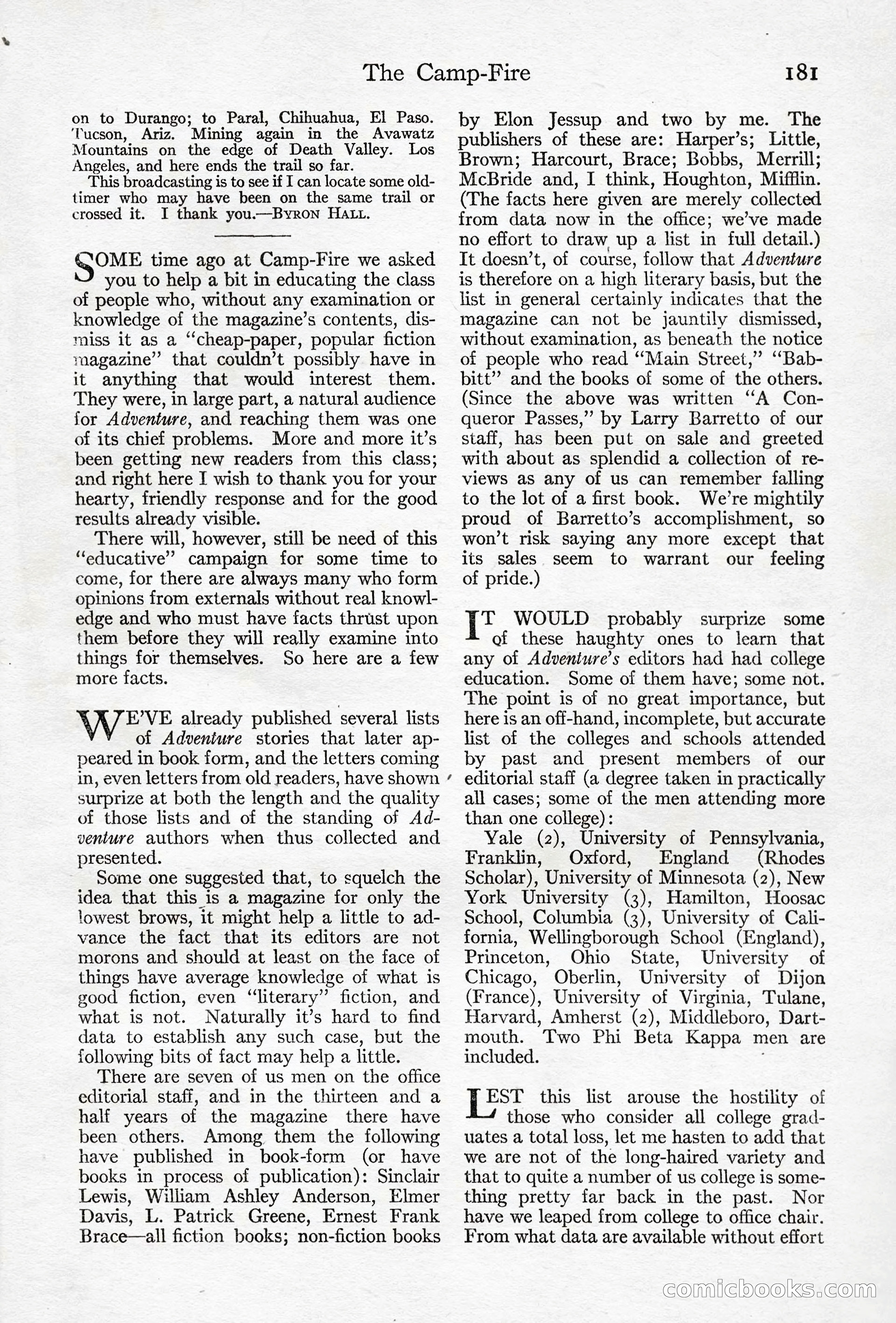
A restored page from Pulp Fiction, 1924. Page through the whole issue in the reader above.
📄 Transcribed text from this page (OCR, searchable)
Machine-transcribed from the original scan — historical spelling and the odd misread are preserved.
The Camp-Fire on to Durango; to Paral, Chihuahua, El Paso. ‘Tucson, Ariz. Mining again in the Avawatz Mountains on the edge of Death Valley. Los Angeles, and here ends ihe trail so far. This broadcasting is to see if I can locate some old- timer who may have been on the same trail or crossed it. I thank you.—Byron HALL. GOME time ago at Camp-Fire we asked you to help a bit in educating the class of people who, without any examination or knowledge of the magazine’s contents, dis- miss it as a “‘cheap-paper, popular fiction magazine” that couldn’t possibly have in it anything that would interest them. They were, in large part, a natural audience for Adventure, and reaching them was one of its chief problems. More and more it’s been getting new readers from this class; and right here I wish to thank you for your hearty, friendly response and for the good results already visible. There will, however, still be need of this “educative” campaign for some time to come, for there are always many who form opinions from externals without real knowl- edge and who must have facts thrust upon them before they will really examine into things for themselves. So here are a few more facts. E’VE already published several lists of Adventure stories that later ap- peared in book form, and the letters coming in, even letters from old readers, have shown surprize at both the length and the quality of those lists and of the standing of Ad- venture authors when thus collected and presented. Some one suggested that, to squelch the idea that this is a magazine for only the lowest brows, it might help a little to ad- vance the fact that its editors are not morons and should at least on the face of things have average knowledge of what is good fiction, even “literary” fiction, and what is not. Naturally it’s hard to find data to establish any such case, but the following bits of fact may help a little. There are seven of us men on the office editorial staff, and in the thirteen and a half years of the magazine there have been others. Among them the following have published in book-form (or have books in process of publication): Sinclair Lewis, William Ashley Anderson, Elmer Davis, L. Patrick Greene, Ernest Frank Brace—all fiction books; non-fiction books / 181 by Elon Jessup and two by me. The publishers of these are: Harper’s; Little, Brown; Harcourt, Brace; Bobbs, Merrill; McBride and, I think, Houghton, Mifflin. (The facts here given are merely collected from data now in the office; we’ve made no effort to draw up a list in full detail.) It doesn’t, of course, follow that Adventure is therefore on a high literary basis, but the list in general certainly indicates that the magazine can not be jauntily dismissed, without examination, as beneath the notice of people who read ‘‘Main Street,” ‘“Bab- bitt” and the books of some of the others. (Since the above was written “A Con- queror Passes,” by Larry Barretto of our staff, has been put on sale and greeted with about as splendid a collection of re- views as any of us can remember falling to the lot of a first book. We’re mightily proud of Barretto’s accomplishment, so won’t risk saying any more except that its sales seem to warrant our feeling of pride.) ig WOULD probably surprize some gf these haughty ones to learn that any of Adveniure’s editors had had college education. Some of them have; some not. The point is of no great importance, but here is an off-hand, incomplete, but accurate list of the colleges and schools attended by past and present members of our editorial staff (a degree taken in practically all cases; some of the men attending more than one college): Yale (2), University of Pennsylvania, Franklin, Oxford, England (Rhodes Scholar), University of Minnesota (2), New York University (3), Hamilton, Hoosac School, Columbia (3), University of Cali- fornia, Wellingborough School (England), Princeton, Ohio State, University of Chicago, Oberlin, University of Dijon (France), University of Virginia, Tulane, Harvard, Amherst (2), Middleboro, Dart- mouth. Two Phi Beta Kappa men are included. | ee this list arouse the hostility of those who consider all college grad- uates a total loss, let me hasten to add that we are not of the long-haired variety and that to quite a number of us college is some- thing pretty far back in the past. Nor have we leaped from college to office chair. From what data are available without effort COnICLOO <S) (© S|