
Pulp Fiction, 1924 · page 184 of 196
Adventure Magazine, April 10, 1924 — page 184: what you’re looking at
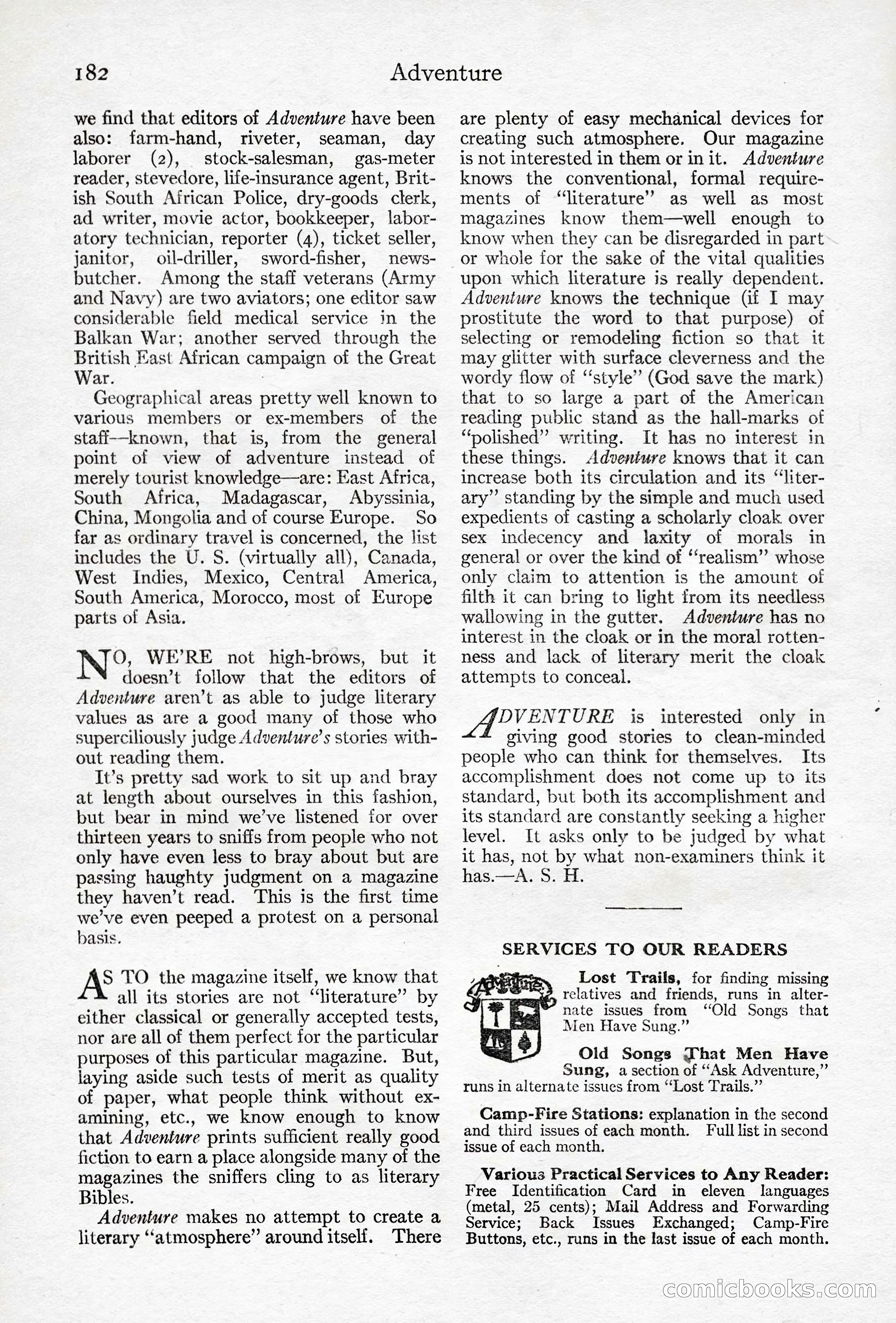
A restored page from Pulp Fiction, 1924. Page through the whole issue in the reader above.
📄 Transcribed text from this page (OCR, searchable)
Machine-transcribed from the original scan — historical spelling and the odd misread are preserved.
182 we find that editors of Adventure have been also: farm-hand, riveter, seaman, day laborer (2), stock-salesman, gas-meter reader, stevedore, life-insurance agent, Brit- ish South African Police, dry-goods clerk, ad writer, movie actor, bookkeeper, labor- atory technician, reporter (4), ticket seller, janitor, oil-driller, sword-fisher, news- butcher. Among the staff veterans (Army and Navy) are two aviators; one editor saw considerable field medical service in the Balkan War; another served through the British Kast African campaign of the Great War. : Geographical areas pretty well known to various members or ex-members of the stafi—-known, that is, from the general point of view of adventure instead of merely tourist knowledge—are: East Africa, South Africa, Madagascar, Abyssinia, China, Mongolia and of course Europe. So far as ordinary travel is concerned, the list includes the U. S. (virtually all), Canada, West Indies, Mexico, Central America, South America, Morocco, most of Europe parts of Asia. O, WE’RE not high-brows, but it doesn’t follow that the editors of Adventure aren’t as able to judge literary values as are a good many of those who superciliously judge Adventure’s stories with- out reading them. It’s pretty sad work to sit up and bray at length about ourselves in this fashion, but bear in mind we’ve listened tor over thirteen years to sniffs from people who not only have even less to bray about but are passing haughty judgment on a magazine they haven’t read. This is the first time we’ve even peeped a protest on a personal basis. S TO the magazine itself, we know that all its stories are not “literature” by either classical or generally accepted tests, nor are all of them perfect for the particular purposes of this particular magazine. But, laying aside such tests of merit as quality of paper, what people think without ex- amining, etc., we know enough to know that Adventure prints sufficient really good fiction to earn a place alongside many of the magazines the sniffers cling to as literary Bibles. Adventure makes no attempt to create a literary ‘“‘atmosphere” around itself. There Adventure are plenty of easy mechanical devices for creating such atmosphere. Our magazine is not interested in them or init. Adventure knows the conventional, formal require- ments of “literature” as well as most magazines know them—well enough to know when they can be disregarded in part or whole for the sake of the vital qualities upon which literature is really dependent. Adventure knows the technique (if I may prostitute the word to that purpose) of selecting or remodeling fiction so that it may glitter with surface cleverness and the wordy flow of “style” (God save the mark) that to so large a part of the American reading public stand as the hall-marks of “polished” writing. It has no interest in these things. Adventure knows that it can increase both its circulation and its “‘liter- ary” standing by the simple and much used expedients of casting a scholarly cloak over sex indecency and laxity of morals in general or over the kind of ‘‘realism”’ whose only claim to attention is the amount of filth it can bring to light from its needless wallowing in the gutter. Adventure has no interest in the cloak or in the moral rotten- ness and lack of literary merit the cloak attempts to conceal. DVENTURE is interested only in giving good stories to clean-minded people who can think for themselves. Its accomplishment does not come up to its standard, but both its accomplishment and its standard are constantly seeking a higher level. It asks only to be judged by what it has, not by what non-examiners think it has.—A. S. H. SERVICES TO OUR READERS Lost Trails, for finding missing relatives and friends, runs in alter- nate issues from ‘Old Songs that Men Have Sung.” Old Songs That Men Have Sung, a section of ‘Ask Adventure,” runs in alternate issues from “Lost Trails.” Camp-Fire Stations: explanation in the second and third issues of each month. Full list in second issue of each month. Various Practical Services to Any Reader: Free Identification Card in eleven languages (metal, 25 cents); Mail Address and Forwarding Service; Back Issues Exchanged; Camp-Fire Buttons, etc., runs in the last issue of each month. COMICOOCKS.CO 5}