
Pulp Fiction, 1924 · page 182 of 196
Adventure Magazine, April 10, 1924 — page 182: what you’re looking at
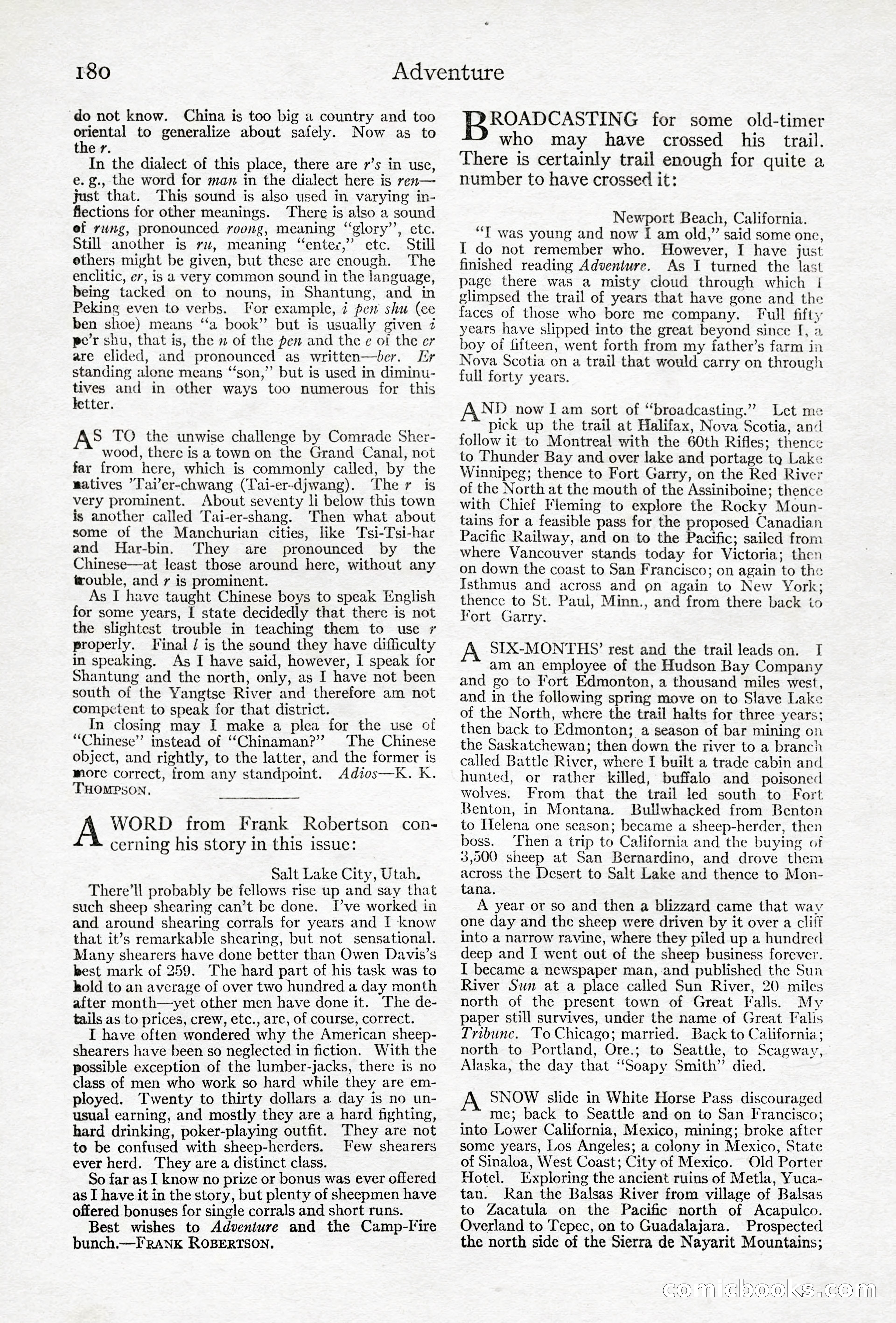
A restored page from Pulp Fiction, 1924. Page through the whole issue in the reader above.
📄 Transcribed text from this page (OCR, searchable)
Machine-transcribed from the original scan — historical spelling and the odd misread are preserved.
180 do not know. China is too big a country and too oriental to generalize about safely. Now as to the r. In the dialect of this place, there are r’s in use, e. g., the word for man in the dialect here is ren— just that. This sound is also used in varying in- fiections for other meanings. There is also a sound ef rung, pronounced roong, meaning “glory’’, etc. Still another is ru, meaning “enter,” etc. Still others might be given, but these are enough. The enclitic, er, is a very common sound in the language, being tacked on to nouns, in Shantung, and in Peking even to verbs. For example, i pew shu (ee ben shoe) means “a book” but is usually given 2z pe'r shu, that is, the 2 of the pen and the e¢ of the er are elided, and pronounced as written—ber. Jir standing alone means “son,’’ but is used in diminu- ae and in other ways too numerous for this tter. S TO the unwise challenge by Comrade Sher- wood, there is a town on the Grand Canal, not far from here, which is commonly called, by the watives ’Tai’er-chwang (Tai-er-djwang). Ther is very prominent. About seventy li below this town is another called Tai-er-shang. Then what about some of the Manchurian cities, like Tsi-Tsi-har and Har-bin. They are pronounced by the Chinese—at least those around here, without any trouble, and 7 is prominent. As I have taught Chinese boys to speak English for some years, I state decidedly that there is not the slightest trouble in teaching them to use 7 properly. Final / is the sound they have difficulty in speaking. As I have said, however, I speak for Shantung and the north, only, as I have not been south of the Yangtse River and therefore am not competent to speak for that district. In closing may I make a plea for the use oi “Chinese” instead of “Chinaman?” The Chinese object, and rightly, to the latter, and the former is more correct, from any standpoint. Adzos—K. K. THOMPSON, WORD from Frank Robertson con- cerning his story in this issue: Salt Lake City, Utah. There'll probably be fellows rise up and say that such sheep shearing can’t be done. Ive worked in and around shearing corrals for years and I know that it’s remarkable shearing, but not sensational. Many shearers have done better than Owen Davis’s best mark of 259. The hard part of his task was to hold to an average of over two hundred a day month after month—yet other men have done it. The de- tails as to prices, crew, etc., are, of course, correct. I have often wondered why the American sheep- shearers have been so neglected in fiction. With the possible exception of the lumber-jacks, there is no class of men who work so hard while they are em- ployed. Twenty to thirty dollars a day is no un- usual earning, and mostly they are a hard fighting, hard drinking, poker-playing outfit. They are not to be confused with sheep-herders. Few shearers ever herd. They are a distinct class. So far as I know no prize or bonus was ever offered as I have.it in the story, but plenty of sheepmen have offered bonuses for single corrals and short runs. Best wishes to Adventure and the Camp-Fire bunch.—I’RANK ROBERTSON. Adventure ROADCASTING for some old-timer who may have crossed his trail. There is certainly trail enough for quite a number to have crossed it: Newport Beach, California. “T was young and now I am old,” said some onc, do not remember who. However, I have just finished reading Adventure. As I turned the last page there was a misty cloud through which i glimpsed the trail of years that have gone and the faces of those who bore me company. Full fifty years have slipped into the great beyond since I, a boy of fifteen, went forth from my father’s farm in Nova Scotia on a trail that would carry on through full forty years. ND now Jam sort of “broadcasting.” Let me pick up the trail at Halifax, Nova Scotia, ancl follow it to Montreal with the 60th Rifles; thence to Thunder Bay and over lake and portage tq Lak« Winnipeg; thence to Fort Garry, on the Red River of the North at the mouth of the Assiniboine; thence with Chief Fleming to explore the Rocky Moun- tains for a feasible pass for the proposed Canadian Pacific Railway, and on to the Pacific; sailed from where Vancouver stands today for Victoria; then on down the coast to San Francisco; on again to the Isthmus and across and on again to New York; thence to St. Paul, Minn., and from there back to Fort Garry. A SIX-MONTHS’ rest and the trail leads on. I am an employee of the Hudson Bay Company and go to Fort Edmonton, a thousand miles west, and in the following spring move on to Slave Lake of the North, where the trail halts for three years; then back to Edmonton; a season of bar mining on the Saskatchewan; then down the river to a branch called Battle River, where I built a trade cabin and hunted, or rather killed, buffalo and poisoned wolves. From that the trail led south to Fort Benton, in Montana. Bullwhacked from Benton to Helena one season; became a sheep-herder, then boss. Then a trip to California and the buying of 3,900 sheep at San Bernardino, and drove them across the Desert to Salt Lake and thence to Mon- tana. A year or so and then a blizzard came that wav one day and the sheep were driven by it over a cliff into a narrow ravine, where they piled up a hundred deep and I went out of the sheep business forever. I became a newspaper man, and published the Sun River Sun at a place called Sun River, 20 miles north of the present town of Great Falls. My paper still survives, under the name of Great Falis Tribune. To Chicago; married. Back to California; north to Portland, Ore.; to Seattle, to Scagway, Alaska, the day that ‘Soapy Smith” died. A SNOW slide in White Horse Pass discouraged me; back to Seattle and on to San Francisco; into Lower California, Mexico, mining; broke after some years, Los Angeles; a colony in Mexico, State of Sinaloa, West Coast; City of Mexico. Old Porter Hotel. Exploring the ancient ruins of Metla, Yuca- tan. Ran the Balsas River from village of Balsas to Zacatula on the Pacific north of Acapulco. Overland to Tepec, on to Guadalajara. Prospected the north side of the Sierra de Nayarit Mountains; mn S S| COnmicloo (C@