
Pulp Fiction, 1924 · page 135 of 196
Adventure Magazine, April 10, 1924 — page 135: what you’re looking at
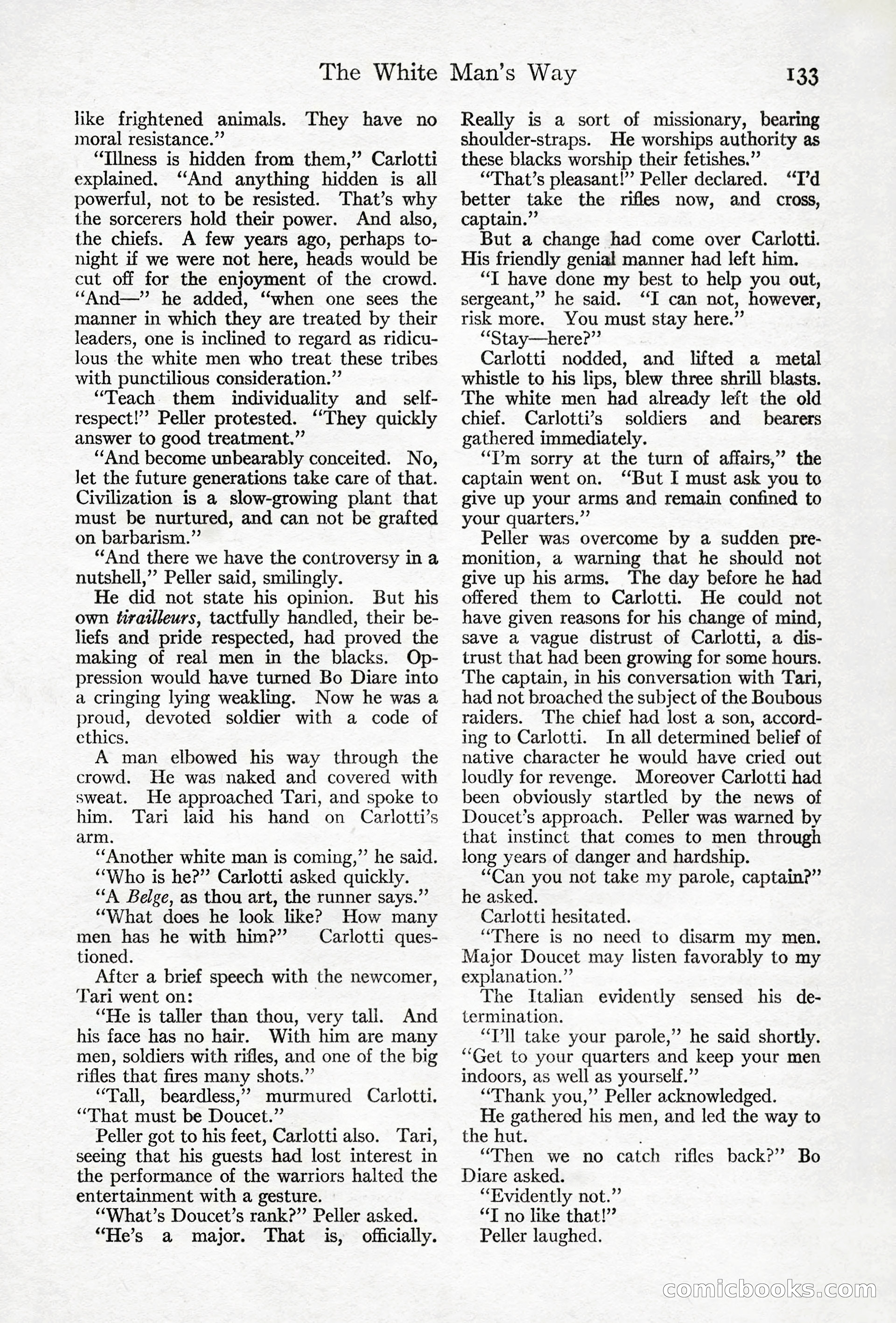
A restored page from Pulp Fiction, 1924. Page through the whole issue in the reader above.
📄 Transcribed text from this page (OCR, searchable)
Machine-transcribed from the original scan — historical spelling and the odd misread are preserved.
The White Man’s Way like frightened animals. moral resistance.” “Tilness is hidden from them,” Carlotti explained. “And anything hidden is all powerful, not to be resisted. That’s why the sorcerers hold their power. And also, the chiefs. A few years ago, perhaps to- night if we were not here, heads would be cut off for the enjoyment of the crowd. ‘“‘And—” he added, “when one sees the manner in which they are treated by their leaders, one is inclined to regard as ridicu- lous the white men who treat these tribes with punctilious consideration.” “Teach them individuality and _ self- respect!’ Peller protested. “They quickly answer to good treatment.’’ ‘“‘And become unbearably conceited. No, Jet the future generations take care of that. Civilization is a slow-growing plant that must be nurtured, and can not be grafted on barbarism.” ‘And there we have the controversy in a nutshell,” Peller said, smilingly. He did not state his opinion. But his own tiratleurs, tactfully handled, their be- liefs and pride respected, had proved the making of real men in the blacks. Op- pression would have turned Bo Diare into a cringing lying weakling. Now he was a proud, devoted soldier with a code of ethics. A man elbowed his way through the crowd. He was naked and covered with sweat. He approached Tari, and spoke to him. Tari laid his hand on Carlotti’s arm. ‘Another white man is coming,” he said. “Who is he?” Carlotti asked quickly. “A Belge, as thou art, the runner says.”’ “What does he look like? How many men has he with him?” Carlotti ques- tioned. After a brief speech with the newcomer, Tari went on: “He is taller than thou, very tall. And his face has no hair. With him are many men, soldiers with rifles, and one of the big rifles that fires many shots.” “Tall, beardless,”” murmured Carlotti. “That must be Doucet.” Peller got to his feet, Carlotti also. Tari, seeing that his guests had lost interest in the performance of the warriors halted the entertainment with a gesture. “What’s Doucet’s rank?”’ Peller asked. “He’s a major. That is, officially. They have no 133 Really is a sort of missionary, bearing shoulder-straps. He worships authority as these blacks worship their fetishes.” “‘That’s pleasant!” Peller declared. “I'd better take the rifles now, and cross, captain.” But a change had come over Carlotti. His friendly genial manner had left him. “T have done my best to help you out, sergeant,” he said. “I can not, however, risk more. You must stay here.” “‘Stay—here?”’ Carlotti nodded, and lifted a metal whistle to his lips, blew three shrill blasts. The white men had already left the old chief. Carlotti’s soldiers and_ bearers gathered immediately. “Ym sorry at the turn of affairs,” the captain went on. ‘‘But I must ask you to give up your arms and remain confined to your quarters.” Peller was overcome by a sudden pre- monition, a warning that he should not give up his arms. The day before he had offered them to Carlotti. He could not have given reasons for his change of mind, save a vague distrust of Carlotti, a dis- trust that had been growing for some hours. The captain, in his conversation with Tari, had not broached the subject of the Boubous raiders. ‘The chief had lost a son, accord- ing to Carlotti. In all determined belief of native character he would have cried out loudly for revenge. Moreover Carlotti had been obviously startled by the news of Doucet’s approach. Peller was warned by that instinct that comes to men through long years of danger and hardship. “Can you not take my parole, captain?” he asked. Carlotti hesitated. “There is no need to disarm my men. Major Doucet may listen favorably to my explanation.” The Italian evidently sensed his de- termination. “T?ll take your parole,” he said shortly. “Get to your quarters and keep your men indoors, as well as yourself.” “Thank you,” Peller acknowledged. He gathered his men, and led the way to the hut. “Then we no catch rifles back?” Bo Diare asked. “Evidently not.” “T no like that!” Peller laughed. E@ DOOLK (C@