
Pulp Fiction, 1924 · page 134 of 196
Adventure Magazine, April 10, 1924 — page 134: what you’re looking at
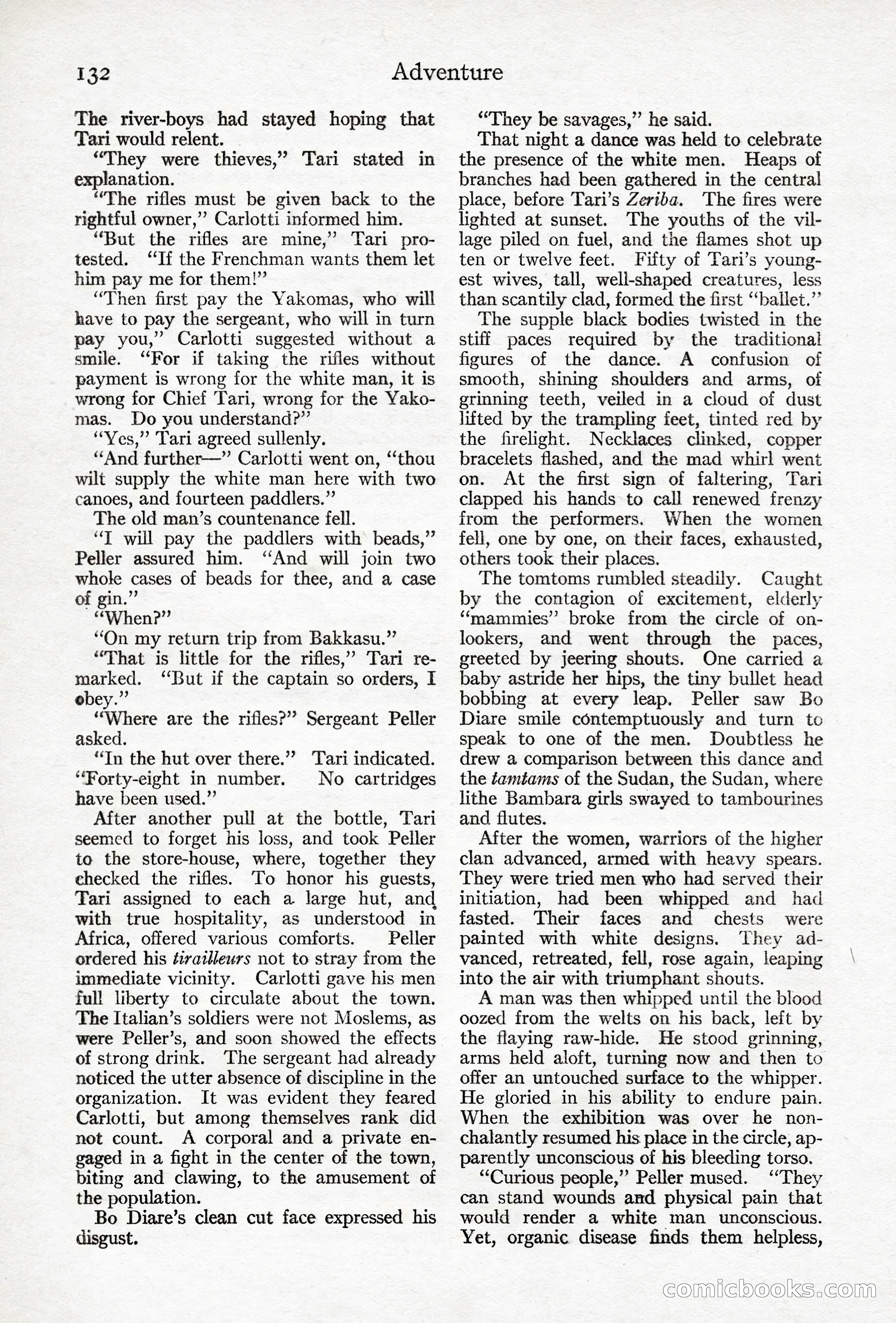
A restored page from Pulp Fiction, 1924. Page through the whole issue in the reader above.
📄 Transcribed text from this page (OCR, searchable)
Machine-transcribed from the original scan — historical spelling and the odd misread are preserved.
132 The river-boys had stayed hoping that Tari would relent. “They were thieves,” Tari stated in explanation. “The rifles must be given back to the rightful owner,” Carlotti informed him. “But the rifles are mine,’ Tari pro- tested. “Ii the Frenchman wants them let him pay me for them!” “Then first pay the Yakomas, who will have to pay the sergeant, who will in turn pay you,” Carlotti suggested without a smile. “For if taking the rifles without payment is wrong for the white man, it is wrong for Chief Tari, wrong for the Yako- mas. Do you understand?” “Ves,” Tari agreed sullenly. “And further—” Carlotti went on, ‘“‘thou wilt supply the white man here with two canoes, and fourteen paddlers.” The old man’s countenance fell. “J will pay the paddlers with beads,” Peller assured him. ‘‘And will join two whole cases of beads for thee, and a case of gin.” “When”? “On my return trip from Bakkasu.” “That is little for the rifles,’ Tari re- marked. ‘But if the captain so orders, I obey.” ‘‘Where are the rifles?’ Sergeant Peller asked. “In the hut over there.” ‘Forty-eight in number. have been used.” After another pull at the bottle, Tari seemed to forget his loss, and took Peller to the store-house, where, together they checked the rifles. To honor his guests, Tari assigned to each a large hut, and with true hospitality, as understood in Africa, offered various comforts. Peller ordered his ¢zrazlleurs not to stray from the immediate vicinity. Carlotti gave his men full liberty to circulate about the town. The Italian’s soldiers were not Moslems, as were Peller’s, and soon showed the effects of strong drink. ‘The sergeant had already noticed the utter absence of discipline in the organization. It was evident they feared Carlotti, but among themselves rank did not count. A corporal and a private en- gaged in a fight in the center of the town, biting and clawing, to the amusement of the population. Bo Diare’s clean cut face expressed his disgust. Tari indicated. No cartridges Adventure “They be savages,” he said. That night a dance was held to celebrate the presence of the white men. Heaps of branches had been gathered in the central place, before Tari’s Zertba. ‘The fires were lighted at sunset. The youths of the vil- lage piled on fuel, and the flames shot up ten or twelve feet. Fifty of Tari’s young- est wives, tall, well-shaped creatures, less than scantily clad, formed the first “‘ballet.”’ The supple black bodies twisted in the stiff paces required by the traditional figures of the dance. A confusion of smooth, snining shoulders and arms, of grinning teeth, veiled in a cloud of dust lifted by the trampling feet, tinted red by the firelight. Necklaces clinked, copper bracelets flashed, and the mad whirl went on. At the first sign of faltering, Tari clapped his hands to call renewed frenzy from the performers. When the women fell, one by one, on their faces, exhausted, others took their places. The tomtoms rumbled steadily. Caught by the contagion of excitement, elderly ‘“‘mammies” broke from the circle of on- lookers, and went through the paces, greeted by jeering shouts. One carried a baby astride her hips, the tiny bullet head bobbing at every leap. Peller saw Bo Diare smile contemptuously and turn to speak to one of the men. Doubtless he drew a comparison between this dance and the famtams of the Sudan, the Sudan, where lithe Bambara girls swayed to tambourines and flutes. After the women, warriors of the higher clan advanced, armed with heavy spears. They were tried men who had served their initiation, had been whipped and had fasted. Their faces and chests were painted with white designs. They ad- vanced, retreated, fell, rose again, leaping into the air with triumphant shouts. A man was then whipped until the blood oozed from the welts on his back, left by the flaying raw-hide. He stood grinning, arms held aloft, turning now and then to offer an untouched surface to the whipper. He gloried in his ability to endure pain. When the exhibition was over he non- chalantly resumed his place in the circle, ap- parently unconscious of his bleeding torso. “Curious people,’”’ Peller mused. ‘‘They can stand wounds and physical pain that would render a white man unconscious. Yet, organic disease finds them helpless, COMmGboo Cc S C@