
Pulp Fiction, 1924 · page 136 of 196
Adventure Magazine, April 10, 1924 — page 136: what you’re looking at
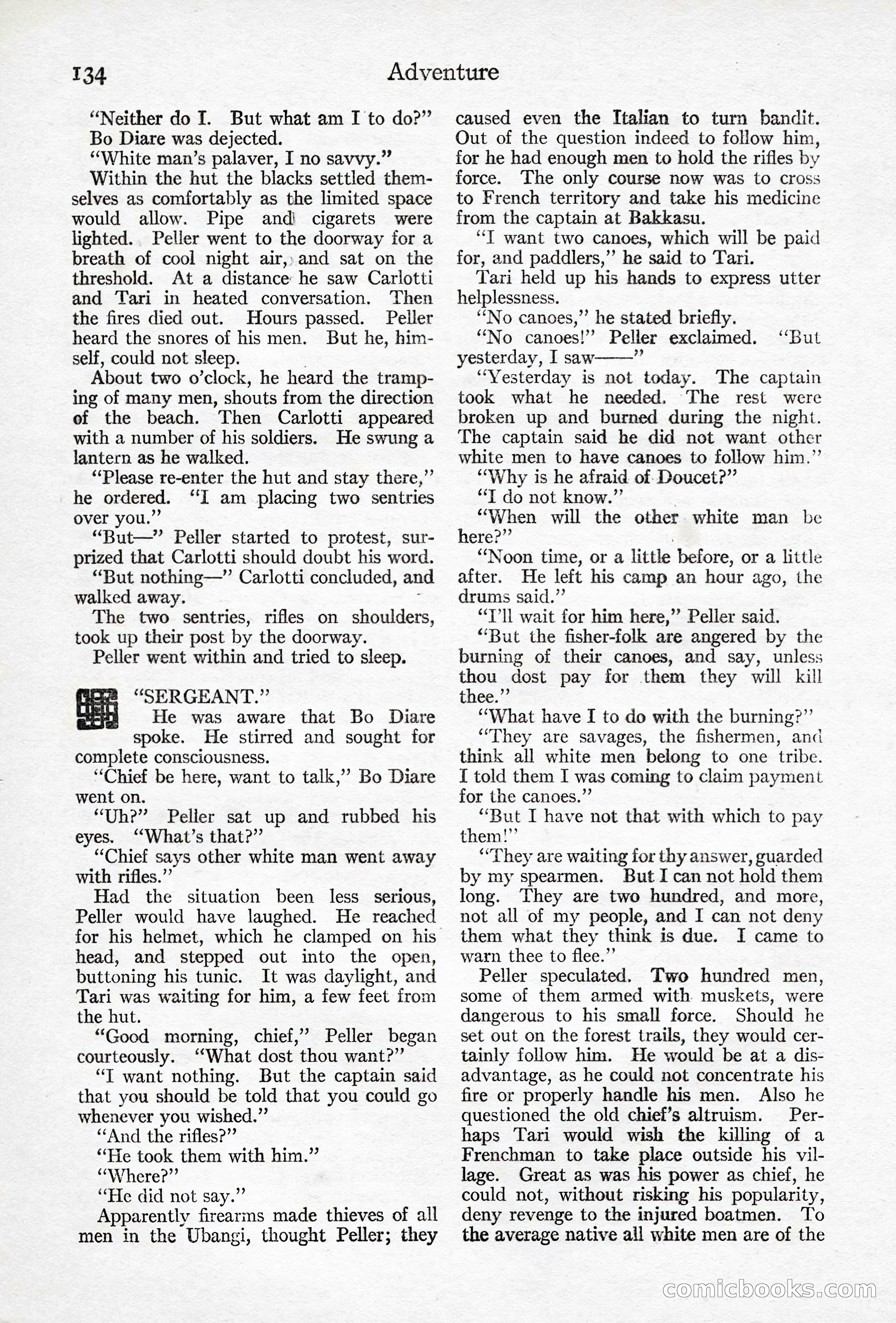
A restored page from Pulp Fiction, 1924. Page through the whole issue in the reader above.
📄 Transcribed text from this page (OCR, searchable)
Machine-transcribed from the original scan — historical spelling and the odd misread are preserved.
134 “Neither do I. But what am I to do?” Bo Diare was dejected. “White man’s palaver, I no savvy.” Within the hut the blacks settled them- selves as comfortably as the limited space would allow. Pipe and! cigarets were lighted. Peller went to the doorway for a breath of cool night air,,and sat on the threshold. At a distance he saw Carlotti and Tari in heated conversation. Then the fires died out. Hours passed. Peller heard the snores of his men. But he, him- self, could not sleep. About two o ’clock, he heard the tramp- ing of many men, shouts from the direction of the beach. Then Carlotti appeared with a number of his soldiers. He swung a lantern as he walked. “Please re-enter the hut and stay there,”’ he ordered. “I am placing two sentries over you.” “But—” Peller started to protest, sur- prized that Carlotti should doubt his word. “But nothing—” Carlotti concluded, and walked away. The two sentries, rifles on shoulders, took up their post by the doorway. Peller went within and tried to sleep. “SERGEANT.” He was aware that Bo Diuare spoke. He stirred and sought for complete consciousness. “Chief be here, want to talk,” Bo Diare went on. “Uh?” Peller sat up and rubbed his eyes. “‘What’s that?” “Chief says other white man went away with rifles.”’ Had the situation been less serious, Peller would have laughed. He reached for his helmet, which he clamped on his head, and stepped out into the open, buttoning his tunic. It was daylight, and Tari was waiting for him, a few feet irom the hut. “Good morning, chief,’ Peller began courteously. ‘‘What dost thou want?” “T want nothing. But the captain said that you should be told that you could go whenever you wished.” ‘“‘And the rifles?” “Fie took them with him.” “Where?” “Fle did not say.” Apparently firearms made thieves of all men in the Ubangi, thought Peller; they Adventure caused even the Italian to turn bandit. Out of the question indeed to follow him, for he had enough men to hold the rifles by force. The only course now was to cross to French territory and take his medicine from the captain at Bakkasu. “T want two canoes, which will be paid for, and paddlers,”’ he said to Tari. Tari held up his hands to express utter helplessness. ‘“‘No canoes,”’ he stated briefly. “No canoes!” Peller exclaimed. yesterday, I saw——” “Yesterday is not today. The captain took what he needed. The rest were broken up and burned during the night. The captain said he did not want other white men to have canoes to follow him.” “Why is he afraid of Doucet?” “TI do not know.” | “When will the other white man be here?” “Noon time, or a little before, or a little after. He left his camp an hour ago, the drums said.”’ “T’ll wait for him here,” Peller said. “But the fisher-folk are angered by the burning of their canoes, and say, unless thou dost pay for them they will kill thee.” “What have I to do with the burning?”’ “They are savages, the fishermen, and think all white men belong to one tribe. I told them I was coming to claim payment for the canoes.” “But I have not that with which to pay them!”’ “They are waiting for thy answer, guarded by my spearmen. But I can not hold them long. They are two hundred, and more, not all of my people, and I can not deny them what they think is due. I came to warn thee to flee.”’ Peller speculated. Two hundred men, some of them armed with muskets, were dangerous to his small force. Should he set out on the forest trails, they would cer- tainly follow him. He would be at a dis- advantage, as he could not concentrate his fire or properly handle his men. Also he questioned the old chief’s altruism. Per- haps Tari would wish the killing of a Frenchman to take place outside his vil- lage. Great as was his power as chief, he could not, without risking his popularity, deny revenge to the injured boatmen. To the average native all white men are of the “But COMICLOOCKKS. GO