
Pulp Fiction, 1924 · page 186 of 200
Adventure Magazine Cover — page 186: what you’re looking at
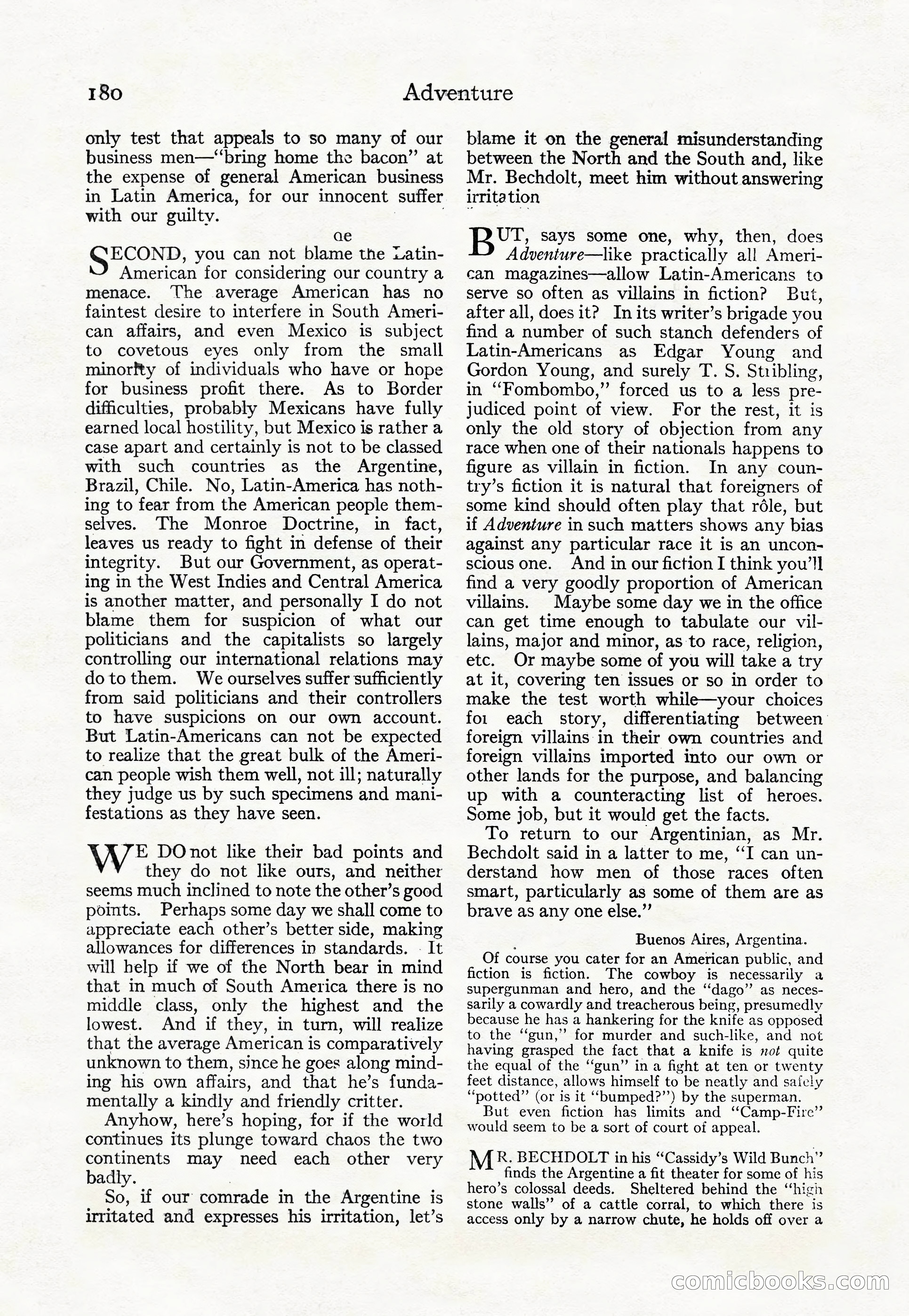
A restored page from Pulp Fiction, 1924. Page through the whole issue in the reader above.
📄 Transcribed text from this page (OCR, searchable)
Machine-transcribed from the original scan — historical spelling and the odd misread are preserved.
180 only test that appeals to so many of our business men—‘‘bring home the bacon” at the expense of general American business in Latin America, for our innocent suffer with our guilty. | ae ECOND, you can not blame the “Latin- American for considering our country a menace. The average American has no faintest desire to interfere in South Ameri- can affairs, and even Mexico is subject to covetous eyes only from the small minorfty of individuals who have or hope for business profit there. As to Border difficulties, probably Mexicans have fully earned local hostility, but Mexico is rather a case apart and certainly is not to be classed with such countries as the Argentine, Brazil, Chile. No, Latin-America has noth- ing to fear from the American people them- selves. The Monroe Doctrine, in fact, leaves us ready to fight in defense of their integrity. But our Government, as operat- ing in the West Indies and Central America is another matter, and personally I do not blame them for suspicion of what our politicians and the capitalists so largely controlling our international relations may dotothem. We ourselves suffer sufficiently from said politicians and their controllers to have suspicions on our own account. But Latin-Americans can not be expected to realize that the great bulk of the Ameri- can people wish them well, not ill; naturally they Judge us by such specimens and mani- festations as they have seen. WE DO not like their bad points and they do not like ours, and neither seems much inclined to note the other’s good points. Perhaps some day we shall come to appreciate each other’s better side, making allowances for differences in standards. - It will help if we of the North bear in mind that m much of South America there is no middle class, only the highest and the lowest. And if they, in turn, will realize that the average American is comparatively unknown to them, since he goes along mind- ing his own affairs, and that he’s funda- mentally a kindly and friendly critter. Anyhow, here’s hoping, for if the world continues its plunge toward chaos the two continents may need each other very badly. : So, if our comrade in the Argentine is irritated and expresses his irritation, let’s Adventure blame it on the general misunderstanding between the North and the South and, like Mr. Bechdolt, meet him without answering irritation BU: says some one, why, then, does Adventure—like practically all Ameri- can magazines—allow Latin-Americans to serve so often as villains in fiction? But, after all, does it? In its writer’s brigade you find a number of such stanch defenders of Latin-Americans as Edgar Young and Gordon Young, and surely T. S. Stribling, in “Fombombo,” forced us to a less pre- judiced point of view. For the rest, it is only the old story of objection from any race when one of their nationals happens to figure as villain in fiction. In any coun- try’s fiction it is natural that foreigners of some kind should often play that rdéle, but if Adventure in such matters shows any bias against any particular race it is an uncon- scious one. And in our fiction I think you’ll find a very goodly proportion of American villains. Maybe some day we in the office can get time enough to tabulate our vil- lains, major and minor, as to race, religion, etc. Or maybe some of you will take a try at it, covering ten issues or so in order to make the test worth while—your choices fol each story, foreign villains in their own countries and foreign villains imported into our own or other lands for the purpose, and balancing up with a counteracting list of heroes. Some job, but it would get the facts. To return to our Argentinian, as Mr. Bechdolt said in a latter to me, “‘I can un- derstand how men of those races often smart, particularly as some of them are as brave as any one else.”’ Buenos Aires, Argentina. Of course you cater for an American public, and fiction is fiction. The cowboy is necessarily a supergunman and hero, and the ‘“‘dago” as neces- sarily a cowardly and treacherous being, presumedly because he has a hankering for the knife as opposed to the ‘‘gun,” for murder and such-like, and not having grasped the fact that a knife is not quite tne equal of the “gun” in a fight at ten or twenty feet distance, allows himself to be neatly and safely “potted” (or is it ‘“‘bumped?’’) by the superman. But even fiction has limits and “‘Camp-Fire” would seem to be a sort of court of appeal. Me: BECHDOLT in his ‘‘Cassidy’s Wild Bunch” finds the Argentine a fit theater for some of his hero’s colossal deeds. Sheltered behind the “hich stone walls” of a cattle corral, to which there is access only by a narrow chute, he holds off over a C© differentiating between MICLOOOKS S|