
Pulp Fiction, 1924 · page 187 of 200
Adventure Magazine Cover — page 187: what you’re looking at
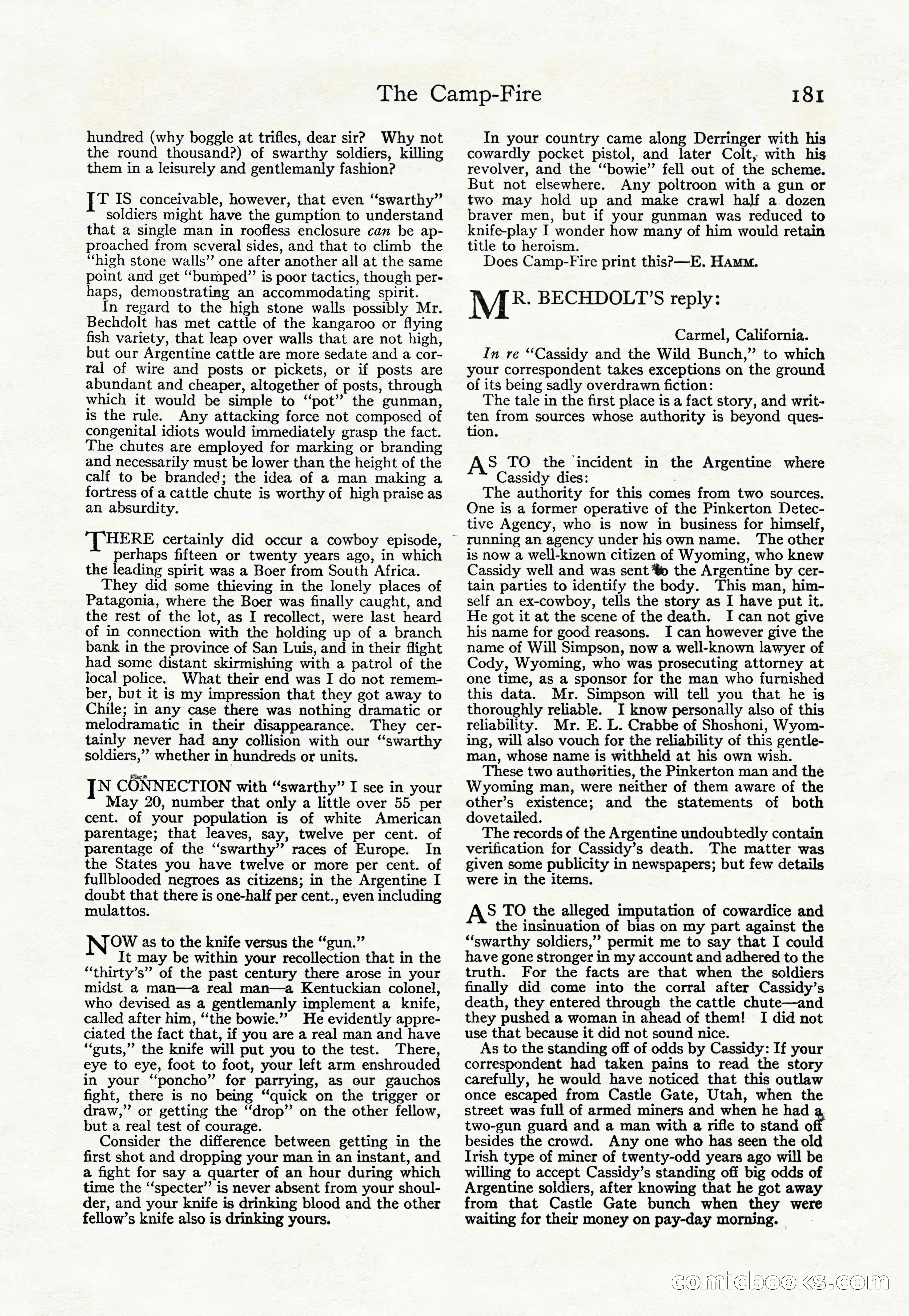
A restored page from Pulp Fiction, 1924. Page through the whole issue in the reader above.
📄 Transcribed text from this page (OCR, searchable)
Machine-transcribed from the original scan — historical spelling and the odd misread are preserved.
The Camp-Fire hundred (why boggle at trifles, dear sir? Why not the round thousand?) of swarthy soldiers, killing them in a leisurely and gentlemanly fashion? T IS conceivable, however, that even “swarthy”’ soldiers might have the gumption to understand that a single man in roofless enclosure can be ap- proached from several sides, and that to climb the “high stone walls” one after another all at the same point and get “bumped” is poor tactics, though per- haps, demonstrating an accommodating spirit. In regard to the high stone walls possibly Mr. Bechdolt has met cattle of the kangaroo or flying fish variety, that leap over walls that are not high, but our Argentine cattle are more sedate and a cor- ral of wire and posts or pickets, or if posts are abundant and cheaper, altogether of posts, through which it would be simple to “pot” the gunman, is the rule. Any attacking force not composed of congenital idiots would immediately grasp the fact. The chutes are employed for marking or branding and necessarily must be lower than the height of the calf to be branded; the idea of a man making a fortress of a cattle chute is worthy of high praise as an absurdity. HERE certainly did occur a cowboy episode, erhaps fifteen or twenty years ago, in which the leading spirit was a Boer from South Africa. They did some thieving in the lonely places of Patagonia, where the Boer was finally caught, and the rest of the lot, as I recollect, were last heard of in connection with the holding up of a branch bank in the province of San Luis, and in their flight had some distant skirmishing with a patrol of the local police. What their end was I do not remem- ber, but it is my impression that they got away to Chile; in any case there was nothing dramatic or melodramatic in their disappearance. They cer- tainly never had any collision with our “swarthy soldiers,’ whether in hundreds or units. IN CONNECTION with “swarthy” I see in your May 20, number that only a little over 55 per cent. of your population is of white American parentage; that leaves, say, twelve per cent. of parentage of the “swarthy” races of Europe. In the States you have twelve or more per cent. of fullblooded negroes as citizens; in the Argentine I doubt that there is one-half per cent., even including mulattos. Now as to the knife versus the “gun.” It may be within your recollection that in the ““thirty’s” of the past century there arose in your midst a man—a real man—a Kentuckian colonel, who devised as a gentlemanly implement a knife, called after him, “the bowie.’’ He evidently appre- ciated the fact that, if you are a real man and have “guts,” the knife will put you to the test. There, eye to eye, foot to foot, your left arm enshrouded in your “poncho” for parrying, as our gauchos fight, there is no being “quick on the trigger or draw,” or getting the “drop” on the other fellow, but a real test of courage. Consider the difference between getting in the first shot and dropping your man in an instant, and a fight for say a quarter of an hour during which time the “‘specter” is never absent from your shoul- der, and your knife is drinking blood and the other fellow’s knife also is drinking yours. 181 In your country came along Derringer with his cowardly pocket pistol, and later Colt, with his revolver, and the ‘‘bowie’’ fell out of the scheme. But not elsewhere. Any poltroon with a gun or two may hold up and make crawl half a. dozen braver men, but if your gunman was reduced to knife-play I wonder how many of him would retain title to heroism. Does Camp-Fire print thisP—E. Hamm. M R. BECHDOLT’S reply: Carmel, California. In re “Cassidy and the Wild Bunch,” to which your correspondent takes exceptions on the ground of its being sadly overdrawn fiction: The tale in the first place is a fact story, and writ- ten from sources whose authority is beyond ques- tion. AS TO the ‘incident in the Argentine where Cassidy dies: The authority for this comes from two sources. One is a former operative of the Pinkerton Detec- tive Agency, who is now in business for himself, running an agency under hisown name. The other is now a well-known citizen of Wyoming, who knew Cassidy well and was sent % the Argentine by cer- tain parties to identify the body. This man, him- self an ex-cowboy, tells the story as I have put it. He got it at the scene of the death. I can not give his name for good reasons. I can however give the name of Will Simpson, now a well-known lawyer of Cody, Wyoming, who was prosecuting attorney at one time, as a sponsor for the man who furnished this data. Mr. Simpson will tell you that he is thoroughly reliable. I know personally also of this reliability. Mr. E. L. Crabbe of Shoshoni, Wyom- ing, will also vouch for the reliability of this gentle- man, whose name is withheld at his own wish. These two authorities, the Pinkerton man and the Wyoming man, were neither of them aware of the other’s existence; and the statements of both dovetailed. The records of the Argentine undoubtedly contain verification for Cassidy’s death. The matter was given some publicity in newspapers; but few details were in the items. AS TO the alleged imputation of cowardice and the insinuation of bias on my part against the “‘swarthy soldiers,”’ permit me to say that I could have gone stronger in my account and adhered to the truth. For the facts are that when the soldiers finally did come into the corral after Cassidy’s death, they entered through the cattle chute—and they pushed a woman in ahead of them! I did not use that because it did not sound nice. As to the standing off of odds by Cassidy: If your correspondent had taken pains to read the story carefully, he would have noticed that this outlaw once escaped from Castle Gate, Utah, when the street was full of armed miners and when he had two-gun guard and a man with a rifle to stand off besides the crowd. Any one who has seen the old Irish type of miner of twenty-odd years ago will be willing to accept Cassidy’s standing off big odds of Argentine soldiers, after knowing that he got away from that Castle Gate bunch when they were waiting for their money on pay-day morning. oO C© MICLOOKS 5}