
Pulp Fiction, 1924 · page 185 of 200
Adventure Magazine Cover — page 185: what you’re looking at
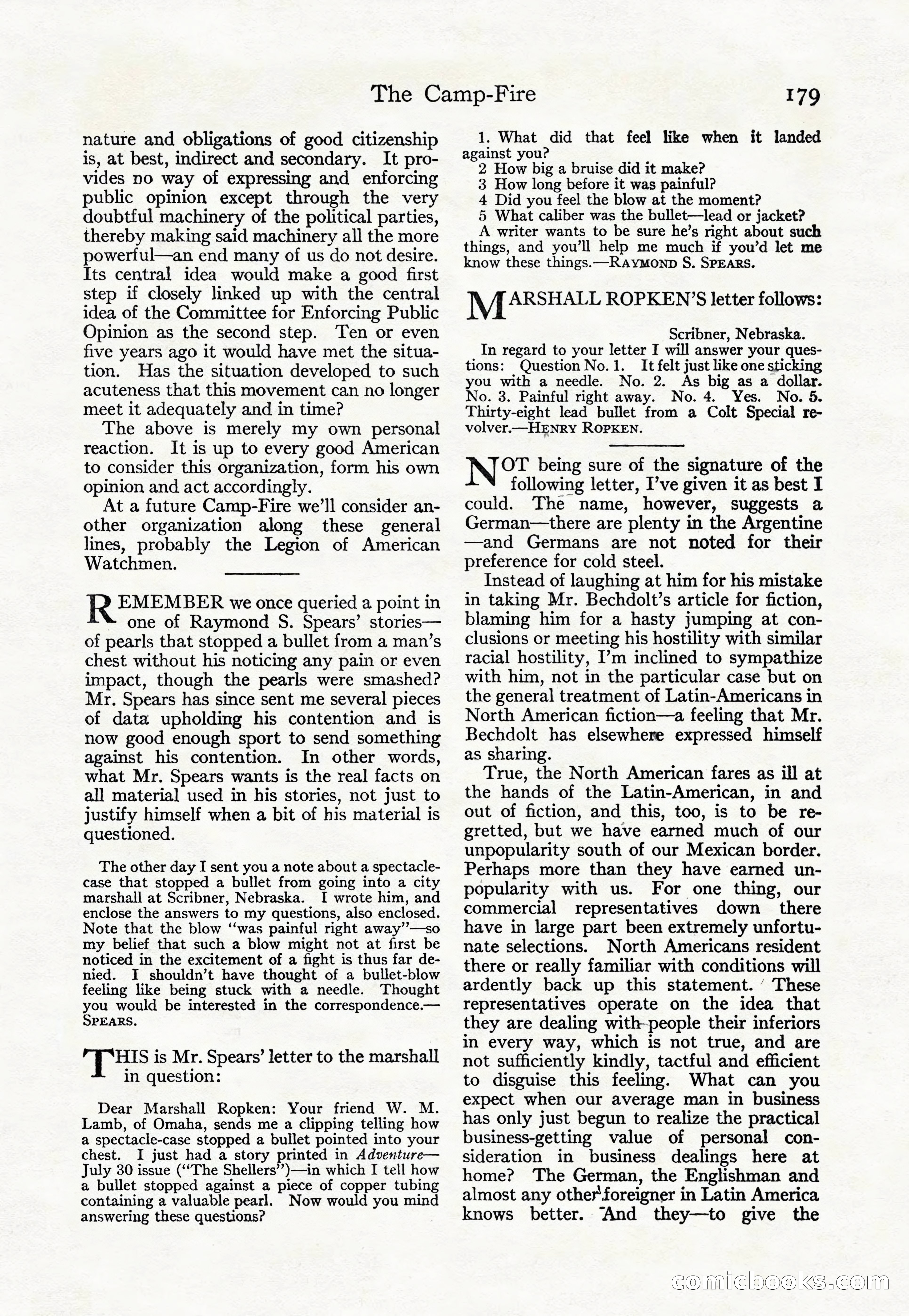
A restored page from Pulp Fiction, 1924. Page through the whole issue in the reader above.
📄 Transcribed text from this page (OCR, searchable)
Machine-transcribed from the original scan — historical spelling and the odd misread are preserved.
The Camp-Fire nature and obligations of good citizenship is, at best, indirect and secondary. It pro- vides no way of expressing and enforcing public opinion except through the very doubtful machinery of the political parties, thereby making said machinery all the more powerful—an end many of us do not desire. Its central idea would make a good first step if closely linked up with the central idea of the Committee for Enforcing Public Opinion as the second step. Ten or even five years ago it would have met the situa- tion. Has the situation developed to such acuteness that this movement can no longer meet it adequately and in time? The above is merely my own personal reaction. It is up to every good American to consider this organization, form his own opinion and act accordingly. At a future Camp-Fire we’ll consider an- other organization along these general lines, probably the Legion of American Watchmen. [¢ EMEMBER we once queried a point in “ one of Raymond S. Spears’ stories— of pearls that stopped a bullet from a man’s chest without his noticing any pain or even impact, though the pearls were smashed? Mr. Spears has since sent me several pieces of data upholding his contention and is now good enough sport to send something against his contention. In other words, what Mr. Spears wants is the real facts on all material used in his stories, not just to justify himself when a bit of his material is questioned. The other day I sent you a note about a spectacle- case that stopped a bullet from going into a city marshall at Scribner, Nebraska. I wrote him, and enclose the answers to my questions, also enclosed. Note that the blow ‘‘was painful right away’’—so my belief that such a blow might not at first be noticed in the excitement of a fight is thus far de- nied. I shouldn’t have thought of a bullet-blow feeling like being stuck with a needle. Thought you would be interested in the correspondence.— SPEARS. Ts: is Mr. Spears’ letter to the marshall in question: Dear Marshall Ropken: Your friend W. M. Lamb, of Omaha, sends me a clipping telling how a spectacle-case stopped a bullet pointed into your chest. I just had a story printed in Adventure— July 30 issue (‘“The Shellers’’)—in which I tell how a bullet stopped against a piece of copper tubing containing a valuable pearl. Now would you mind answering these questions? 179 1. What did that feel like when it landed against youe 2 How big a bruise did it make? 3 How long before it was painful? 4 Did you feel the blow at the moment? 5 What caliber was the bullet—lead or jacket? A writer wants to be sure he’s right about such things, and you’ll help me much if you’d let me know these things.—RaAymonp S. SPEARS. nt Bee ROPKEN’S letter follows: Scribner, Nebraska. In regard to your letter I will answer your ques- tions: Question No.1. It felt just like one sticking you with a needle. No. 2. As big as a dollar. No. 3. Painful right away. No. 4. Yes. No. 5. Thirty-eight lead bullet from a Colt Special re- volver.— HENRY ROPKEN. Not being sure of the signature of the following letter, I’ve given it as best I could. The name, however, suggests a German—there are plenty in the Argentine —and Germans are not noted for their preference for cold steel. Instead of laughing at him for his mistake in taking Mr. Bechdolt’s article for fiction, blaming him for a hasty jumping at con- clusions or meeting his hostility with similar racial hostility, I’m inclined to sympathize with him, not in the particular case but on the general treatment of Latin-Americans in North American fiction—a feeling that Mr. Bechdolt has elsewhere expressed himself as sharing. True, the North American fares as ill at the hands of the Latin-American, in and out of fiction, and this, too, is to be re- gretted, but we have earned much of our unpopularity south of our Mexican border. Perhaps more than they have earned un- popularity with us. For one thing, our commercial representatives down there have in large part been extremely unfortu- nate selections. North Americans resident there or really familiar with conditions will ardently back up this statement. ’ These representatives operate on the idea that they are dealing with-people their inferiors in every way, which is not true, and are not sufficiently kindly, tactful and efficient to disguise this feeling. What can you expect when our average man in business has only just begun to realize the practical business-getting value of personal con- sideration in business dealings here at home? The German, the Englishman and almost any other’ foreigner in Latin America knows better. “And they—to give the oO CO MICLOOKS 5}