
Pulp Fiction, 1922 · page 192 of 204
Adventure Magazine Cover — page 192: what you’re looking at
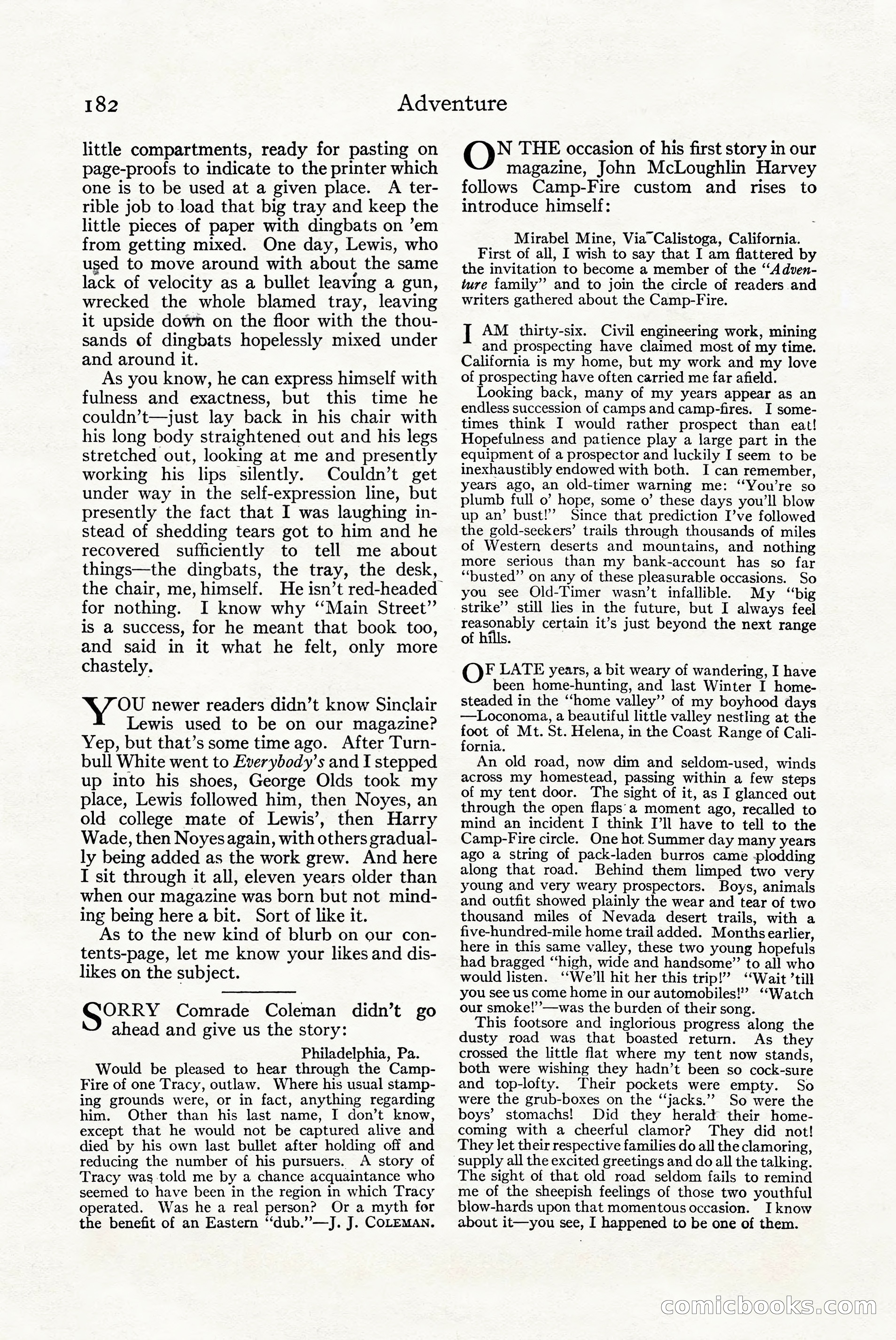
A restored page from Pulp Fiction, 1922. Page through the whole issue in the reader above.
📄 Transcribed text from this page (OCR, searchable)
Machine-transcribed from the original scan — historical spelling and the odd misread are preserved.
182 little compartments, ready for pasting on page-proofs to indicate to the printer which one is to be used at a given place. A ter- rible job to load that big tray and keep the little pieces of paper with dingbats on ’em from getting mixed. One day, Lewis, who used to move around with about the same lack of velocity as a bullet leaving a gun, wrecked the whole blamed tray, leaving it upside down on the floor with the thou- sands of dingbats hopelessly mixed under and around it. As you know, he can express himself with fulness and exactness, but this time he couldn’t—just lay back in his chair with his long body straightened out and his legs stretched out, looking at me and presently working his lips silently. Couldn’t get under way in the self-expression line, but presently the fact that I was laughing in- stead of shedding tears got to him and he recovered sufficiently to tell me about things—the dingbats, the tray, the desk, the chair, me, himself. He isn’t red-headed for nothing. I know why ‘Main Street” is a success, for he meant that book too, and said in it what he felt, only more chastely. OU newer readers didn’t know Sinclair Lewis used to be on our magazine? Yep, but that’s some time ago. After Turn- bull White went to Everybody’s and I stepped up into his shoes, George Olds took my place, Lewis followed him, then Noyes, an old college mate of Lewis’, then Harry Wade, then Noyes again, with others gradual- ly being added as the work grew. And here I sit through it all, eleven years older than when our magazine was born but not mind- ing being here a bit. Sort of like it. As to the new kind of blurb on our con- tents-page, let me know your likes and dis- likes on the subject. ORRY Comrade Coleman didn’t go ahead and give us the story: Philadelphia, Pa. Would be pleased to hear through the Camp- Fire of one Tracy, outlaw. Where his usual stamp- ing grounds were, or in fact, anything regarding him. Other than his last name, I don’t know, except that he would not be captured alive and died by his own last bullet after holding off and reducing the number of his pursuers. <A story of Tracy wag -told me by a chance acquaintance who seemed to have been in the region in which Tracy operated. Was he a real person? Or a myth for the benefit of an Eastern “‘dub.”’—J. J. COLEMAN. Adventure ON THE occasion of his first story in our magazine, John McLoughlin Harvey follows Camp-Fire custom and rises to introduce himself: Mirabel Mine, Via Calistoga, California. First of all, I wish to say that I am flattered by the invitation to become a member of the ‘‘A dven- ture family” and to join the circle of readers and writers gathered about the Camp-Fire. AM thirty-six. Civil engineering work, mining and prospecting have claimed most of my time. California is my home, but my work and my love of prospecting have often carried me far afield. Looking back, many of my years appear as an endless succession of camps and camp-fires. I some- times think I would rather prospect than eat! Hopefulness and patience play a large part in the equipment of a prospector and luckily I seem to be inexhaustibly endowed with both. I can remember, years ago, an old-timer warning me: ‘‘You’re so plumb full o’ hope, some o’ these days you’ll blow up an’ bust!’ Since that prediction I’ve followed the gold-seekers’ trails through thousands of miles of Western deserts and mountains, and nothing more serious than my bank-account has so far ‘““‘busted”’ on any of these pleasurable occasions. So you see Old-Timer wasn’t infallible. My “big strike” still lies in the future, but I always feel reasonably certain it’s just beyond the next range of hills. OF LATE years, a bit weary of wandering, I have been home-hunting, and last Winter I home- steaded in the “home valley” of my boyhood days —Loconoma, a beautiful little valley nestling at the foot of Mt. St. Helena, in the Coast Range of Cali- fornia. An old road, now dim and seldom-used, winds across my homestead, passing within a few steps of my tent door. The sight of it, as I glanced out through the open flaps’'a moment ago, recalled to mind an incident I think I’ll have to tell to the Camp-Fire circle. One hot Summer day many years ago a string of pack-laden burros came plodding along that road. Behind them limped two very young and very weary prospectors. Boys, animals and outfit showed plainly the wear and tear of two thousand miles of Nevada desert trails, with a five-hundred-mile home trail added. Months earlier, here in this same valley, these two young hopefuls had bragged “high, wide and handsome’’ to all who would listen. ‘‘We’ll hit her this trip!”? “Wait ’till you see us come home in our automobiles!” ‘“Watch our smoke!’’—was the burden of their song. This footsore and inglorious progress along the dusty road was that boasted return. As they crossed the little flat where my tent now stands, both were wishing they hadn’t been so cock-sure and top-lofty. Their pockets were empty. So were the grub-boxes on the ‘‘jacks.”? So were the boys’ stomachs! Did they herald their home- coming with a cheerful clamor? They did not! They Jet their respective families do all the clamoring, ‘supply all the excited greetings and do all the talking. The sight of that old road seldom fails to remind me of the sheepish feelings of those two youthful blow-hards upon that momentous occasion. I know about it—you see, I happened to be one of them. DOO (©