
Pulp Fiction, 1922 · page 191 of 204
Adventure Magazine Cover — page 191: what you’re looking at
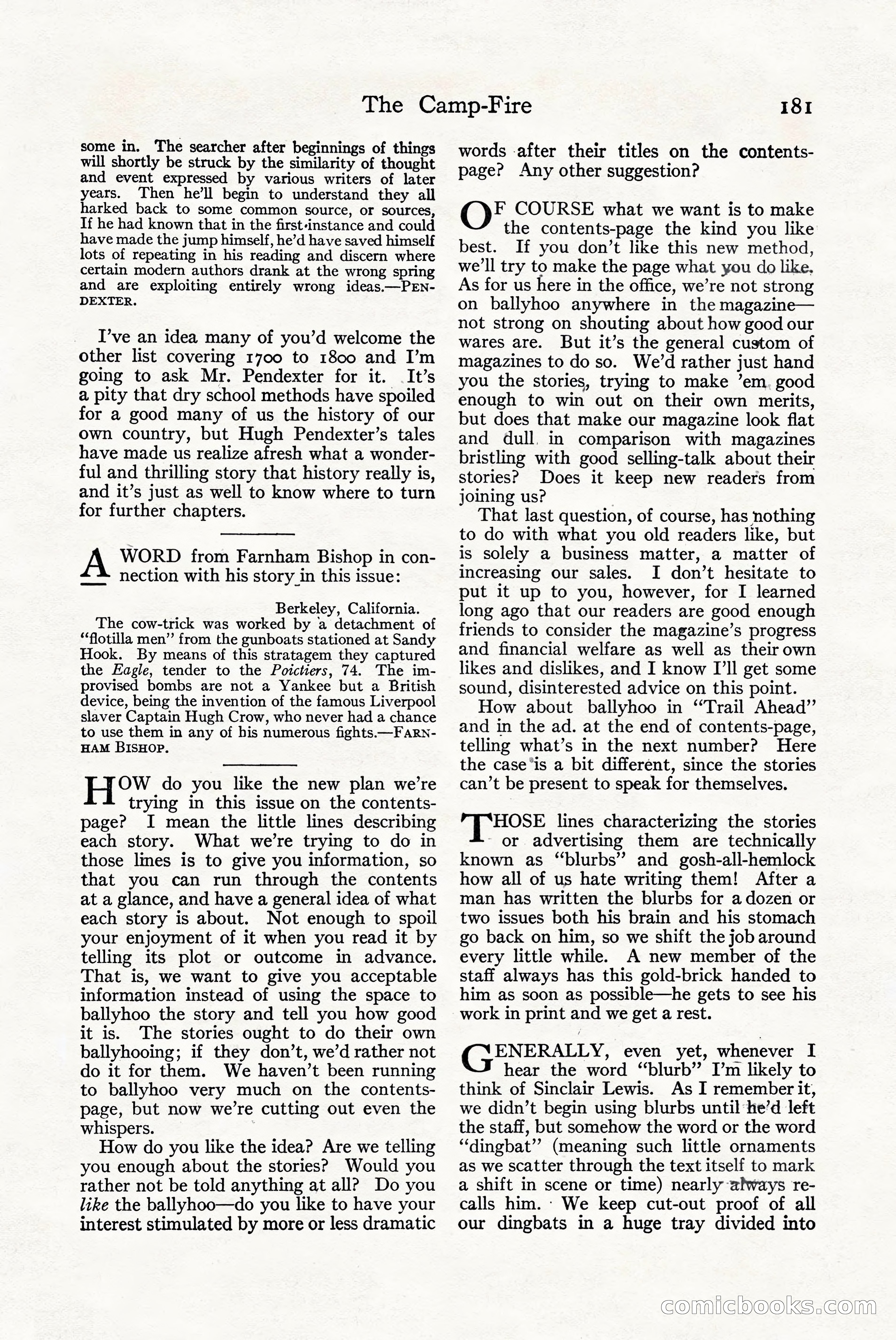
A restored page from Pulp Fiction, 1922. Page through the whole issue in the reader above.
📄 Transcribed text from this page (OCR, searchable)
Machine-transcribed from the original scan — historical spelling and the odd misread are preserved.
The Camp-Fire some in. The searcher after beginnings of things will shortly be struck by the similarity of thought and event expressed by various writers of later years. Then he’ll begin to understand they all harked back to some common source, or sources, If he had known that in the first-instance and could have made the jump himself, he’d have saved himself lots of repeating in his reading and discern where certain modern authors drank at the wrong spring and are exploiting entirely wrong ideas.—PEN- DEXTER. I’ve an idea many of you’d welcome the other list covering 1700 to 1800 and I’m going to ask Mr. Pendexter for it. It’s a pity that dry school methods have spoiled for a good many of us the history of our own country, but Hugh Pendexter’s tales have made us realize afresh what a wonder- ful and thrilling story that history really is, and it’s just as well to know where to turn for further chapters. Berkeley, California. The cow-trick was worked by a detachment of “flotilla men” from the gunboats stationed at Sandy Hook. By means of this stratagem they captured the Eagle, tender to the Poictiers, 74. The im- provised bombs are not a Yankee but a British device, being the invention of the famous Liverpool slaver Captain Hugh Crow, who never had a chance to use them in any of his numerous fights.—FARN- HAM BISHOP. Hew do you like the new plan we’re trying in this issue on the contents- page? I mean the little lines describing each story. What we’re trying to do in those lines is to give you information, so that you can run through the contents at a glance, and have a general idea of what each story is about. Not enough to spoil your enjoyment of it when you read it by telling its plot or outcome in advance. That is, we want to give you acceptable information instead of using the space to ballyhoo the story and tell you how good it is. The stories ought to do their own ballyhooing; if they don’t, we’d rather not do it for them. We haven’t been running to ballyhoo very much on the contents- page, but now we’re cutting out even the whispers. How do you like the idea? Are we telling you enough about the stories? Would you rather not be told anything at all? Do you like the ballyhoo—do you like to have your interest stimulated by more or less dramatic WORD from Farnham Bishop in con- nection with his story in this issue: 181 words after their titles on the contents- page? Any other suggestion? F COURSE what we want is to make the contents-page the kind you like best. If you don’t like this new method, we'll try to make the page what you do like, As for us here in the office, we’re not strong on ballyhoo anywhere in the magazine— not strong on shouting about how good our wares are. But it’s the general custom of magazines to do so. We’d rather just hand you the stories, trying to make ’em. good enough to win out on their own merits, but does that make our magazine look flat and dull. in comparison with magazines bristling with good selling-talk about their stories? Does it keep new readers from joining us? That last question, of course, has nothing to do with what you old readers like, but is solely a business matter, a matter of increasing our sales. I don’t hesitate to put it up to you, however, for I learned long ago that our readers are good enough friends to consider the magazine’s progress and financial welfare as well as their own likes and dislikes, and I know I’ll get some sound, disinterested advice on this point. How about ballyhoo in “Trail Ahead’’ and in the ad. at the end of contents-page, telling what’s in the next number? Here the case‘is a bit different, since the stories can’t be present to speak for themselves. ap HOSe lines characterizing the stories - or advertising them are technically known as “blurbs” and gosh-all-hemlock how all of us hate writing them! After a man has written the blurbs for a dozen or two issues both his brain and his stomach go back on him, so we shift the job around every little while. A new member of the staff always has this gold-brick handed to him as soon as possible—he gets to see his work in print and we get a rest. Ce even yet, whenever I hear the word “blurb” I’m likely to think of Sinclair Lewis. As I remember it, we didn’t begin using blurbs until he’d left the staff, but somehow the word or the word “dingbat” (meaning such little ornaments as we scatter through the text itself to mark a shift in scene or time) nearly always re- calls him. : We keep cut-out proof of all our dingbats in a huge tray divided into 1DOO C@