
Pulp Fiction, 1922 · page 193 of 204
Adventure Magazine Cover — page 193: what you’re looking at
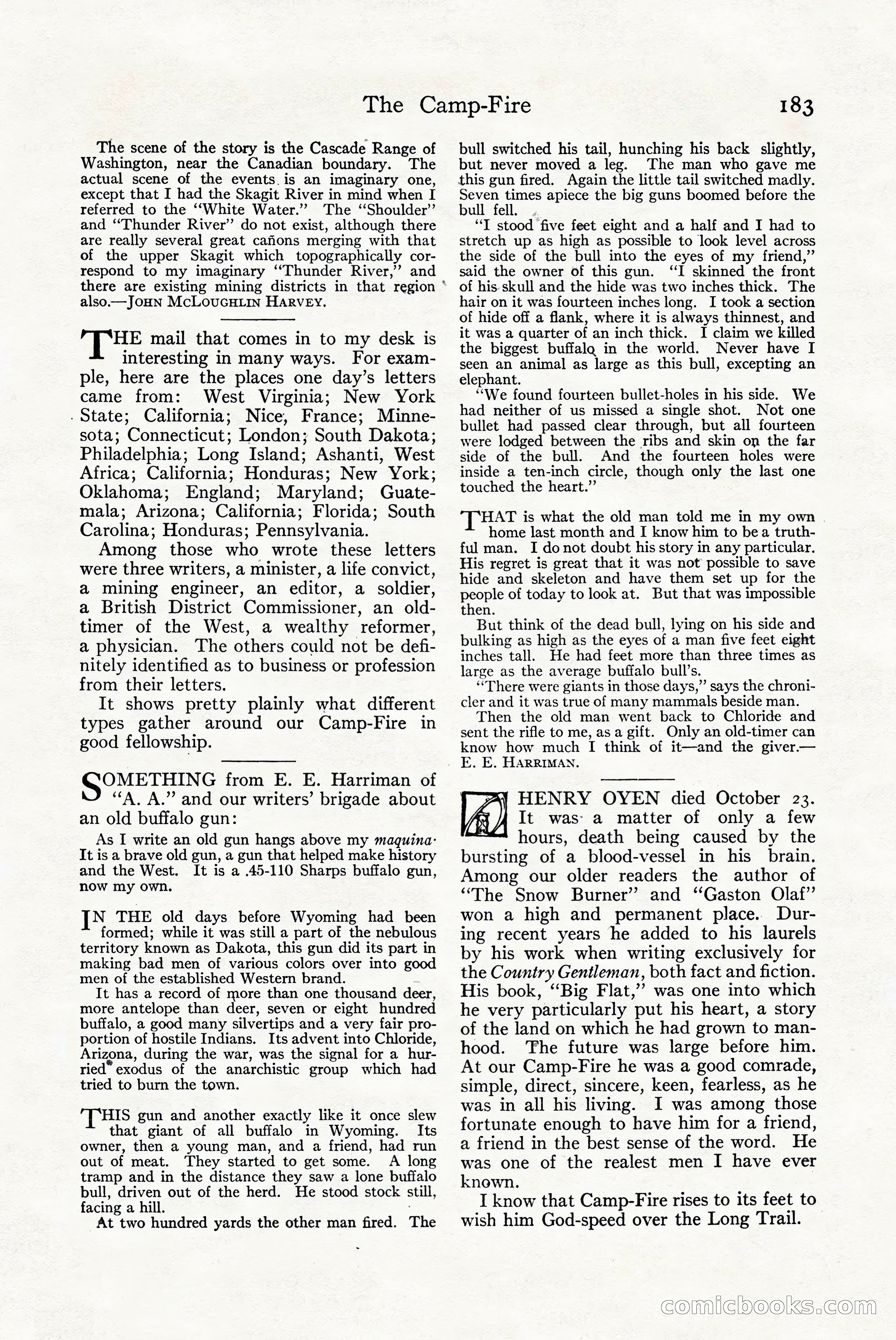
A restored page from Pulp Fiction, 1922. Page through the whole issue in the reader above.
📄 Transcribed text from this page (OCR, searchable)
Machine-transcribed from the original scan — historical spelling and the odd misread are preserved.
The Camp-Fire The scene of the story is the Cascade Range of Washington, near the Canadian boundary. The actual scene of the events.is an imaginary one, except that I had the Skagit River in mind when I referred to the ‘‘White Water.” The ‘Shoulder’ and ‘‘Thunder River’ do not exist, although there are really several great cafions merging with that of the upper Skagit which topographically cor- respond to my imaginary ‘‘Thunder River,” and there are existing mining districts in that region ‘ also. JoHN McLouGHLIN HARVEY. "TH mail that comes in to my desk is interesting in many ways. For exam- ple, here are the places one day’s letters came from: West Virginia; New York . State; California; Nice, France; Minne- sota; Connecticut; London; South Dakota; Philadelphia; Long Island; Ashanti, West Africa; California; Honduras; New York; Oklahoma; England; Maryland; Guate- mala; Arizona; California; Florida; South Carolina; Honduras; Pennsylvania. Among those who wrote these letters were three writers, a minister, a life convict, a mining engineer, an editor, a soldier, a British District Commissioner, an old- timer of the West, a wealthy reformer, a physician. The others could not be defi- nitely identified as to business or profession from their letters. It shows pretty plainly what different types gather around our Camp-Fire in good fellowship. OMETHING from E. E. Harriman of ‘“‘A. A.” and our writers’ brigade about an old buffalo gun: As I write an old gun hangs above my maquina: It is a brave old gun, a gun that helped make history and the West. It is a .45-110 Sharps buffalo gun, now my own. IN THE old days before Wyoming had been formed; while it was still a part of the nebulous territory known as Dakota, this gun did its part in making bad men of various colors over into good men of the established Western brand. It has a record of more than one thousand deer, more antelope than deer, seven or eight hundred buffalo, a good many silvertips and a very fair pro- portion of hostile Indians. Its advent into Chloride, Arizona, during the war, was the signal for a hur- ried” exodus of the anarchistic group which had tried to burn the town. ‘THIS gun and another exactly like it once slew that giant of all buffalo in Wyoming. Its owner, then a young man, and a friend, had run out of meat. They started to get some. A long tramp and in the distance they saw a lone buffalo bull, driven out of the herd. He stood stock still, facing a hill. At two hundred yards the other man fired. The 183 bull switched his tail, hunching his back slightly, but never moved a leg. The man who gave me this gun fired. Again the little tail switched madly. Seven times apiece the big guns boomed before the bull fell. | “IT stood five feet eight and a half and I had to stretch up as high as possible to look level across the side of the bull into the eyes of my friend,” said the owner of this gun. “I skinned the front of his.skull and the hide was two inches thick. The hair on it was fourteen inches long. I took a section of hide off a flank, where it is always thinnest, and it was a quarter of an inch thick. I claim we killed the biggest buffala in the world. Never have I seen an animal as large as this bull, excepting an elephant. ‘‘We found fourteen bullet-holes in his side. We had neither of us missed a single shot. Not one bullet had passed clear through, but all fourteen were lodged between the ribs and skin on the far side of the bull. And the fourteen holes were inside a ten-inch circle, though only the last one touched the heart.” "THAT is what the old man told me in my own . home last month and I know him to be a truth- ful man. I donot doubt his story in any particular. His regret is great that it was not possible to save hide and skeleton and have them set up for the people of today to look at. But that was impossible then. But think of the dead bull, lying on his side and bulking as high as the eyes of a man five feet eight inches tall. He had feet more than three times as large as the average buffalo bull’s. ‘There were giants in those days,” says the chroni- cler and it was true of many mammals beside man. Then the old man went back to Chloride and sent the rifle to me, as a gift. Only an old-timer can know how much I think of it—and the giver.— E. E. HARRIMAN. Pr It was: a matter of only a few rf hours, death being caused by the bursting of a blood-vessel in his_ brain. Among our older readers the author of “The Snow Burner” and “Gaston Olaf” won a high and permanent place. Dur- ing recent years he added to his laurels by his work when writing exclusively for the Country Gentleman, both fact and fiction. His book, “‘Big Flat,’’ was one into which he very particularly put his heart, a story of the land on which he had grown to man- hood. ‘The future was large before him. At our Camp-Fire he was a good comrade, simple, direct, sincere, keen, fearless, as he was in all his living. I was among those fortunate enough to have him for a friend, a friend in the best sense of the word. He was one of the realest men I have ever known. I know that Camp-Fire rises to its feet to wish him God-speed over the Long Trail. HENRY OYEN died October 23. DOO C@