
Pulp Fiction, 1921 · page 191 of 204
Adventure Magazine Cover, June 18, 1921 — page 191: what you’re looking at
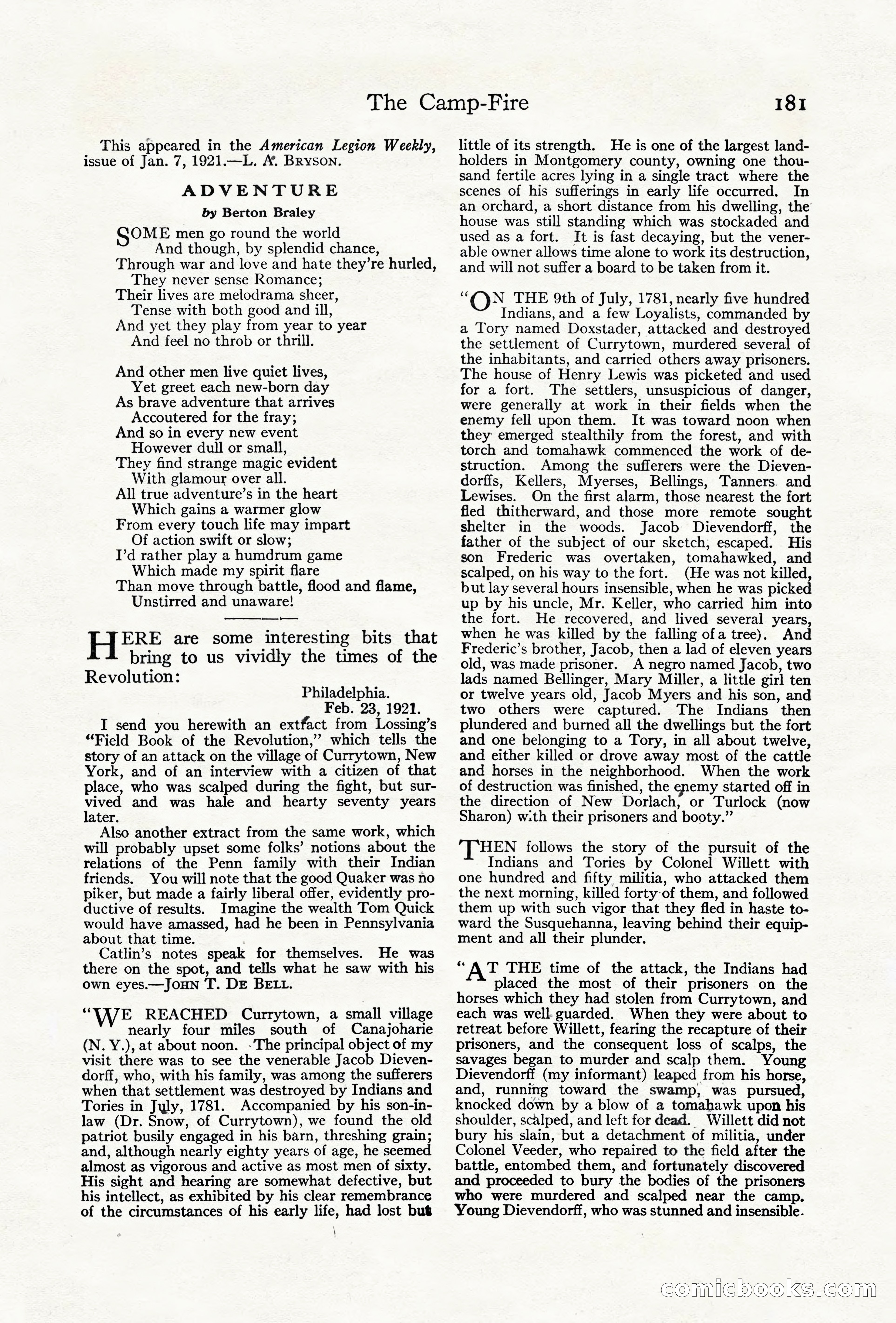
A restored page from Pulp Fiction, 1921. Page through the whole issue in the reader above.
📄 Transcribed text from this page (OCR, searchable)
Machine-transcribed from the original scan — historical spelling and the odd misread are preserved.
The Camp-Fire This appeared in the American Legion Weekly, issue of Jan. 7, 1921.—L. AY. Bryson. ADVENTURE by Berton Braley SOME men go round the world And though, by splendid chance, Through war and love and hate they’re hurled, They never sense Romance; Their lives are melodrama sheer, Tense with both good and ill, And yet they play from year to year And feel no throb or thrill. And other men live quiet lives, Yet greet each new-born day As brave adventure that arrives Accoutered for the fray; And so in every new event However dull or small, They find strange magic evident With glamour over all. All true adventure’s in the heart Which gains a warmer glow From every touch life may impart Of action swift or slow; I’d rather play a humdrum game Which made my spirit flare Than move through battle, flood and flame, Unstirred and unaware! HERE are some interesting bits that bring to us vividly the times of the Revolution: Philadelphia. Feb. 23, 1921. I send you herewith an extfact from Lossing’s “Field Book of the Revolution,” which tells the story of an attack on the village of Currytown, New York, and of an interview with a citizen of that place, who was scalped during the fight, but sur- vived and was hale and hearty seventy years later. Also another extract from the same work, which will probably upset some folks’ notions about the relations of the Penn family with their Indian friends. You will note that the good Quaker was no piker, but made a fairly liberal offer, evidently pro- ductive of results. Imagine the wealth Tom Quick would have amassed, had he been in Pennsylvania about that time. Catlin’s notes speak for themselves. He was there on the spot, and tells what he saw with his own eyes.—JOHN T. DE BELL. “WE REACHED Currytown, a small village nearly four miles south of Canajoharie (N. Y.), at about noon. -The principal object of my visit there was to see the venerable Jacob Dieven- dorff, who, with his family, was among the sufferers when that settlement was destroyed by Indians and Tories in Jyly, 1781. Accompanied by his son-in- law (Dr. Snow, of Currytown), we found the old patriot busily engaged in his barn, threshing grain; and, although nearly eighty years of age, he seemed almost as vigorous and active as most men of sixty. His sight and hearing are somewhat defective, but his intellect, as exhibited by his clear remembrance of the circumstances of his early life, had lost but \ 181 little of its strength. He is one of the largest land- holders in Montgomery county, owning one thou- sand fertile acres lying in a single tract where the scenes of his sufferings in early life occurred. In an orchard, a short distance from his dwelling, the house was still standing which was stockaded and used as a fort. It is fast decaying, but the vener- able owner allows time alone to work its destruction, and will not suffer a board to be taken from it. “C)YN THE 9th of July, 1781, nearly five hundred Indians, and a few Loyalists, commanded by a Tory named Doxstader, attacked and destroyed the settlement of Currytown, murdered several of the inhabitants, and carried others away prisoners. The house of Henry Lewis was picketed and used for a fort. The settlers, unsuspicious of danger, were generally at work in their fields when the enemy fell upon them. It was toward noon when they emerged stealthily from the forest, and with torch and tomahawk commenced the work of de- struction. Among the sufferers were the Dieven- dorffs, Kellers, Myerses, Bellings, Tanners. and Lewises. On the first alarm, those nearest the fort fled thitherward, and those more remote sought shelter in the woods. Jacob Dievendorff, the father of the subject of our sketch, escaped. His son Frederic was overtaken, tomahawked, and scalped, on his way to the fort. (He was not killed, but lay several hours insensible, when he was picked up by his uncle, Mr. Keller, who carried him into the fort. He recovered, and lived several years, when he was killed by the falling ofa tree). And Frederic’s brother, Jacob, then a lad of eleven years old, was made prisoner. A negro named Jacob, two lads named Bellinger, Mary Miller, a little girl ten or twelve years old, Jacob Myers and his son, and two others were captured. The Indians then plundered and burned all the dwellings but the fort and one belonging to a Tory, in all about twelve, and either killed or drove away most of the cattle and horses in the neighborhood. When the work of destruction was finished, the enemy started off in the direction of New Dorlach, or Turlock (now Sharon) w:th their prisoners and booty.” "THEN follows the story of the pursuit of the Indians and Tories by Colonel Willett with one hundred and fifty militia, who attacked them the next morning, killed forty:of them, and followed them up with such vigor that they fled in haste to- ward the Susquehanna, leaving behind their equip- ment and all their plunder. “AT THE time of the attack, the Indians had placed the most of their prisoners on the horses which they had stolen from Currytown, and each was well- guarded. When they were about to retreat before Willett, fearing the recapture of their prisoners, and the consequent loss of scalps, the savages began to murder and scalp them. Young Dievendorff (my informant) leaped from his horse, and, running toward the swamp, was pursued, knocked down by a blow of a tomahawk upon his shoulder, scalped, and left for dead. Willett did not bury his slain, but a detachment of militia, under Colonel Veeder, who repaired to the field after the battle, entombed them, and fortunately discovered and proceeded to bury the bodies of the prisoners who were murdered and scalped near the camp. Young Dievendorff, who was stunned and insensible. COmicloo S|