
Pulp Fiction, 1921 · page 192 of 204
Adventure Magazine Cover, June 18, 1921 — page 192: what you’re looking at
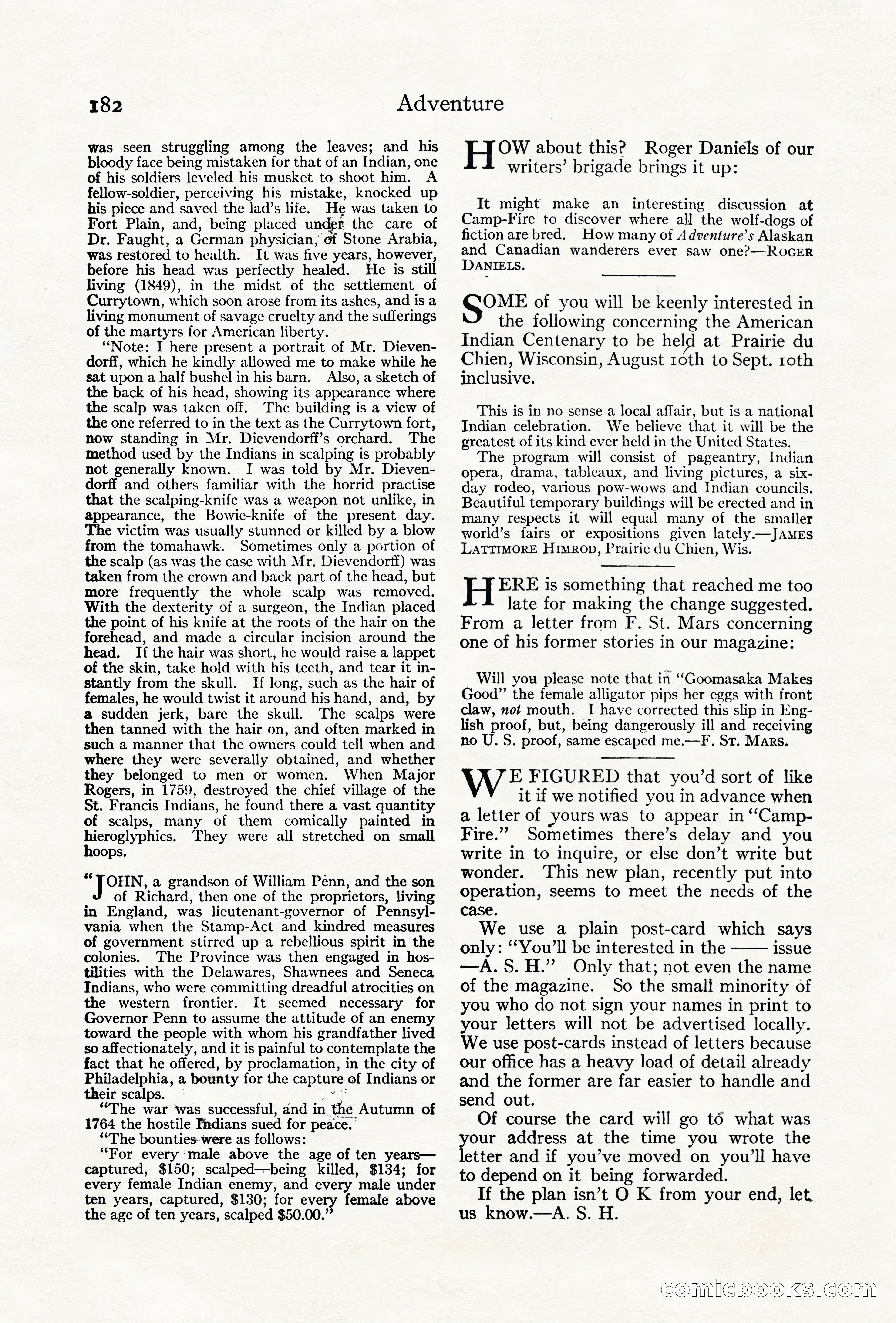
A restored page from Pulp Fiction, 1921. Page through the whole issue in the reader above.
📄 Transcribed text from this page (OCR, searchable)
Machine-transcribed from the original scan — historical spelling and the odd misread are preserved.
182 was seen struggling among the leaves; and his bloody face being mistaken for that of an Indian, one of his soldiers leveled his musket to shoot him. A fellow-soldier, perceiving his mistake, knocked up his piece and saved the lad’s life. He was taken to Fort Plain, and, being placed under the care of Dr. Faught, a German physician, of Stone Arabia, was restored to health. It was five years, however, before his head was perfectly healed. He is still living (1849), in the midst of the settlement of Currytown, which soon arose from its ashes, and is a living monument of savage cruelty and the sufferings of the martyrs for American liberty. “Note: I here present a portrait of Mr. Dieven- dorff, which he kindly allowed me to make while he sat upon a half bushel in his barn. Also, a sketch of the back of his head, showing its appearance where the scalp was taken off. The building is a view of the one referred to in the text as the Currytown fort, now standing in Mr. Dievendorff’s orchard. The method used by the Indians in scalping is probably not generally known. I was told by Mr. Dieven- dorff and others familiar with the horrid practise that the scalping-knife was a weapon not unlike, in appearance, the Bowie-knife of the present day. The victim was usually stunned or killed by a blow from the tomahawk. Sometimes only a portion of the scalp (as was the case with Mr. Dievendorff) was taken from the crown and back part of the head, but more frequently the whole scalp was removed. With the dexterity of a surgeon, the Indian placed the point of his knife at the roots of the hair on the forehead, and made a circular incision around the head. If the hair was short, he would raise a lappet of the skin, take hold with his teeth, and tear it in- stantly from the skull. If long, such as the hair of females, he would twist it around his hand, and, by a sudden jerk, bare the skull. The scalps were then tanned with the hair on, and often marked in such a manner that the owners could tell when and where they were severally obtained, and whether they belonged to men or women. When Major Rogers, in 1759, destroyed the chief village of the St. Francis Indians, he found there a vast quantity of scalps, many of them comically painted in hieroglyphics. ‘They were all stretched on small hoops. "J OBN, a grandson of William Penn, and the son of Richard, then one of the proprietors, living in England, was lieutenant-governor of Pennsyl- vania when the Stamp-Act and kindred measures of government stirred up a rebellious spirit in the colonies. The Province was then engaged in hos- tilities with the Delawares, Shawnees and Seneca Indians, who were committing dreadful atrocities on the western frontier. It seemed necessary for Governor Penn to assume the attitude of an enemy toward the people with whom his grandfather lived so affectionately, and it is painful to contemplate the fact that he offered, by proclamation, in the city of Philadelphia, a bounty for the capture of Indians or their scalps. — oe “The war was successful, and in the Autumn of 1764 the hostile Indians sued for peace. “The bounties were as follows: “For every ‘male above the age of ten years— captured, $150; scalped—being killed, $134; for every female Indian enemy, and every male under ten years, captured, $130; for every female above the age of ten years, scalped $50.00.” Adventure jg ow about this? Roger Daniels of our writers’ brigade brings it up: It might make an interesting discussion at Camp-Fire to discover where all the wolf-dogs of fiction are bred. How many of Adventure’s Alaskan and Canadian wanderers ever saw one?—ROGER DANIELS, eaten of you will be keenly interested in the following concerning the American Indian Centenary to be held at Prairie du Chien, Wisconsin, August 10th to Sept. roth inclusive. This is in no sense a local affair, but is a national Indian celebration. We believe that it will be the greatest of its kind ever held in the United States. The program will consist of pageantry, Indian opera, drama, tableaux, and living pictures, a six- day rodeo, various pow-wows and Indian councils. Beautiful temporary buildings will be erected and in many respects it will equal many of the smaller world’s fairs or expositions given lately.— JAMES LATTIMORE HimMRop, Prairie du Chien, Wis. jg ioe is something that reached me too late for making the change suggested. From a letter from F. St. Mars concerning one of his former stories in our magazine: Will you please note that in ‘“Goomasaka Makes Good” the female alligator pips her eggs with front claw, not mouth. I have corrected this slip in Eng- lish proof, but, being dangerously ill and receiving no U.S. proof, same escaped me.—F. St. Mars. WE FIGURED that you’d sort of like it if we notified you in advance when a letter of yours was to appear in “Camp- Fire.”” Sometimes there’s delay and you write in to inquire, or else don’t write but wonder. ‘This new plan, recently put into operation, seems to meet the needs of the case. We use a plain post-card which says only: ‘‘You’ll be interested in the issue —A.S.H.” Only that; not even the name of the magazine. So the small minority of you who do not sign your names in print to your letters will not be advertised locally. We use post-cards instead of letters because our office has a heavy load of detail already and the former are far easier to handle and send out. Of course the card will go t6 what was your address at the time you wrote the letter and if you’ve moved on you'll have to depend on it being forwarded. If the plan isn’t O K from your end, let. us know.—A. S. H. COmiclboo CO