
Pulp Fiction, 1921 · page 190 of 204
Adventure Magazine Cover, June 18, 1921 — page 190: what you’re looking at
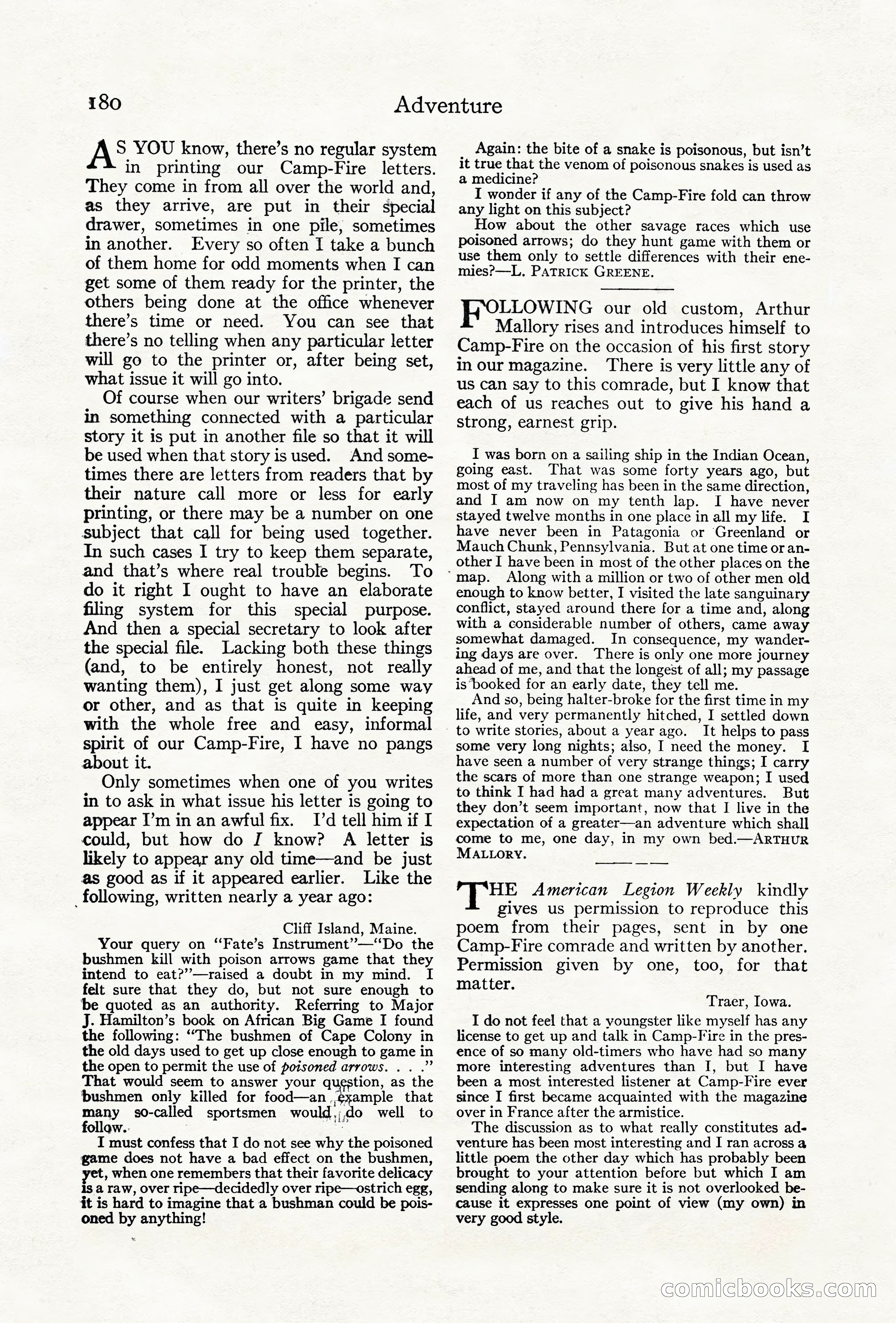
A restored page from Pulp Fiction, 1921. Page through the whole issue in the reader above.
📄 Transcribed text from this page (OCR, searchable)
Machine-transcribed from the original scan — historical spelling and the odd misread are preserved.
180 A° YOU know, there’s no regular system in printing our Camp-Fire letters. They come in from all over the world and, as they arrive, are put in their special drawer, sometimes in one pile, sometimes in another. Every so often I take a bunch of them home for odd moments when I can get some of them ready for the printer, the others being done at the office whenever there’s time or need. You can see that there’s no telling when any particular letter will go to the printer or, after being set, what issue it will go into. Of course when our writers’ brigade send in something connected with a particular story it is put in another file so that it will be used when that story is used. And some- times there are letters from readers that by their nature call more or less for early printing, or there may be a number on one subject that call for being used together. In such cases I try to keep them separate, and that’s where real trouble begins. To do it right I ought to have an elaborate filing system for this special purpose. And then a special secretary to look after the special file. Lacking both these things (and, to be entirely honest, not really wanting them), I just get along some way or other, and as that is quite in keeping with the whole free and easy, informal spirit of our Camp-Fire, I have no pangs about it. Only sometimes when one of you writes in to ask in what issue his letter is going to appear I’m in an awful fix. I'd tell himif I could, but how do J know? A letter is likely to appear any old time—and be just as good as if it appeared earlier. Like the following, written nearly a year ago: Cliff Island, Maine. Your query on ‘‘Fate’s Instrument”—‘Do the bushmen kill with poison arrows game that they intend to eat?’’—raised a doubt in my mind. I felt sure that they do, but not sure enough to be quoted as an authority. Referring to Major J. Hamilton’s book on African Big Game I found the following: ““The bushmen of Cape Colony in the old days used to get up close enough to game in the open to permit the use of poisoned arrows. . . .”’ That would seem to answer your question, as the bushmen only killed for food—an example that many so-called sportsmen would,;do well to follow.. ; I must confess that I do not see why the poisoned game does not have a bad effect on the bushmen, yet, when one remembers that their favorite delicacy 1s a raw, over ripe—decidedly over ripe—ostrich egg, it is hard to imagine that a bushman could be pois- oned by anything! - to write stories, about a year ago. Adventure Again: the bite of a snake is poisonous, but isn’t it true that the venom of poisonous snakes is used as a medicine? I wonder if any of the Camp-Fire fold can throw any light on this subject? How about the other savage races which use poisoned arrows; do they hunt game with them or use them only to settle differences with their ene- miesP—L,. PATRICK GREENE. ONG our old custom, Arthur Mallory rises and introduces himself to Camp-Fire on the occasion of his first story in our magazine. There is very little any of us can say to this comrade, but I know that each of us reaches out to give his hand a strong, earnest grip. I was born on a sailing ship in the Indian Ocean, going east. That was some forty years ago, but most of my traveling has been in the same direction, and I am now on my tenth lap. I have never stayed twelve months in one place in all my life. I have never been in Patagonia or Greenland or Mauch Chunk, Pennsylvania. But at one time or an- other I have been in most of the other places on the ‘map. Along with a million or two of other men old enough to know better, I visited the late sanguinary conflict, stayed around there for a time and, along with a considerable number of others, came away somewhat damaged. In consequence, my wander- ing days are over. There is only one more journey ahead of me, and that the longest of all; my passage is booked for an early date, they tell me. And so, being halter-broke for the first time in my life, and very permanently hitched, I settled down It helps to pass some very long nights; also, I need the money. I have seen a number of very strange things; I carry the scars of more than one strange weapon; I used to think I had had a great many adventures. But they don’t seem important, now that I live in the expectation of a greater—an adventure which shall come to me, one day, in my own bed.—ARTHUR MALLOorY. —_ -_— rT HE American Legion Weekly kindly gives us permission to reproduce this poem from their pages, sent in by one Camp-Fire comrade and written by another. Permission given by one, too, for that matter. Traer, Iowa. I do not feel that a youngster like myself has any license to get up and talk in Camp-Fire in the pres- ence of so many old-timers who have had so many more interesting adventures than I, but I have been a most interested listener at Camp-Fire ever since I first became acquainted with the magazine over in France after the armistice. The discussion as to what really constitutes ad- venture has been most interesting and I ran across a little poem the other day which has probably been brought to your attention before but which I am sending along to make sure it is not overlooked be- cause it expresses one point of view (my own) in very good style. COmicloo S|