
Pulp Fiction, 1921 · page 189 of 204
Adventure Magazine Cover, June 18, 1921 — page 189: what you’re looking at
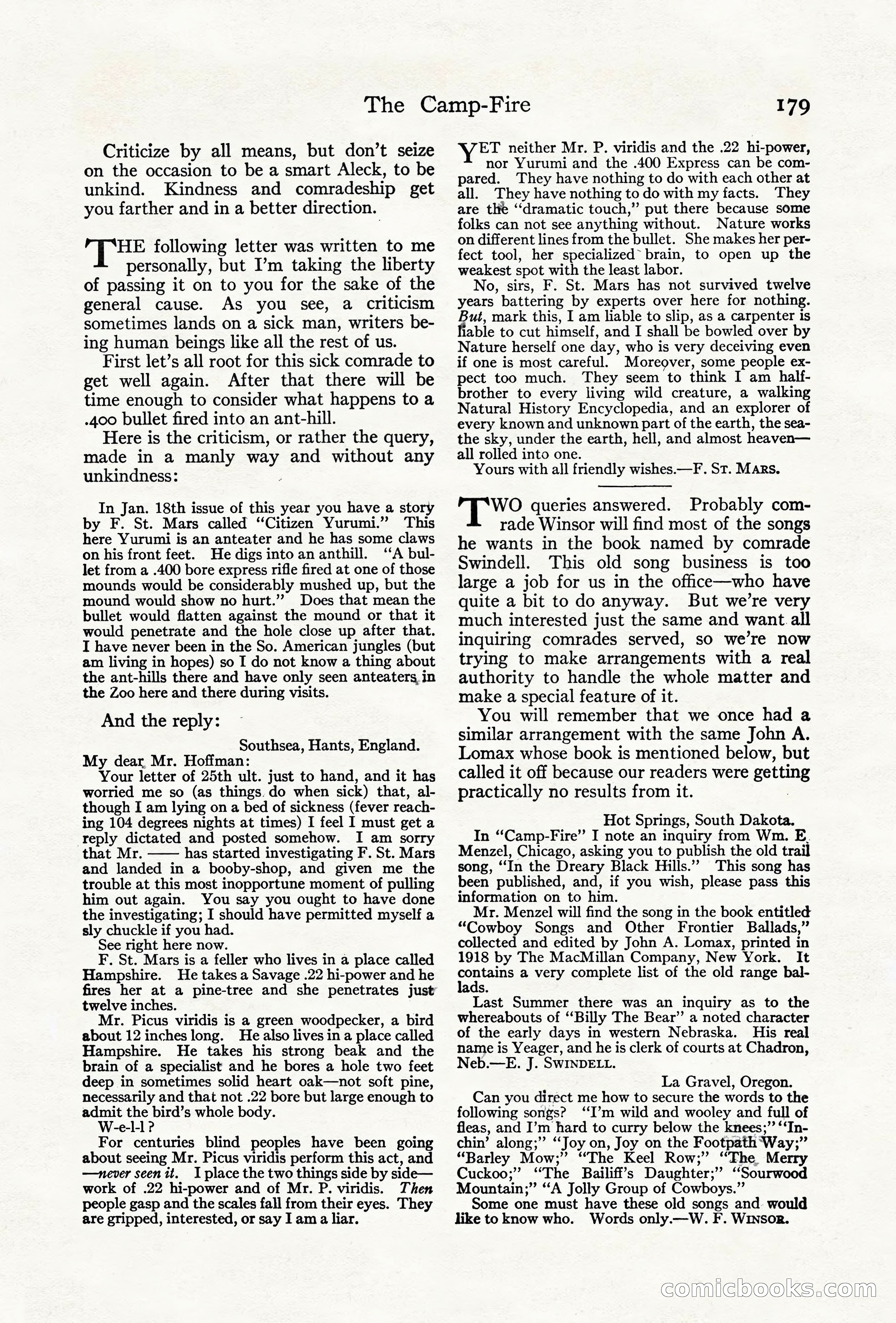
A restored page from Pulp Fiction, 1921. Page through the whole issue in the reader above.
📄 Transcribed text from this page (OCR, searchable)
Machine-transcribed from the original scan — historical spelling and the odd misread are preserved.
The Camp-Fire Criticize by all means, but don’t seize on the occasion to be a smart Aleck, to be unkind. Kindness and comradeship get you farther and in a better direction. Cpe following letter was written to me personally, but I’m taking the liberty of passing it on to you for the sake of the general cause. As you see, a criticism sometimes lands on a sick man, writers be- ing human beings like all the rest of us. First let’s all root for this sick comrade to get well again. After that there will be time enough to consider what happens to a .400 bullet fired into an ant-hill. Here is the criticism, or rather the query, made in a manly way and without any unkindness: In Jan. 18th issue of this year you have a story by F. St. Mars called “Citizen Yurumi.” This here Yurumi is an anteater and he has some claws on his front feet. He digs into an anthill. ‘A bul- let from a .400 bore express rifle fired at one of those mounds would be considerably mushed up, but the mound would show no hurt.” Does that mean the bullet would flatten against the mound or that it would penetrate and the hole close up after that. I have never been in the So. American jungles (but am living in hopes) so I do not know a thing about the ant-hills there and have only seen anteaters, in the Zoo here and there during visits. And the reply: Southsea, Hants, England. My dear Mr. Hoffman: Your letter of 25th ult. just to hand, and it has worried me so (as things. do when sick) that, al- though I am lying on a bed of sickness (fever reach- ing 104 degrees nights at times) I feel I must get a reply dictated and posted somehow. I am sorry that Mr. has started investigating F. St. Mars and landed in a booby-shop, and given me the trouble at this most inopportune moment of pulling him out again. You say you ought to have done the investigating; I should have permitted myself a sly chuckle if you had. See right here now. F. St. Mars is a feller who lives in a place called Hampshire. He takes a Savage .22 hi-power and he fires her at a pine-tree and she penetrates just twelve inches. Mr. Picus viridis is a green woodpecker, a bird about 12 inches long. He also lives in a place called Hampshire. He takes his strong beak and the brain of a specialist and he bores a hole two feet deep in sometimes solid heart oak—not soft pine, necessarily and that not .22 bore but large enough to admit the bird’s whole body. W-e-]-1 ? For centuries blind peoples have been going about seeing Mr. Picus viridis perform this act, and —never seenit. I place the two things side by side— work of .22 hi-power and of Mr. P. viridis. Then people gasp and the scales fall from their eyes. They are gripped, interested, or say I am a liar. 179 yet neither Mr. P. viridis and the .22 hi-power, nor Yurumi and the .400 Express can be com- pared. They have nothing to do with each other at all. They have nothing to do with my facts. They are thie “dramatic touch,” put there because some folks can not see anything without. Nature works on different lines from the bullet. She makes her per- fect tool, her specialized” brain, to open up the weakest spot with the least labor. No, sirs, F. St. Mars has not survived twelve years battering by experts over here for nothing. But, mark this, I am liable to slip, as a carpenter is fiable to cut himself, and I shall be bowled over by Nature herself one day, who is very deceiving even if one is most careful. Moreover, some people ex- pect too much. They seem to think I am half- brother to every living wild creature, a walking Natural History Encyclopedia, and an explorer of every known and unknown part of the earth, the sea- the sky, under the earth, hell, and almost heaven— all rolled into one. Yours with all friendly wishes.—F. St. Mars. Leo queries answered. Probably com- rade Winsor will find most of the songs he wants in the book named by comrade Swindell. This old song business is too large a job for us in the office—who have quite a bit to do anyway. But we’re very much interested just the same and want all inquiring comrades served, so we’re now trying to make arrangements with a real authority to handle the whole matter and make a special feature of it. You will remember that we once had a similar arrangement with the same John A. Lomax whose book is mentioned below, but called it off because our readers were Japle practically no results from it. Hot Springs, South Dakota. In “(Camp-Fire” I note an inquiry from Wm. E. Menzel, Chicago, asking you to publish the old trail song, “In the Dreary Black Hills.”” This song has been published, and, if you wish, please pass this information on to him. Mr. Menzel will find the song in the book entitled “Cowboy Songs and Other Frontier Ballads,” collected and edited by John A. Lomax, printed in 1918 by The MacMillan Company, New York. It lg a very complete list of the old range bal- ads. Last Summer there was an inquiry as to the whereabouts of “Billy The Bear” a noted character of the early days in western Nebraska. His real name is Yeager, and he is clerk of courts at Chadron, Neb.—E. J. SWINDELL. La Gravel, Oregon. Can you direct me how to secure the words to the following songs? ‘I’m wild and wooley and full of fleas, and I’m hard to curry below the knees;”’ “In- chin’ along;” “Joy on, Joy on the Footpath ‘Way; ag “Barley Mow;” “The Keel Row;” ‘The Merry Cuckoo. ” “The Bailiff’s Daughter; ” «“Sourwood Mountain; 3” “A Jolly Group of Cowboys.” Some one must have these old songs and. would like to know who. Words only.—W. F. Winsor. COmicloo S}