
Pulp Fiction, 1921 · page 158 of 204
Adventure Magazine Cover, June 18, 1921 — page 158: what you’re looking at
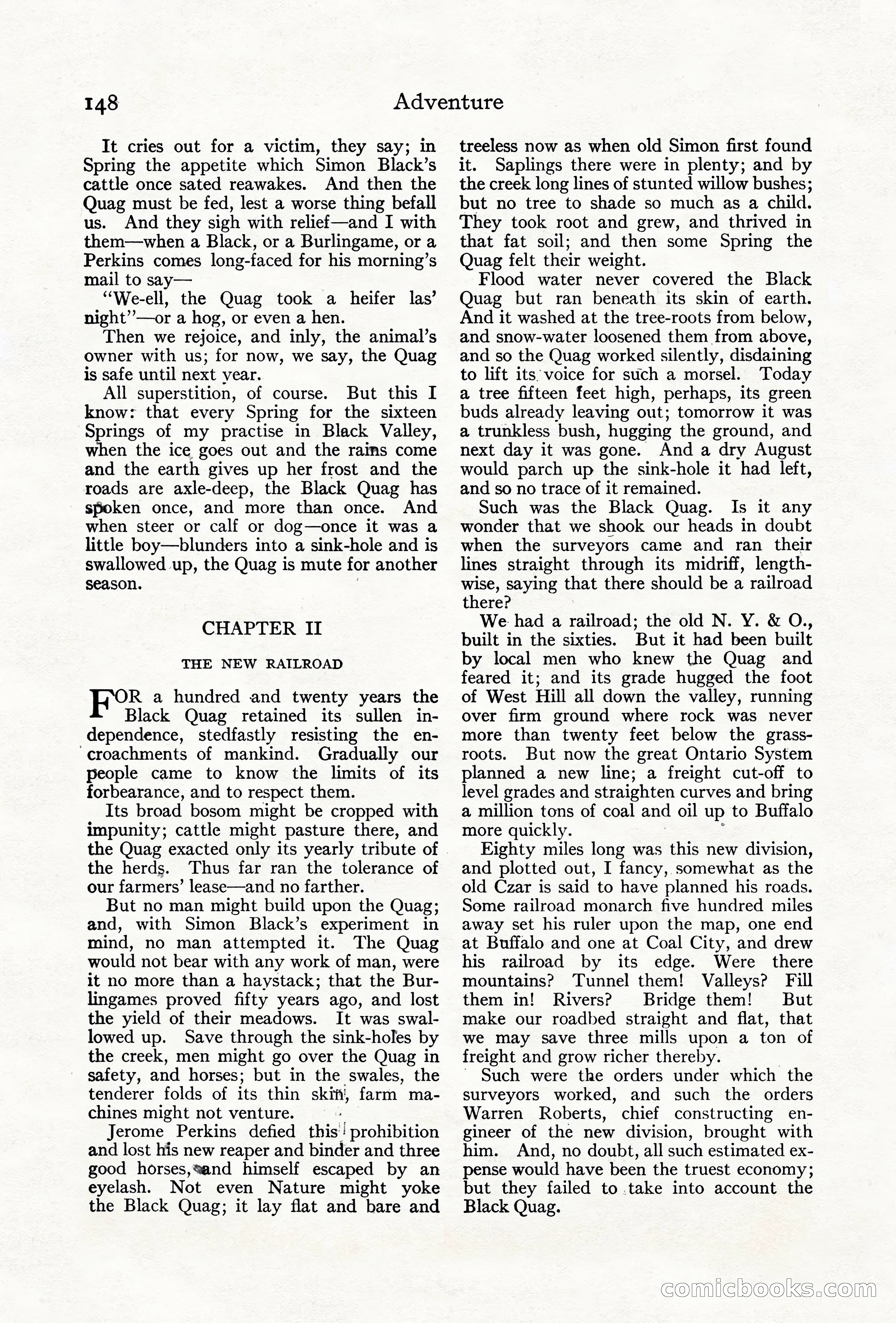
A restored page from Pulp Fiction, 1921. Page through the whole issue in the reader above.
📄 Transcribed text from this page (OCR, searchable)
Machine-transcribed from the original scan — historical spelling and the odd misread are preserved.
148 It cries out for a victim, they say; in Spring the appetite which Simon Black’s cattle once sated reawakes. And then the Quag must be fed, lest a worse thing befall us. And they sigh with relief—and I with them—when a Black, or a Burlingame, or a Perkins comes long-faced for his morning’s mail to say— “We-ell, the Quag took a heifer las’ night’’—or a hog, or even a hen. Then we rejoice, and inly, the animal’s owner with us; for now, we say, the Quag is safe until next vear. All superstition, of course. But this I know: that every Spring for the sixteen Springs of my practise in Black Valley, when the ice goes out and the rains come and the earth gives up her frost and the roads are axle-deep, the Black Quag has spoken once, and more than once. And when steer or calf or dog—once it was a little boy—blunders into a sink-hole and is swallowed up, the Quag is mute for another season. CHAPTER II THE NEW RAILROAD free a hundred and twenty years the Black Quag retained its sullen in- dependence, stedfastly resisting the en- croachments of mankind. Gradually our people came to know the limits of its forbearance, and to respect them. Its broad bosom might be cropped with impunity; cattle might pasture there, and the Quag exacted only its yearly tribute of . the herds. Thus far ran the tolerance of our farmers’ lease—and no farther. But no man might build upon the Quag; and, with Simon Black’s experiment in mind, no man attempted it. The Quag would not bear with any work of man, were it no more than a haystack; that the Bur- lingames proved fifty years ago, and lost the yield of their meadows. It was swal- lowed up. Save through the sink-holes by the creek, men might go over the Quag in ' safety, and horses; but in the swales, the tenderer folds of its thin skity, farm ma- chines might not venture. Jerome Perkins defied this! prohibition and lost his new reaper and binder and three good horses,8and himself escaped by an eyelash. Not even Nature might yoke the Black Quag; it lay flat and bare and Adventure treeless now as when old Simon first found it. Saplings there were in plenty; and by the creek long lines of stunted willow bushes; but no tree to shade so much as a child. They took root and grew, and thrived in that fat soil; and then some Spring the Quag felt their weight. Flood water never covered the Black Quag but ran beneath its skin of earth. And it washed at the tree-roots from below, and snow-water loosened them from above, and so the Quag worked silently, disdaining to lift its’ voice for such a morsel. Today a tree fifteen feet high, perhaps, its green buds already leaving out; tomorrow it was a trunkless bush, hugging the ground, and next day it was gone. And a dry August would parch up the sink-hole it had left, and so no trace of it remained. Such was the Black Quag. Is it any wonder that we shook our heads in doubt when the surveyors came and ran their lines straight through its midriff, length- wise, saying that there should be a railroad there? We had a railroad; the old N. Y. & O., built in the sixties. But it had been built by local men who knew the Quag and feared it; and its grade hugged the foot of West Hill all down the valley, running over firm ground where rock was never more than twenty feet below the grass- roots. But now the great Ontario System planned a new line; a freight cut-off to level grades and straighten curves and bring a million tons of coal and oil up to Buffalo more quickly. Eighty miles long was this new division, and plotted out, I fancy, somewhat as the old Czar is said to have planned his roads. Some railroad monarch five hundred miles away set his ruler upon the map, one end at Buffalo and one at Coal City, and drew his railroad by its edge. Were there mountains? Tunnel them! Valleys? Fill them in! Rivers? Bridge them! But make our roadbed straight and flat, that we may save three mills upon a ton of freight and grow richer thereby. ~ Such were the orders under which the surveyors worked, and such the orders Warren Roberts, chief constructing en- gineer of the new division, brought with him. And, no doubt, all such estimated ex- pense would have been the truest economy; but they failed to .take into account the Black Quag. COmicloo oN ) CO