
Pulp Fiction, 1921 · page 159 of 204
Adventure Magazine Cover, June 18, 1921 — page 159: what you’re looking at
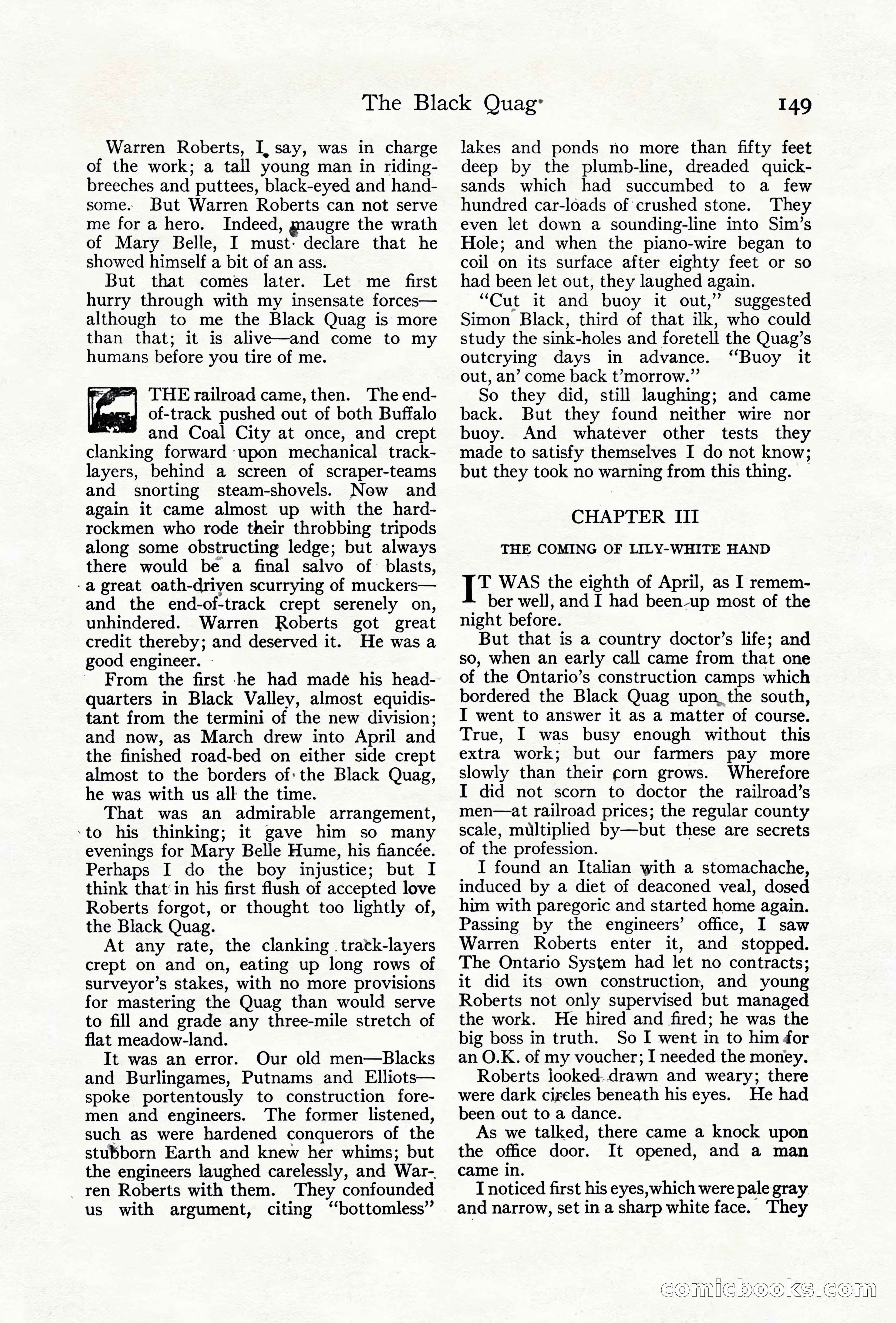
A restored page from Pulp Fiction, 1921. Page through the whole issue in the reader above.
📄 Transcribed text from this page (OCR, searchable)
Machine-transcribed from the original scan — historical spelling and the odd misread are preserved.
The Black Quag” Warren Roberts, I, say, was in charge of the work; a tall young man in riding- breeches and puttees, black-eyed and hand- some. But Warren Roberts can not serve me for a hero. Indeed, maugre the wrath of Mary Belle, I must: declare that he showed himself a bit of an ass. But that comes later. Let me _ first hurry through with my insensate forces— although to me the Black Quag is more than that; it is alive—and come to my humans before you tire of me. + THE railroad came, then. The end- of-track pushed out of both Buffalo and Coal City at once, and crept clanking forward upon mechanical track- layers, behind a screen of scraper-teams and snorting steam-shovels. Now and again it came almost up with the hard- rockmen who rode their throbbing tripods along some obstructing ledge; but always there would be a final salvo of. blasts, -a great oath-driven scurrying of muckers— and the end-of-track crept serenely on, unhindered. Warren Roberts got great credit thereby; and deserved it. He was a good engineer. - From the first he had made his head- quarters in Black Valley, almost equidis- tant from the termini of the new division; and now, as March drew into April and the finished road-bed on either side crept almost to the borders of: the Black Quag, he was with us all the time. That was an admirable arrangement, ‘to his thinking; it gave him so many evenings for Mary Belle Hume, his fiancée. Perhaps I do the boy injustice; but I think that in his first flush of accepted love Roberts forgot, or thought too lightly of, the Black Quag. At any rate, the clanking tratk-layers crept on and on, eating up long rows of surveyor’s stakes, with no more provisions for mastering the Quag than would serve to fill and grade any three-mile stretch of flat meadow-land. It was an error. Our old men—Blacks and Burlingames, Putnams and Elliots— spoke portentously to construction fore- men and engineers. The former listened, such as were hardened conquerors of the stubborn Earth and knew her whims; but the engineers laughed carelessly, and War- ren Roberts with them. They confounded us with argument, citing ‘bottomless’ 149 lakes and ponds no more than fifty feet deep by the plumb-line, dreaded quick- sands which had succumbed to a few hundred car-loads of crushed stone. They even let down a sounding-line into Sim’s Hole; and when the piano-wire began to coil on its surface after eighty feet or so had been let out, they laughed again. “Cut it and buoy it out,” suggested Simon Black, third of that ilk, who could study the sink-holes and foretell the Quag’s outcrying days in advance. “Buoy it out, an’ come back t’morrow.”’ So they did, still laughing; and came back. But they found neither wire nor buoy. And whatever other tests they made to satisfy themselves I do not know; but they took no gees from this thing. CHAPTER III THE COMING OF LILY-WHITE HAND | ES WAS the eighth of April, as I remem- ber well, and I had been-up most of the night before. But that is a country doctor’s life; and so, when an early call came from that one of the Ontario’s construction camps which bordered the Black Quag upon, the south, I went to answer it as a matter of course. True, I was busy enough without this extra work; but our farmers pay more slowly than their corn grows. Wherefore I did not scorn to doctor the railroad’s men—at railroad prices; the regular county scale, multiplied by—but these are secrets of the profession. I found an Italian with a stomachache, induced by a diet of deaconed veal, dosed him with paregoric and started home again. Passing by the engineers’ office, I saw Warren Roberts enter it, and stopped. The Ontario System had let no contracts; it did its own construction, and young Roberts not only supervised but managed the work. He hired and fired; he was the big boss in truth. So I went in to him for an O.K. of my voucher; I needed the money. Roberts looked. drawn and weary; there were dark cireles beneath his eyes. He had been out to a dance. As we talked, there came a knock upon the office door. It opened, and a man came in. T noticed first his eyes,which were pale gray and narrow, set in a sharp white face. They COmicloo \ ) ©