
Pulp Fiction, 1921 · page 157 of 204
Adventure Magazine Cover, June 18, 1921 — page 157: what you’re looking at
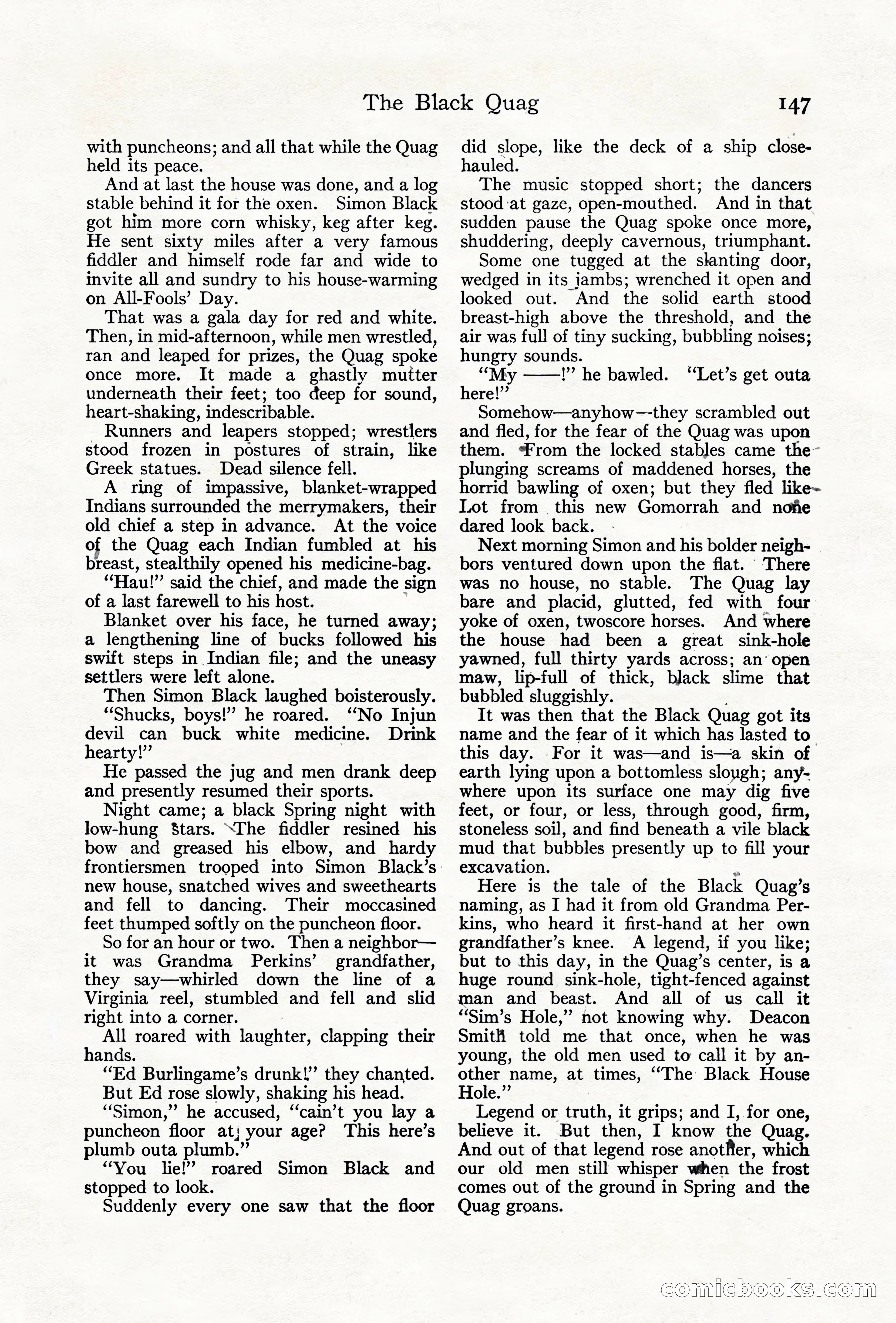
A restored page from Pulp Fiction, 1921. Page through the whole issue in the reader above.
📄 Transcribed text from this page (OCR, searchable)
Machine-transcribed from the original scan — historical spelling and the odd misread are preserved.
The Black Quag with puncheons; and all that while the Quag held its peace. And at last the house was done, and a log stable behind it for the oxen. Simon Black got him more corn whisky, keg after keg. He sent sixty miles after a very famous fiddler and himself rode far and wide to invite all and sundry to his house-warming on All-Fools’ Day. That was a gala day for red and white. Then, in mid-afternoon, while men wrestled, ran and leaped for prizes, the Quag spoke once more. It made a ghastly mutter underneath their feet; too deep for sound, heart-shaking, indescribable. Runners and leapers stopped; wrestlers stood frozen in postures of strain, like Greek statues. Dead silence fell. A ring of impassive, blanket-wrapped Indians surrounded the merrymakers, their old chief a step in advance. At the voice of the Quag each Indian fumbled at his breast, stealthily opened his medicine-bag. ““Hau!”’ said the chief, and made the sign of a last farewell to his host. : Blanket over his face, he turned away; a lengthening line of bucks followed his swift steps in Indian file; and the uneasy settlers were left alone. Then Simon Black laughed boisterously. ‘“‘Shucks, boys!”’ he roared. “No Injun devil can buck white medicine. Drink hearty!” He passed the jug and men drank deep and presently resumed their sports. Night came; a black Spring night with low-hung $8tars. “The fiddler resined his bow and greased his elbow, and hardy frontiersmen trooped into Simon Black’s: new house, snatched wives and sweethearts and fell to dancing. Their moccasined feet thumped softly on the puncheon floor. So for an hour or two. Then a neighbor— it was Grandma Perkins’ grandfather, they say—whirled down the line of a Virginia reel, stumbled and fell and slid right into a corner. All roared with laughter, clapping their hands. “Ed Burlingame’s drunk!’ they chanted. But Ed rose slowly, shaking his head. “Simon,” he accused, ‘‘cain’t you lay a puncheon floor at; your age? This here’s plumb outa plumb.” “You lie!” roared Simon Black and stopped to look. Suddenly every one saw that the floor 147 did slope, like the deck of a ship close- hauled. The music stopped short; the dancers stood at gaze, open-mouthed. And in that sudden pause the Quag spoke once more, shuddering, deeply cavernous, triumphant. Some one tugged at the slanting door, wedged in its jambs; wrenched it open and looked out. And the solid earth stood breast-high above the threshold, and the air was full of tiny sucking, bubbling noises; hungry sounds. “My ——!” he bawled. here!’ Somehow—anyhow—-they scrambled out and fled, for the fear of the Quag was upon “Let’s get outa them. *rom the locked stables came the~ plunging screams of maddened horses, the horrid bawling of oxen; but they fled like~ Lot from this new Gomorrah and nofie dared look back. Next morning Simon and his bolder neigh- bors ventured down upon the flat. There was no house, no stable. The Quag lay bare and placid, glutted, fed with four yoke of oxen, twoscore horses. And where the house had been a great sink-hole yawned, full thirty yards across; an’ open maw, lip-full of thick, bJack slime that bubbled sluggishly. It was then that the Black Quag got its name and the fear of it which has lasted to” this day. For it was—and is—a skin of earth lying upon a bottomless slough; any- where upon its surface one may dig five feet, or four, or less, through good, firm, stoneless soil, and find beneath a vile black mud that bubbles presently up to fill your excavation. = Here is the tale of the Black Quag’s naming, as I had it from old Grandma Per- kins, who heard it first-hand at her own grandfather’s knee. A legend, if you like; but to this day, in the Quag’s center, is a huge round sink-hole, tight-fenced against man and beast. And all of us call it ‘Sim’s Hole,” not knowing why. Deacon Smith told me that once, when he was young, the old men used to call it by an- other name, at times, ‘““The Black House Hole.”’ Legend or truth, it grips; and I, for one, believe it. But then, I know the Quag. And out of that legend rose anotfer, which our old men still whisper when the frost comes out of the ground in Spring and the Quag groans. Clo@@ CN Wp) CO CO