
Pulp Fiction, 1919 · page 46 of 208
Adventure Magazine Cover — page 46: what you’re looking at
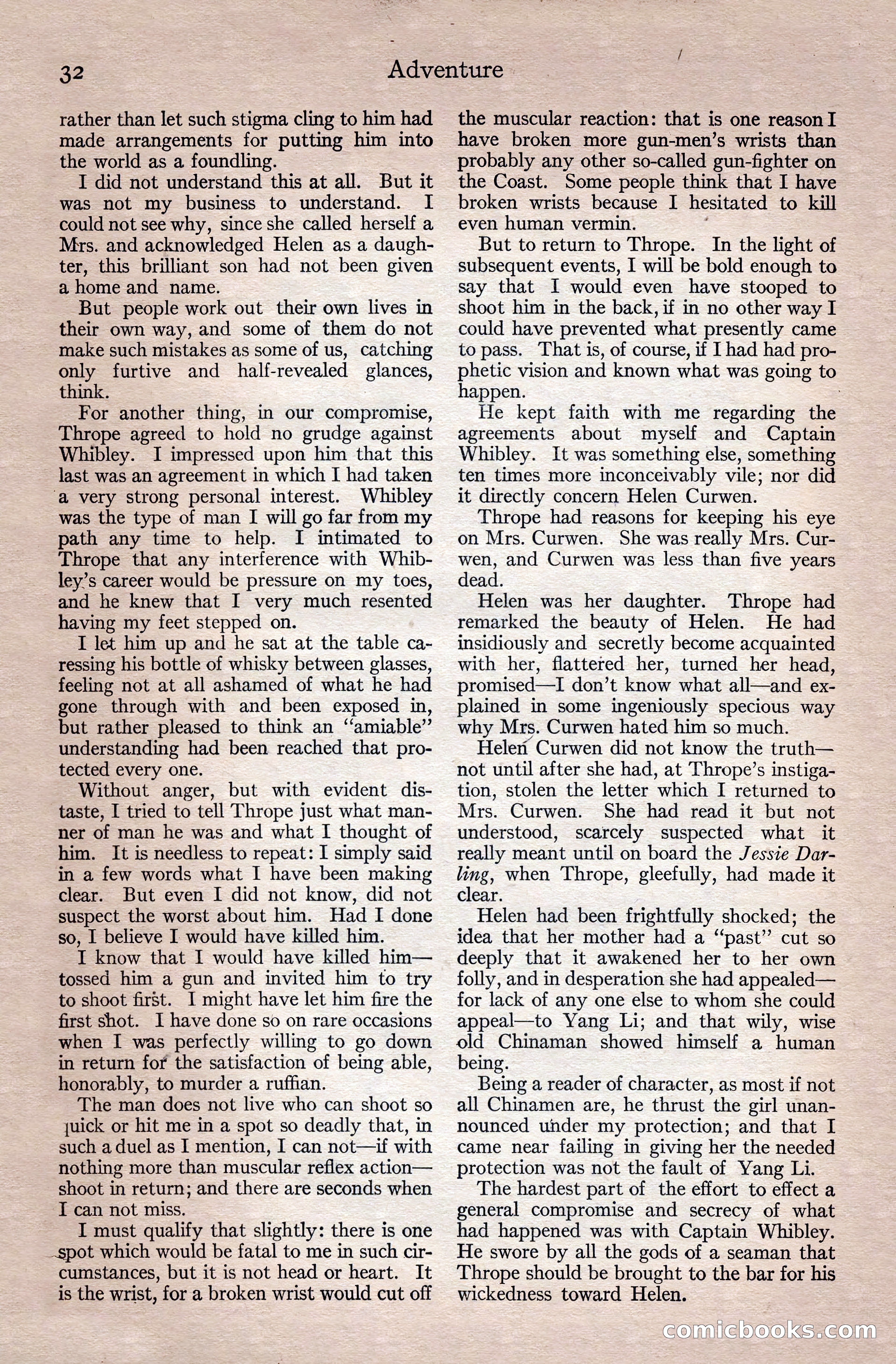
A restored page from Pulp Fiction, 1919. Page through the whole issue in the reader above.
📄 Transcribed text from this page (OCR, searchable)
Machine-transcribed from the original scan — historical spelling and the odd misread are preserved.
32 rather than let such stigma cling to him had made arrangements for putting him into the world as a foundling. I did not understand this at all. But it was not my business to understand. I could not see why, since she called herself a Mrs. and acknowledged Helen as a daugh- ter, this brilliant son had not been given a home and name. But people work out their own lives in their own way, and some of them do not make such mistakes as some of us, catching only furtive and half-revealed glances, For another thing, in our compromise, Thrope agreed to hold no grudge against Whibley. I impressed upon him that this last was an agreement in which I had taken ‘a very strong personal interest. Whibley was the type of man I will go far from my path any time to help. I intimated to Thrope that any interference with Whib- ley’s career would be pressure on my toes, and he knew that I very much resented having my feet stepped on. I let him up and he sat at the table ca- ressing his bottle of whisky between glasses, feeling not at all ashamed of what he had gone through with and been exposed in, but rather pleased to think an ‘‘amiable”’ understanding had been reached that pro- tected every one. Without anger, but with evident dis- taste, I tried to tell Thrope just what man- ner of man he was and what I thought of him. It is needless to repeat: I simply said in a few words what I have been making clear. But even I did not know, did not suspect the worst about him. Had I done so, I believe I would have killed him. I know that I would have killed him— tossed him a gun and invited him to try to shoot first. I might have let him fire the first shot. I have done so on rare occasions when I was perfectly willing to go down in return for the satisfaction of being able, honorably, to murder a ruffian. The man does not live who can shoot so juick or hit me in a spot so deadly that, in such a duel as I mention, I can not—if with nothing more than muscular reflex action— shoot in return; and there are seconds when I can not miss. I must qualify that slightly: there is one _spot which would be fatal to me in such cir- cumstances, but it is not head or heart. It is the wrist, for a broken wrist would cut off Adventure the muscular reaction: that is one reason I have broken more gun-men’s wrists than probably any other so-called gun-fighter on the Coast. Some people think that I have broken wrists because I hesitated to kill even human vermin. But to return to Thrope. In the light of subsequent events, I will be bold enough to say that I would even have stooped to shoot him in the back, if in no other way I could have prevented what presently came to pass. That is, of course, if I had had pro- phetic vision and known what was going to happen. He kept faith with me regarding the agreements about myself and Captain Whibley. It was something else, something ten times more inconceivably vile; nor did it directly concern Helen Curwen. Thrope had reasons for keeping his eye on Mrs. Curwen. She was really Mrs. Cur- wen, and Curwen was less than five years dead. Helen was her daughter. Thrope had remarked the beauty of Helen. He had insidiously and secretly become acquainted with her, flattered her, turned her head, promised—I don’t know what all—and ex- plained in some ingeniously specious way why Mrs. Curwen hated him so much. Helert Curwen did not know the truth— not until after she had, at Thrope’s instiga- tion, stolen the letter which I returned to Mrs. Curwen. She had read it but not understood, scarcely suspected what it really meant until on board the Jessie Dar- ling, when Thrope, gleefully, had made it clear. Helen had been frightfully shocked; the idea that her mother had a “past” cut so deeply that it awakened her to her own folly, and in desperation she had appealed— for lack of any one else to whom she could appeal—to Yang Li; and that wily, wise old Chinaman showed himself a human being. Being a reader of character, as most if not all Chinamen are, he thrust the girl unan- nounced under my protection; and that I came near failing in giving her the needed protection was not the fault of Yang Li. The hardest part of the effort to effect a general compromise and secrecy of what had happened was with Captain Whibley. He swore by all the gods of a seaman that Thrope should be brought to the bar for his wickedness toward Helen. Eomichooks.co nm