
Pulp Fiction, 1919 · page 45 of 208
Adventure Magazine Cover — page 45: what you’re looking at
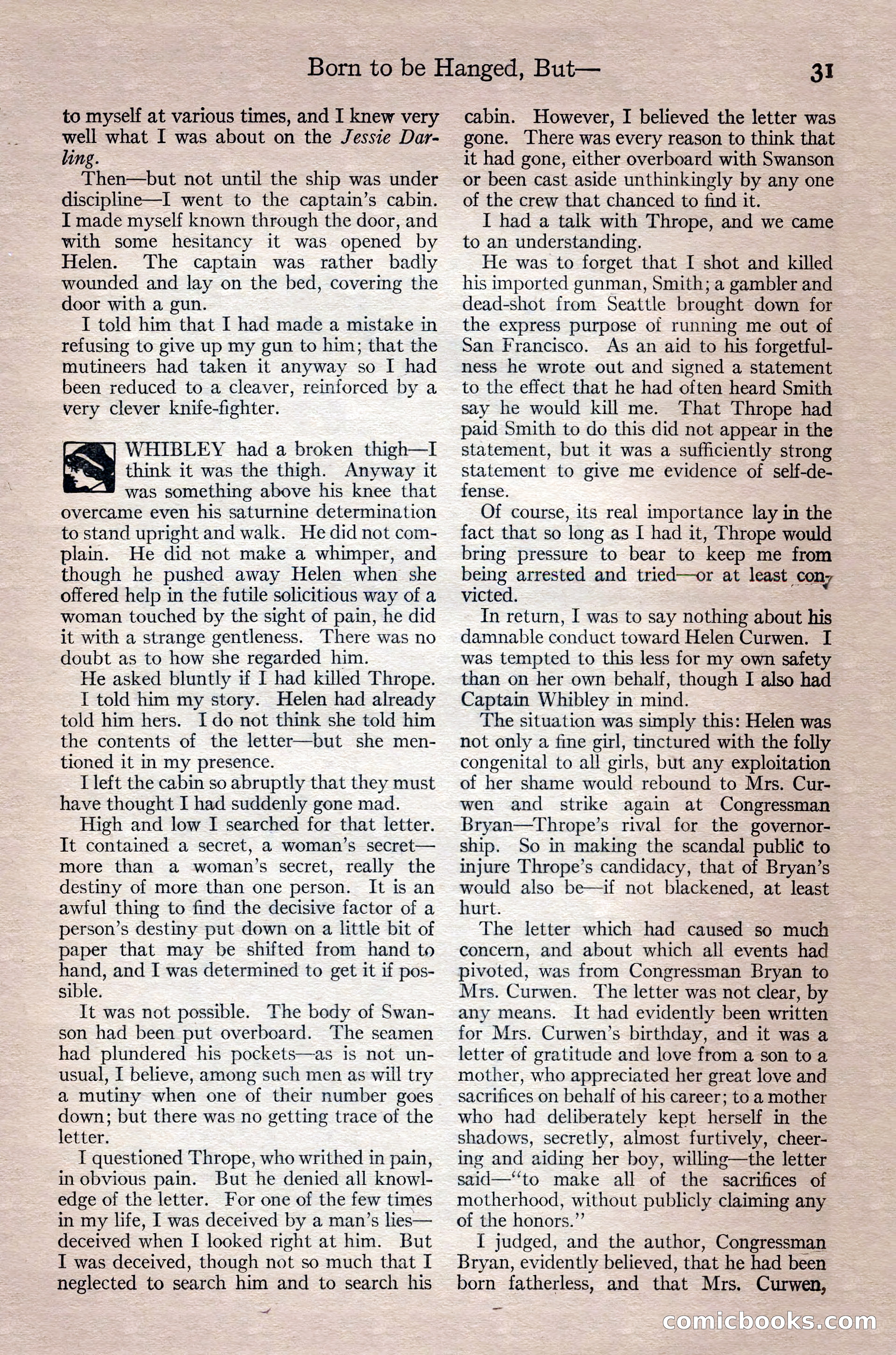
A restored page from Pulp Fiction, 1919. Page through the whole issue in the reader above.
📄 Transcribed text from this page (OCR, searchable)
Machine-transcribed from the original scan — historical spelling and the odd misread are preserved.
Born to be Hanged, But— 31 to myself at various times, and I knew very well what I was about on the Jessie Dar- ling. Then—but not until the ship was under discipline—I went to the captain’s cabin. I made myself known through the door, and with some hesitancy it was opened by Helen. The captain was rather badly wounded and lay on the bed, covering the door with a gun. I told him that I had made a mistake in refusing to give up my gun to him; that the mutineers had taken it anyway so I had been reduced to a cleaver, reinforced by a very clever knife-fighter. (ae | WHIBLEY had a broken thigh—I 3 re A think it was the thigh. Anyway it <S was something above his knee that overcame even his saturnine determination to stand upright and walk. He did not com- plain. He did not make a whimper, and though he pushed away Helen when she offered help in the futile solicitious way of a woman touched by the sight of pain, he did it with a strange gentleness. There was no doubt as to how she regarded him. He asked bluntly if I had killed Thrope. I told him my story. Helen had already told him hers. I do not think she told him the contents of the letter—but she men- tioned it in my presence. I left the cabin so abruptly that they must have thought I had suddenly gone mad. High and low I searched for that letter. It contained a secret, a woman’s secret— more than a woman’s secret, really the destiny of more than one person. It is an awful thing to find the decisive factor of a person’s destiny put down on a little bit of paper that may be shifted from hand to hand, and I was determined to get it if pos- sible. It was not possible. The body of Swan- son had been put overboard. The seamen had plundered his pockets—as is not un- usual, I believe, among such men as will try a mutiny when one of their number goes down; but there was no getting trace of the letter. I questioned Thrope, who writhed in pain, in obvious pain. But he denied all knowl- edge of the letter. For one of the few times in my life, I was deceived by a man’s lies— deceived when I looked right at him. But I was deceived, though not so much that I neglected to search him and to search his — cabin. However, I believed the letter was gone. There was every reason to think that it had gone, either overboard with Swanson or been cast aside unthinkingly by any one of the crew that chanced to find it. I had a talk with Thrope, and we came to an understanding. He was to forget that I shot and killed his imported gunman, Smith; a gambler and dead-shot from Seattle brought down for the express purpose of running me out of San Francisco. As an aid to his forgetful- ness he wrote out and signed a statement to the effect that he had often heard Smith say he would kill me. That Thrope had paid Smith to do this did not appear in the statement, but it was a sufficiently strong statement to give me evidence of self-de- fense. Of course, its real importance lay in the fact that so long as I had it, Thrope would bring pressure to bear to keep me from being arrested and tried—or at least conz victed. In return, I was to say nothing about his damnable conduct toward Helen Curwen. I was tempted to this less for my own safety than on her own behalf, though I also had Captain Whibley in mind. The situation was simply this: Helen was not only a fine girl, tinctured with the folly congenital to all girls, but any exploitation of her shame would rebound to Mrs. Cur- wen and strike again at Congressman Bryan—Thrope’s rival for the governor- ship. So in making the scandal publi¢ to injure Thrope’s candidacy, that of Bryan’s would also be—if not blackened, at least hurt. The letter which had caused so much concern, and about which all events had pivoted, was from Congressman Bryan to Mrs. Curwen. The letter was not clear, by any means. It had evidently been written for Mrs. Curwen’s birthday, and it was a letter of gratitude and love from a son to a mother, who appreciated her great love and sacrifices on behalf of his career; to a mother who had deliberately kept herself in the shadows, secretly, almost furtively, cheer- ing and aiding her boy, willing—the letter said—‘‘to make all of the sacrifices of motherhood, without publicly claiming any of the honors.”’ { judged, and the author, Congressman Bryan, evidently believed, that he had been born fatherless, and that Mrs, Curwen, — GEomicbooks.co