
Pulp Fiction, 1919 · page 47 of 208
Adventure Magazine Cover — page 47: what you’re looking at
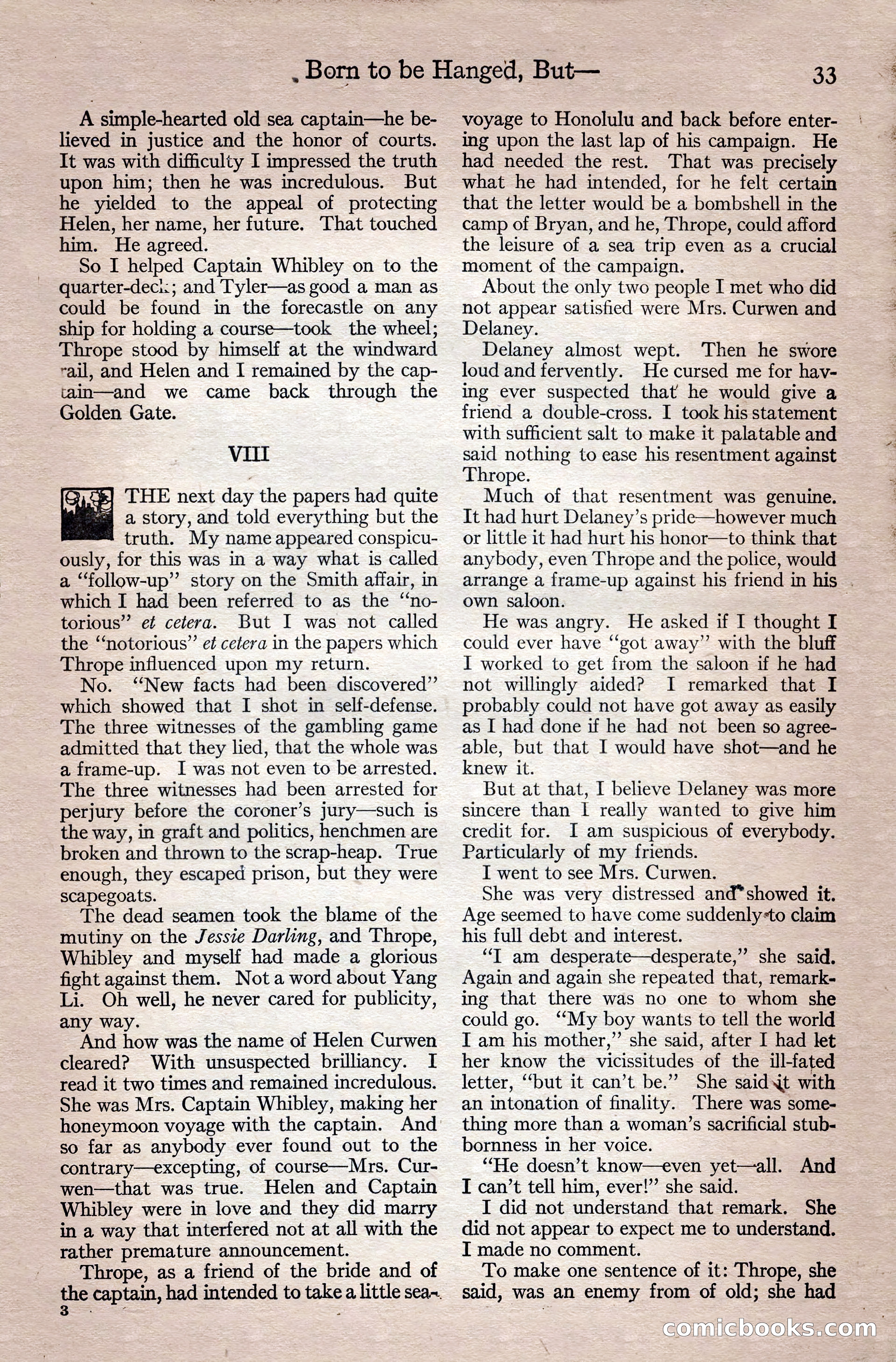
A restored page from Pulp Fiction, 1919. Page through the whole issue in the reader above.
📄 Transcribed text from this page (OCR, searchable)
Machine-transcribed from the original scan — historical spelling and the odd misread are preserved.
. Born to be Hanged, But— A simple-hearted old sea captain—he be- lieved in justice and the honor of courts. It was with difficulty I impressed the truth upon him; then he was incredulous. But he yielded to the appeal of protecting Helen, her name, her future. That touched him. He agreed. So I helped Captain Whibley on to the quarter-deci:; and Tyler—as good a man as could be found in the forecastle on any ship for holding a course—took the wheel; Thrope stood by himself at the windward rail, and Helen and I remained by the cap- tain—and we came back through the Golden Gate. Vitti THE next day the papers had quite a story, and told everything but the truth. My name appeared conspicu- ously, for this was in a way what is called a “follow-up” story on the Smith affair, in which I had been referred to as the “no- torious” et cetera. But I was not called the ‘‘notorious”’ et cetera in the papers which Thrope influenced upon my return. No. ‘‘New facts had been discovered” which showed that I shot in self-defense. The three witnesses of the gambling game admitted that they lied, that the whole was aframe-up. I was not even to be arrested. The three witnesses had been arrested for perjury before the coroner’s Jury—such is the way, in graft and politics, henchmen are broken and thrown to the scrap-heap. True enough, they escaped prison, but they were scapegoats. The dead seamen took the blame of the mutiny on the Jessie Darling, and Thrope, Whibley and myself had made a glorious fight against them. Nota word about Yang Li. Oh well, he never cared for publicity, any way. And how was the name of Helen Curwen cleared? With unsuspected brilliancy. I read it two times and remained incredulous. She was Mrs. Captain Whibley, making her honeymoon voyage with the captain. And so far as anybody ever found out to the contrary—excepting, of course—Mrs. Cur- wen—that was true. Helen and Captain Whibley were in love and they did marry in a way that interfered not at all with the rather premature announcement. Thrope, as a friend of the bride and of the captain, had intended to take a little sea-. 33 voyage to Honolulu and back before enter- ing upon the last lap of his campaign. He had needed the rest. That was precisely what he had intended, for he felt certain that the letter would be a bombshell in the camp of Bryan, and he, Thrope, could afford the leisure of a sea trip even as a crucial moment of the campaign. About the only two people I met who did not appear satisfied were Mrs. Curwen and Delaney. Delaney almost wept. Then he swore loud and fervently. He cursed me for hav- ing ever suspected that’ he would give a friend a double-cross. I took his statement with sufficient salt to make it palatable and said nothing to ease his resentment against Thrope. Much of that resentment was genuine. It had hurt Delaney’s pride—however much or little it had hurt his honor—to think that anybody, even Thrope and the police, would arrange a frame-up against his friend in his . own saloon. He was angry. He asked if I thought I could ever have “‘got away” with the bluff I worked to get from the saloon if he had not willingly aided? I remarked that I probably could not have got away as easily as I had done if he had not been so agree- able, but that I would have shot—and he knew it. But at that, I believe Delaney was more sincere than | really wanted to give him credit for. I am suspicious of everybody. Particularly of my friends. I went to see Mrs. Curwen. She was very distressed and*showed it. Age seemed to have come suddenly-to claim his full debt and interest. “T am desperate—desperate,” she said. Again and again she repeated that, remark- ing that there was no one to whom she could go. ‘‘My boy wants to tell the world IT am his mother,” she said, after I had let her know the vicissitudes of the ill-fated letter, ‘‘but it can’t be.” She said Nt with an intonation of finality. There was some- thing more than a woman’s sacrificial stub- bornness in her voice. “He doesn’t know—even yet—all. And I can’t tell him, ever!” she said. I did not understand that remark. She did not appear to expect me to understand. I made no comment. To make one sentence of it: Thrope, she said, was an enemy from of old; she had Eomicbooks co)