
Pulp Fiction, 1919 · page 203 of 208
Adventure Magazine Cover — page 203: what you’re looking at
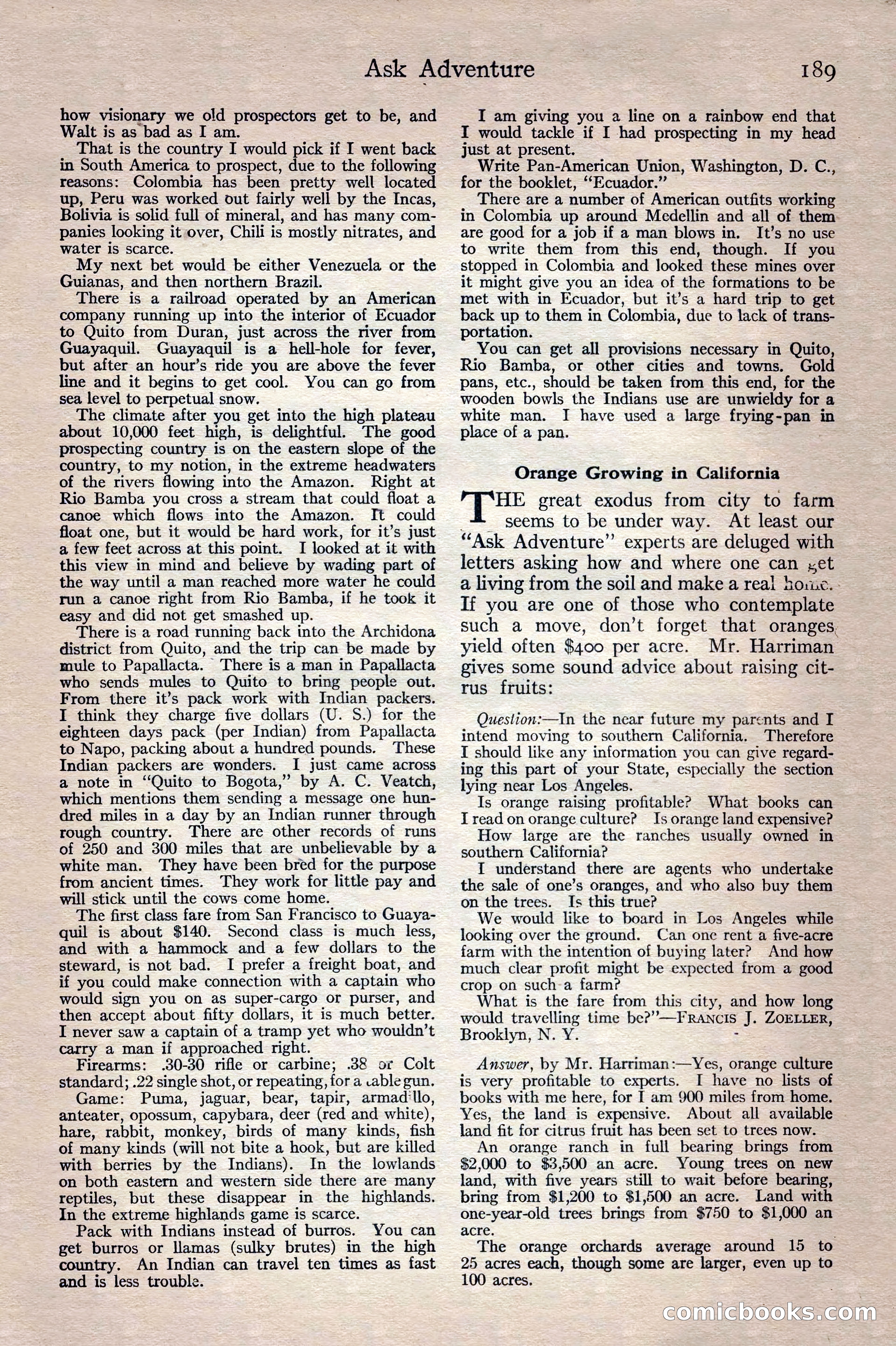
A restored page from Pulp Fiction, 1919. Page through the whole issue in the reader above.
📄 Transcribed text from this page (OCR, searchable)
Machine-transcribed from the original scan — historical spelling and the odd misread are preserved.
Ask Adventure how visionary we old prospectors get to be, and Walt is as bad as I am. That is the country I would pick if I went back in South America to prospect, due to the following reasons: Colombia has been pretty well located up, Peru was worked out fairly well by the Incas, Bolivia is solid full of mineral, and has many com- panies looking it over, Chili is mostly nitrates, and water is scarce. My next bet would be either Venezuela or the Guianas, and then northern Brazil. There is a railroad operated by an American company running up into the interior of Ecuador to Quito from Duran, just across the river from Guayaquil. Guayaquil is a hell-hole for fever, but after an hour’s ride you are above the fever line and it begins to get cool. You can go from sea level to perpetual snow. The climate after you get into the high plateau about 10,000 feet high, is delightful. The good prospecting country is on the eastern slope of the country, to my notion, in the extreme headwaters of the rivers flowing into the Amazon. Right at Rio Bamba you cross a stream that could float a canoe which flows into the Amazon. It could float one, but it would be hard work, for it’s just a few feet across at this point. I looked at it with this view in mind and believe by wading part of the way until a man reached more water he could run a canoe right from Rio Bamba, if he took it easy and did not get smashed up. There is a road running back into the Archidona district from Quito, and the trip can be made by mule to Papallacta. There is a man in Papallacta who sends mules to Quito to bring people out. From there it’s pack work with Indian packers. I think they charge five dollars (U. S.) for the eighteen days pack (per Indian) from Papallacta to Napo, packing about a hundred pounds. These Indian packers are wonders. I just came across a note in ‘Quito to Bogota,” by A. C. Veatch, which mentions them sending a message one hun- dred miles in a day by an Indian runner through rough country. There are other records of runs of 250 and 300 miles that are unbelievable by a white man. They have been bred for the purpose from ancient times. They work for little pay and will stick until the cows come home. The first class fare from San Francisco to Guaya- quil is about $140. Second class is much less, and with a hammock and a few dollars to the steward, is not bad. I prefer a freight boat, and if you could make connection with a captain who would sign you on as super-cargo or purser, and then accept about fifty dollars, it is much better. I never saw a captain of a tramp yet who wouldn’t carry a man if approached right. Firearms: .30-30 rifle or carbine; .38 or Colt standard; .22 single shot, or repeating, for a vable gun. Game: Puma, jaguar, bear, tapir, armadillo, anteater, opossum, capybara, deer (red and white), hare, rabbit, monkey, birds of many kinds, fish of many kinds (will not bite a hook, but are killed with berries by the Indians). In the lowlands on both eastern and western side there are many reptiles, but these disappear in the highlands. In the extreme highlands game is scarce. Pack with Indians instead of burros. You can get burros or llamas (sulky brutes) in the high country. An Indian can travel ten times as fast and is less trouble. I am giving you a line on a rainbow end that I would tackle if I had prospecting in my head just at present. Write Pan-American Union, Washington, D. C., for the booklet, “‘Ecuador.”’ There are a number of American outfits working in Colombia up around Medellin and all of them. are good for a job if a man blows in. It’s no use to write them from this end, though. If you stopped in Colombia and looked these mines over it might give you an idea of the formations to be met with in Ecuador, but it’s a hard trip to get back up to them in Colombia, due to lack of trans- portation. You can get all provisions necessary in Quito, Rio Bamba, or other cities and towns. Gold pans, etc., should be taken from this end, for the wooden bowls the Indians use are unwieldy for a white man. I have used a large frying-pan in place of a pan. | Orange Growing in California ap Be great exodus from city to farm = seems to be under way. At least our “Ask Adventure’ experts are deluged with letters asking how and where one can zet 189 a living from the soil and make a real house. - If you are one of those who contemplate such a move, don’t forget that oranges, yield often $400 per acre. Mr. Harriman gives some sound advice about raising cit- rus fruits: Question:—In the near future my parents and I intend moving to southern California. Therefore I should like any information you can give regard- ing this part of your State, especially the section lying near Los Angeles. Is orange raising profitable? What books can J read on orange culture? Is orange land expensive? How large are the ranches usually owned in southern California? I understand there are agents who undertake the sale of one’s oranges, and who also buy them on the trees. Is this true? We would like to board in Los Angeles while looking over the ground. Can one rent a five-acre farm with the intention of buying later? And how much clear profit might be expected from a good crop on such-a farm? What is the fare from this city, and how long would travelling time be?”—Francis J. ZOELLER, Brooklyn, N. Y. : Answer, by Mr. Harriman:—Yes, orange culture is very profitable to experts. I have no lists of books with me here, for I am 900 miles from home. Yes, the land is expensive. About all available land fit for citrus fruit has been set to trees now. An orange ranch in full bearing brings from $2,000 to $3,500 an acre. Young trees on new land, with five years still to wait before bearing, bring from $1,200 to $1,500 an acre. Land with one-year-old trees brings from $750 to $1,000 an acre. The orange orchards average around 15 to 25 acres each, though some are larger, even up to 100 acres. mnichboo <SiiG