
Pulp Fiction, 1919 · page 202 of 208
Adventure Magazine Cover — page 202: what you’re looking at
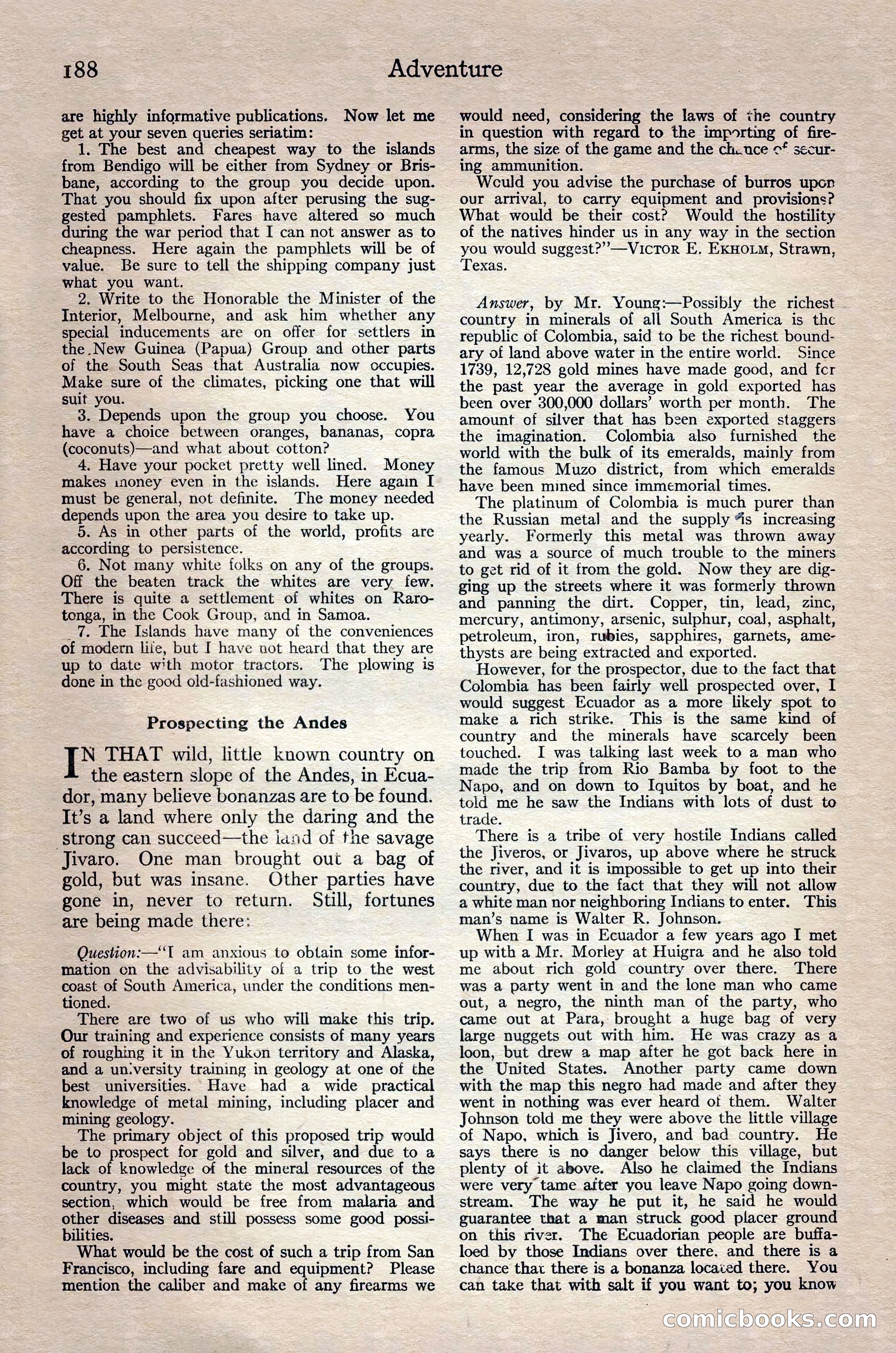
A restored page from Pulp Fiction, 1919. Page through the whole issue in the reader above.
📄 Transcribed text from this page (OCR, searchable)
Machine-transcribed from the original scan — historical spelling and the odd misread are preserved.
188 are highly informative publications. Now let me get at your seven queries seriatim: 1. The best and cheapest way to the islands from Bendigo will be either from Sydney or Bris- bane, according to the group you decide upon. That you should fix upon after perusing the sug- gested pamphlets. Fares have altered so much during the war period that I can not answer as to cheapness. Here again the pamphlets will be of value. Be sure to tell the shipping company just what you want. 2. Write to the Honorable the Minister of the Interior, Melbourne, and ask him whether any special inducements are on offer for settlers in the New Guinea (Papua) Group and other parts of the South Seas that Australia now occupies. Make sure of the climates, picking one that will suit you. | 3. Depends upon the group you choose. You have a choice between oranges, bananas, copra (coconuts)—and what about cotton? 4. Have your pocket pretty well lined. Money makes inoney even in the islands. Here again I must be general, not definite. The money needed depends upon the area you desire to take up. 5. As in other parts of the world, profits are according to persistence. 6. Not many white folks on any of the groups. Off the beaten track the whites are very lew. There is quite a settlement of whites on Raro- tonga, in the Cook Group, and in Samoa. _%. The Islands have many of the conveniences of modern life, but I have not heard that they are up to date with motor tractors. The plowing is done in the good old-fashioned way. Prospecting the Andes 2 THAT wild, little known country on the eastern slope of the Andes, in Ecua- dor, many believe bonanzas are to be found. It’s a land where only the daring and the ‘strong can succeed—the iand of the savage Jivaro. One man brought out a bag of gold, but was insane. Other parties have gone in, never to return. Still, fortunes are being made there: Question: —“T am anxious to obtain some infor- mation cn the advisability of a trip to the west coast of South America, under the conditions men- ticned. There are two of us who will make this trip. Our training and experience consists of many years of roughing it in the Yukon territory and Alaska, and a un.versity training in geology at one of the best universities. Have had a wide practical knowledge of metal mining, including placer and mining geology. The primary object of this proposed trip would be to prospect for gold and silver, and due to a lack of knowledge of the mineral resources of the country, you might state the most advantageous section, which would be free from malaria and other diseases and still possess some good possi- bilities. What would be the cost of such a trip from San Francisco, including fare and equipment? Please mention the caliber and make of any firearms we Adventure would need, considering the laws of the country in question with regard to the importing of fire- arms, the size of the game and the ch.uce o* secur- ing ammunition. Weuld you advise the purchase of burros upon our arrival, to carry equipment and provisions? What would be their cost? Would the hostility of the natives hinder us in any way in the section you would suggest?” —VicTor E. EKHoLm, Strawn, Texas. Answer, by Mr. Young:—Possibly the richest country in minerals of all South America is the republic of Colombia, said to be the richest bound- ary of land above water in the entire world. Since 1739, 12,728 gold mines have made good, and fer the past year the average in gold exported has been over 300,000 dollars’ worth per month. The amount of silver that has been exported staggers the imagination. Colombia also furnished the world with the bulk of its emeralds, mainly from the famous Muzo district, from which emeralds have been mined since immemorial times. The platinum of Colombia is much purer than the Russian metal and the supply “is increasing yearly. Formerly this metal was thrown away and was a source of much trouble to the miners to get rid of it from the gold. Now they are dig- ging up the streets where it was formerly thrown and panning the dirt. Copper, tin, lead, zinc, mercury, antimony, arsenic, sulphur, coal, asphalt, petroleum, iron, rubies, sapphires, garnets, ame- thysts are being extracted and exported. However, for the prospector, due to the fact that Colombia has been fairly well prospected over, I would suggest Ecuador as a more likely spot to make a rich strike. This is the same kind of country and the minerals have scarcely been touched. I was talking last week to a man who made the trip from Rio Bamba by foot to the Napo, and on down to Iquitos by boat, and he told me he saw the Indians with lots of dust to trade. There is a tribe of very hostile Indians called the Jiveros, or Jivaros, up above where he struck the river, and it is impossible to get up into their country, due to the fact that they will not allow a white man nor neighboring Indians to enter. This man’s name is Walter R. Johnson. When I was in Ecuador a few years ago I met up with a Mr. Morley at Huigra and he also told me about rich gold country over there. There was a party went in and the lone man who came out, a negro, the ninth man of the party, who came out at Para, brought a huge bag of very large nuggets out with him. He was crazy as a loon, but drew a map after he got back here in the United States. Another party came down with the map this negro had made and after they went in nothing was ever heard of them. Walter Johnson told me they were above the little village of Napo, which is Jivero, and bad country. He says there is no danger below this village, but plenty of it above. Also he claimed the Indians were very tame after you leave Napo going down- stream. The way he put it, he said he would guarantee that a man struck good placer ground on this river. The Ecuadorian people are buffa- loed by those Indians over there. and there is a chance that there is a bonanza located there. You can take that with salt if you want to; you know (COMME NCKO KS (EC)