
Pulp Fiction, 1919 · page 204 of 208
Adventure Magazine Cover — page 204: what you’re looking at
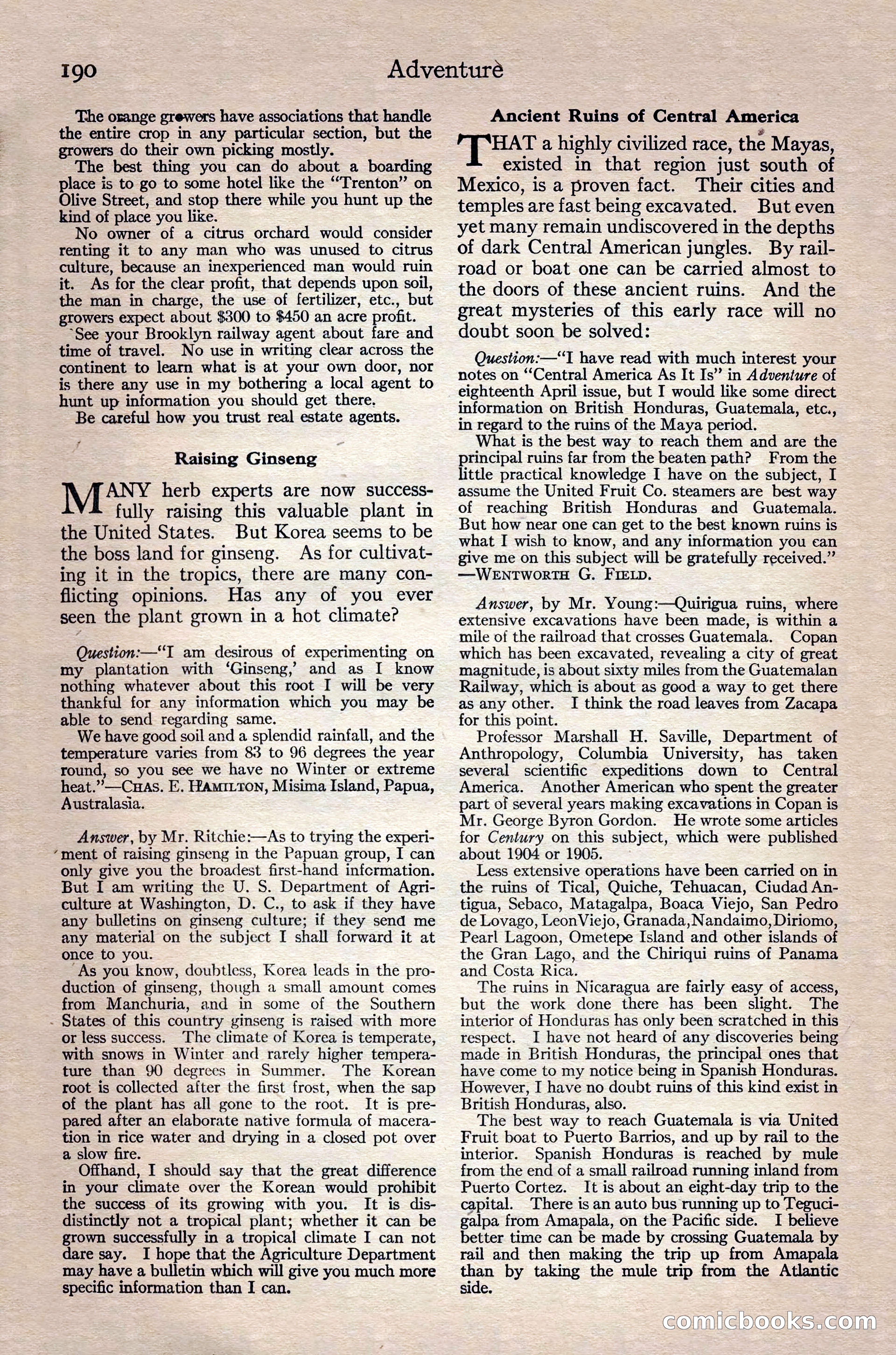
A restored page from Pulp Fiction, 1919. Page through the whole issue in the reader above.
📄 Transcribed text from this page (OCR, searchable)
Machine-transcribed from the original scan — historical spelling and the odd misread are preserved.
190 The orange grewers have associations that handle the entire crop in any particular section, but the growers do their own picking mostly. The best thing you can do about a boarding place is to go to some hotel like the “Trenton” on Olive Street, and stop there while you hunt up the kind of place you like. No owner of a citrus orchard would consider renting it to any man who was unused to citrus culture, because an inexperienced man would ruin it. As for the clear profit, that depends upon soil, the man in charge, the use of fertilizer, etc., but growers expect about $300 to $450 an acre profit. “See your Brooklyn railway agent about fare and time of travel. No use in writing clear across the continent to learn what is at your own door, nor is there any use in my bothering a local agent to hunt up information you should get there. Be careful how you trust real estate agents. Raising Ginseng Wes: herb experts are now success- fully raising this valuable plant in the United States. But Korea seems to be the boss land for ginseng. As for cultivat- ing it in the tropics, there are many con- flicting opinions. Has any of you ever seen the plant grown in a hot climate? Question: —“T am desirous of experimenting on my plantation with ‘Ginseng,’ and as I know nothing whatever about this root I will be very thankful for any information which you may be able to send regarding same. We have good soil and a splendid rainfall, and the temperature varies from 83 to 96 degrees the year round, so you see we have no Winter or extreme heat.”—Cuas. E. Hamitton, Misima Island, Papua, Australasia. Answer, by Mr. Ritchie:—As to trying the experi- ‘ment of raising ginseng in the Papuan group, I can only give you the broadest first-hand infcrmation. But I am writing the U. S. Department of Agri- culture at Washington, D. C., to ask if they have any bulletins on ginseng culture; if they send me any material on the subject I shall forward it at once to you. As you know, doubtless, Korea leads in the pro- duction of ginseng, though a small amount comes from Manchuria, and in some of the Southern - States of this country ginseng is raised with more or less success. The climate of Korea is temperate, with snows in Winter and rarely higher tempera- ture than 90 degrees in Summer. The Korean root is collected after the first frost, when the sap of the plant has all gone to the root. It is pre- pared after an elaborate native formula of macera- tion in rice water and drying in a closed pot over a slow fire. Offhand, I should say that the great difference in your climate over the Korean would prohibit the success of its growing with you. It is dis- distinctly not a tropical plant; whether it can be grown successfully in a tropical climate I can not dare say. I hope that the Agriculture Department may have a bulletin which will give you much more specific information than I can. Adventuré Ancient Ruins of Central America pur a highly civilized race, the Mayas, existed in that region just south of Mexico, is a proven fact. temples are fast being excavated. But even yet many remain undiscovered in the depths of dark Central American jungles. By rail- road or boat one can be carried almost to the doors of these ancient ruins. And the great mysteries of this early race will no doubt soon be solved: Question:—“T have read with much interest your notes on “‘Central America As It Is” in Adventure of eighteenth April issue, but I would like some direct information on British Honduras, Guatemala, etc., in regard to the ruins of the Maya period. What is the best way to reach them and are the principal ruins far from the beaten path? From the little practical knowledge I have on the subject, I assume the United Fruit Co. steamers are best way of reaching British Honduras and Guatemala. But how near one can get to the best known ruins is what I wish to know, and any information you can give me on this subject will be gratefully received.” —WENTWoRTH G. FIELD. Answer, by Mr. Young:—Quirigua ruins, where extensive excavations have been made, is within a mile of the railroad that crosses Guatemala. Copan which has been excavated, revealing a city of great magnitude, is about sixty miles from the Guatemalan Railway, which is about as good a way to get there as any other. I think the road leaves from Zacapa for this point. Professor Marshall H. Saville, Department of Anthropology, Columbia University, has taken several scientific expeditions down to Central America. Another American who spent the greater part of several years making excavations in Copan is Mr. George Byron Gordon. He wrote some articles for Century on this subject, which were published about 1904 or 1905. Less extensive operations have been carried on in the ruins of Tical, Quiche, Tehuacan, Ciudad An- tigua, Sebaco, Matagalpa, Boaca Viejo, San Pedro de Lovago, LeonViejo, Granada, Nandaimo, Diriomo, Pearl Lagoon, Ometepe Island and other islands of the Gran Lago, and the Chiriqui ruins of Panama and Costa Rica. The ruins in Nicaragua are fairly easy of access, but the work done there has been slight. The interior of Honduras has only been scratched in this _ respect. I have not heard of any discoveries being made in British Honduras, the principal ones that have come to my notice being in Spanish Honduras. However, I have no doubt ruins of this kind exist in British Honduras, also. The best way to reach Guatemala is via United Fruit boat to Puerto Barrios, and up by rail to the interior. Spanish Honduras is reached by mule from the end of a small railroad running inland from Puerto Cortez. It is about an eight-day trip to the capital. There is an auto bus running up to Teguci- galpa from Amapala, on the Pacific side. I believe better time can be made by crossing Guatemala by rail and then making the trip up from Amapala oe by taking the mule trip from the Atlantic side. Eomicbooks Their cities and (E@) im