
Pulp Fiction, 1918 · page 150 of 194
Adventure Magazine Cover, April 3, 1918 — page 150: what you’re looking at
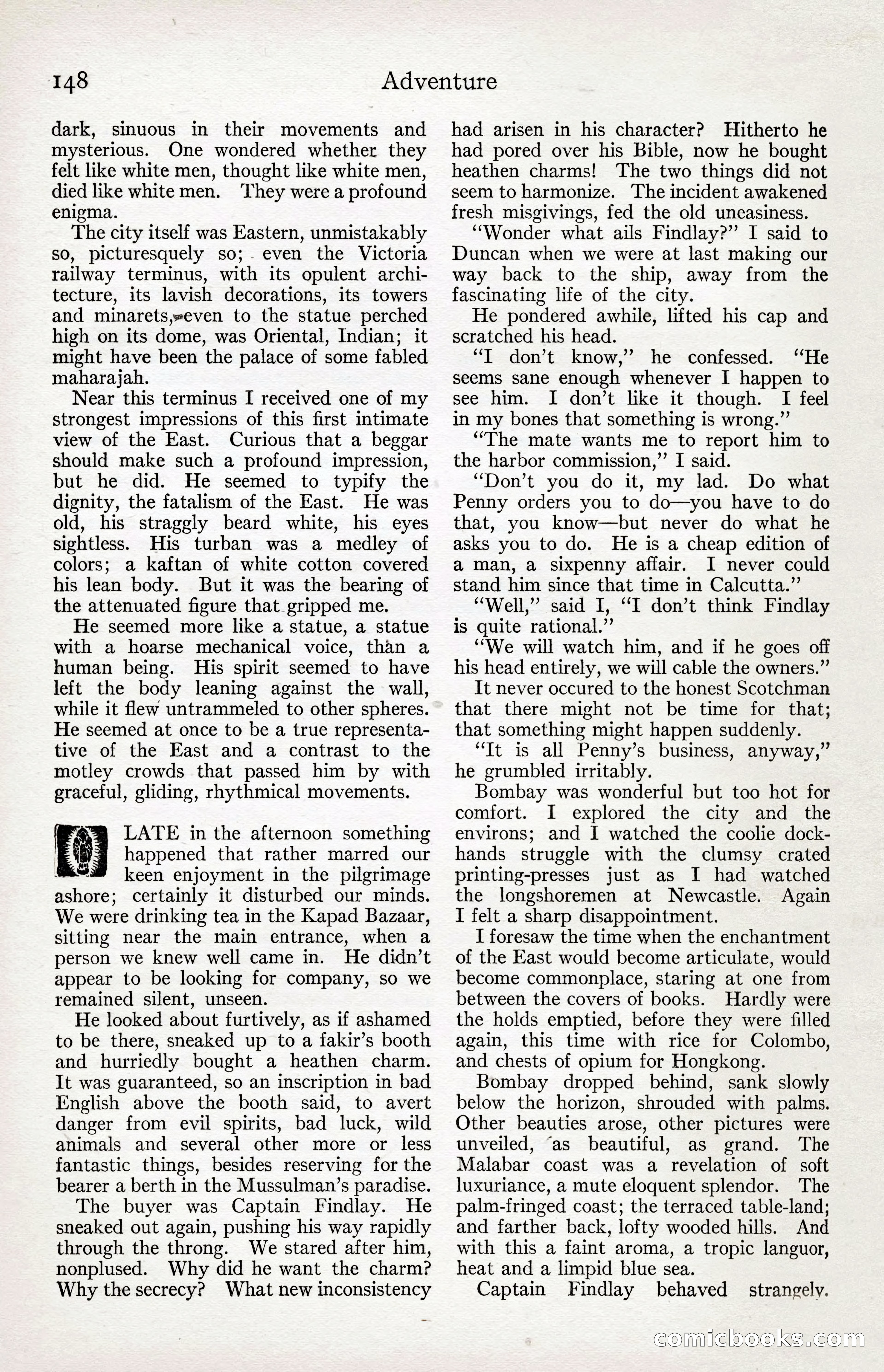
A restored page from Pulp Fiction, 1918. Page through the whole issue in the reader above.
📄 Transcribed text from this page (OCR, searchable)
Machine-transcribed from the original scan — historical spelling and the odd misread are preserved.
148 dark, sinuous in their movements and mysterious. One wondered whether they felt like white men, thought like white men, died like whitemen. They were a profound enigma. The city itself was Eastern, unmistakably SO, picturesquely so; -even the Victoria railway terminus, with its opulent archi- tecture, its lavish decorations, its towers and minarets,»even to the statue perched high on its dome, was Oriental, Indian; it might have been the palace of some fabled maharajah. Near this terminus I received one of my strongest impressions of this first intimate view of the East. Curious that a beggar should make such a profound impression, but he did. He seemed to typify the dignity, the fatalism of the East. He was old, his straggly beard white, his eyes sightless. His turban was a medley of colors; a kaftan of white cotton covered his lean body. But it was the bearing of the attenuated figure that gripped me. He seemed more like a statue, a statue with a hoarse mechanical voice, than a human being. His spirit seemed to have left the body leaning against the wall, while it flew untrammeled to other spheres. He seemed at once to be a true representa- tive of the East and a contrast to the motley crowds that passed him by with graceful, gliding, rhythmical movements. ‘ LATE in the afternoon something | is happened that rather marred our 3 keen enjoyment in the pilgrimage ) ashore; certainly it disturbed our minds. We were drinking tea in the Kapad Bazaar, sitting near the main entrance, when a person we knew well came in. He didn’t appear to be looking for company, so we remained silent, unseen. He looked about furtively, as if ashamed to be there, sneaked up to a fakir’s booth and hurriedly bought a heathen charm. It was guaranteed, so an inscription in bad English above the booth said, to avert danger from evil spirits, bad luck, wild animals and several other more or less fantastic things, besides reserving for the bearer a berth in the Mussulman’s paradise. The buyer was Captain Findlay. He sneaked out again, pushing his way rapidly through the throng. We stared after him, nonplused. Why did he want the charm? Why the secrecy? What new inconsistency Adventure had arisen in his character? Hitherto he had pored over his Bible, now he bought heathen charms! The two things did not seem to harmonize. The incident awakened fresh misgivings, fed the old uneasiness. ‘Wonder what ails Findlay?” I said to Duncan when we were at last making our way back to the ship, away from the fascinating life of the city. He pondered awhile, lifted his cap and scratched his head. “T don’t know,” he confessed. ‘He seems sane enough whenever I happen to see him. I don’t like it though. I feel in my bones that something is wrong.”’ “The mate wants me to report him to the harbor commission,” I said. “Don’t you do it, my lad. Do what Penny orders you to do—you have to do that, you know—but never do what he asks you to do. He is a cheap edition of a man, a sixpenny affair. I never could stand him since that time in Calcutta.” “Well,” said I, “I don’t think Findlay is quite rational.” “We will watch him, and if he goes off his head entirely, we will cable the owners.” It never occured to the honest Scotchman that there might not be time for that; that something might happen suddenly. “Tt is all Penny’s business, anyway,” he grumbled irritably. Bombay was wonderful but too hot for comfort. I explored the city and the environs; and I watched the coolie dock- hands struggle with the clumsy crated printing-presses just as I had watched the longshoremen at Newcastle. Again I felt a sharp disappointment. I foresaw the time when the enchantment of the East would become articulate, would become commonplace, staring at one from between the covers of books. Hardly were the holds emptied, before they were filled again, this time with rice for Colombo, and chests of opium for Hongkong. Bombay dropped behind, sank slowly below the horizon, shrouded with palms. Other beauties arose, other pictures were unveiled, “as beautiful, as grand. The Malabar coast was a revelation of soft luxuriance, a mute eloquent splendor. The palm-fringed coast; the terraced table-land; and farther back, lofty wooded hills. And with this a faint aroma, a tropic languor, heat and a limpid blue sea. Captain Findlay behaved strangely. GOmiicsdoo S (C@