
Pulp Fiction, 1918 · page 151 of 194
Adventure Magazine Cover, April 3, 1918 — page 151: what you’re looking at
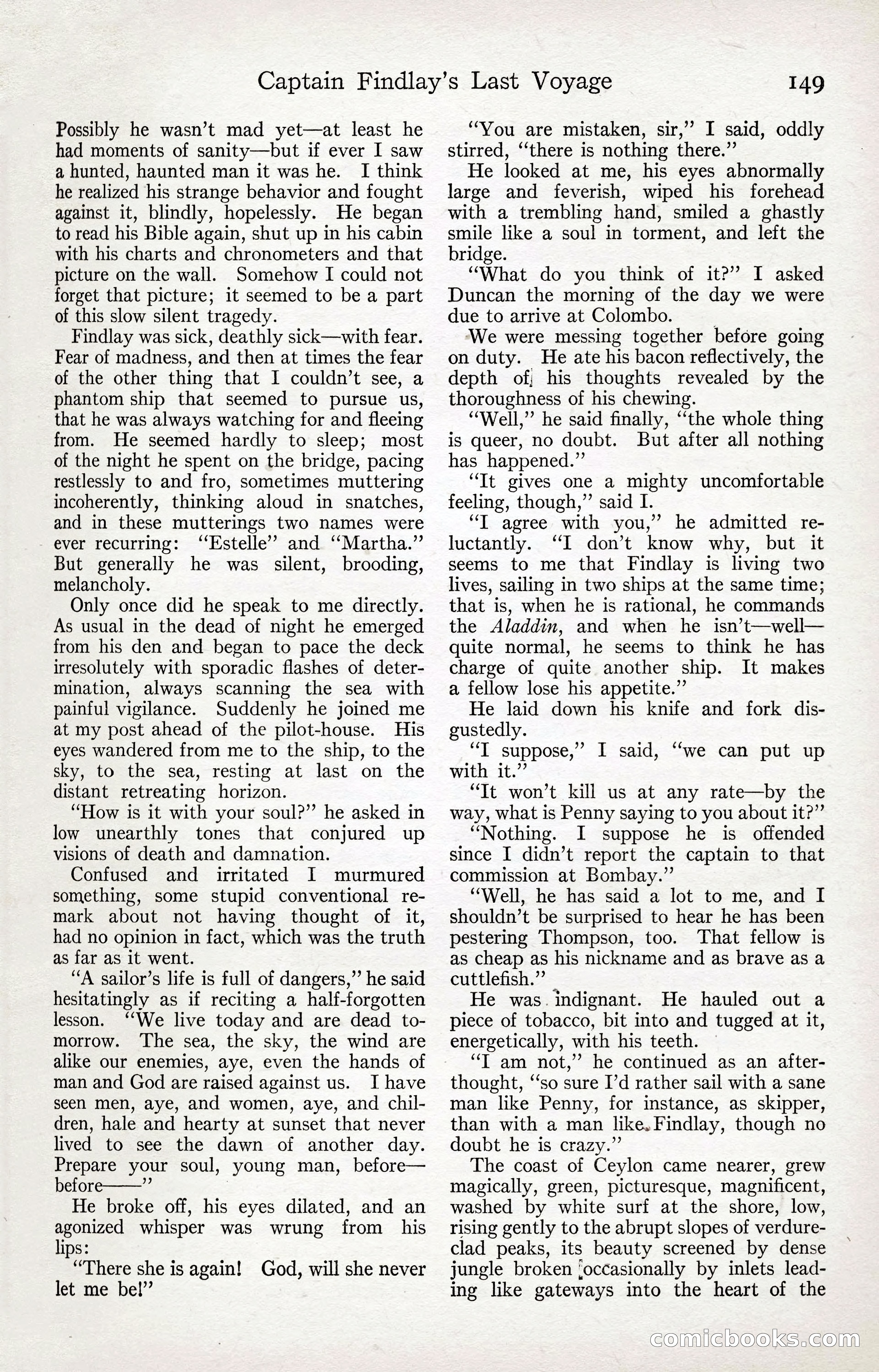
A restored page from Pulp Fiction, 1918. Page through the whole issue in the reader above.
📄 Transcribed text from this page (OCR, searchable)
Machine-transcribed from the original scan — historical spelling and the odd misread are preserved.
Captain Findlay’s Last Voyage Possibly he wasn’t mad yet—at least he had moments of sanity—but if ever I saw a hunted, haunted man it was he. I think he realized his strange behavior and fought against it, blindly, hopelessly. He began to read his Bible again, shut up in his cabin with his charts and chronometers and that picture on the wall. Somehow I could not forget that picture; it seemed to be a part of this slow silent tragedy. Findlay was sick, deathly sick—with fear. Fear of madness, and then at times the fear of the other thing that I couldn’t see, a phantom ship that seemed to pursue us, that he was always watching for and fleeing from. He seemed hardly to sleep; most of the night he spent on the bridge, pacing restlessly to and fro, sometimes muttering incoherently, thinking aloud in snatches, and in these mutterings two names were ever recurring: ‘‘Estelle’” and ‘‘Martha.”’ But generally he was silent, brooding, melancholy. Only once did he speak to me directly. As usual in the dead of night he emerged from his den and began to pace the deck irresolutely with sporadic flashes of deter- mination, always scanning the sea with painful vigilance. Suddenly he joined me at my post ahead of the pilot-house. His eyes wandered from me to the ship, to the sky, to the sea, resting at last on the distant retreating horizon. “How is it with your soul?” he asked in low unearthly tones that conjured up visions of death and damnation. Confused and irritated I murmured something, some stupid conventional re- mark about not having thought of it, had no opinion in fact, which was the truth as far as it went. “A sailor’s life is full of dangers,’’ he said hesitatingly as if reciting a half-forgotten lesson. ‘We live today and are dead to- morrow. ‘The sea, the sky, the wind are alike our enemies, aye, even the hands of man and God are raised against us. I have seen men, aye, and women, aye, and chil- dren, hale and hearty at sunset that never lived to see the dawn of another day. Prepare your soul, young man, before— before——”’ | He broke off, his eyes dilated, and an agonized whisper was wrung from his lips: “There she is again! let me bel” God, will she never 149 “Vou are mistaken, sir,’ I said, oddly stirred, “‘there is nothing there.” He looked at me, his eyes abnormally large and feverish, wiped his forehead with a trembling hand, smiled a ghastly smile like a soul in torment, and left the bridge. “What do you think of it?” I asked Duncan the morning of the day we were due to arrive at Colombo. 3 We were messing together before going on duty. He ate his bacon reflectively, the depth of; his thoughts revealed by the thoroughness of his chewing. “Well,” he said finally, “the whole thing is queer, no doubt. But after all nothing has happened.” “Tt gives one a mighty uncomfortable feeling, though,” said I. “T agree with you,” he admitted re- luctantly. ‘I don’t know why, but it seems to me that Findlay is living two lives, sailing in two ships at the same time; that is, when he is rational, he commands the Aladdin, and when he isn’t—well— quite normal, he seems to think he has charge of quite another ship. It makes a fellow lose his appetite.”’ He laid down his knife and fork dis- gustedly. “T suppose,” I said, “we can put up with it.” “It won’t kill us at any rate—by the way, what is Penny saying to you about it?” “Nothing. I suppose he is offended since I didn’t report the captain to that commission at Bombay.” “Well, he has said a lot to me, and I shouldn’t be surprised to hear he has been pestering Thompson, too. That fellow is as cheap as his nickname and as brave as a cuttlefish.” He was. indignant. He hauled out a piece of tobacco, bit into and tugged at it, energetically, with his teeth. “T am not,’ he continued as an after- thought, “‘so sure I’d rather sail with a sane man like Penny, for instance, as skipper, than with a man like. Findlay, though no doubt he is crazy.” The coast of Ceylon came nearer, grew magically, green, picturesque, magnificent, washed by white surf at the shore, low, rising gently to the abrupt slopes of verdure- clad peaks, its beauty screened by dense jungle broken ‘occasionally by inlets lead- ing like gateways into the heart of the CORnnICLOO S (C@