
Pulp Fiction, 1918 · page 149 of 194
Adventure Magazine Cover, April 3, 1918 — page 149: what you’re looking at
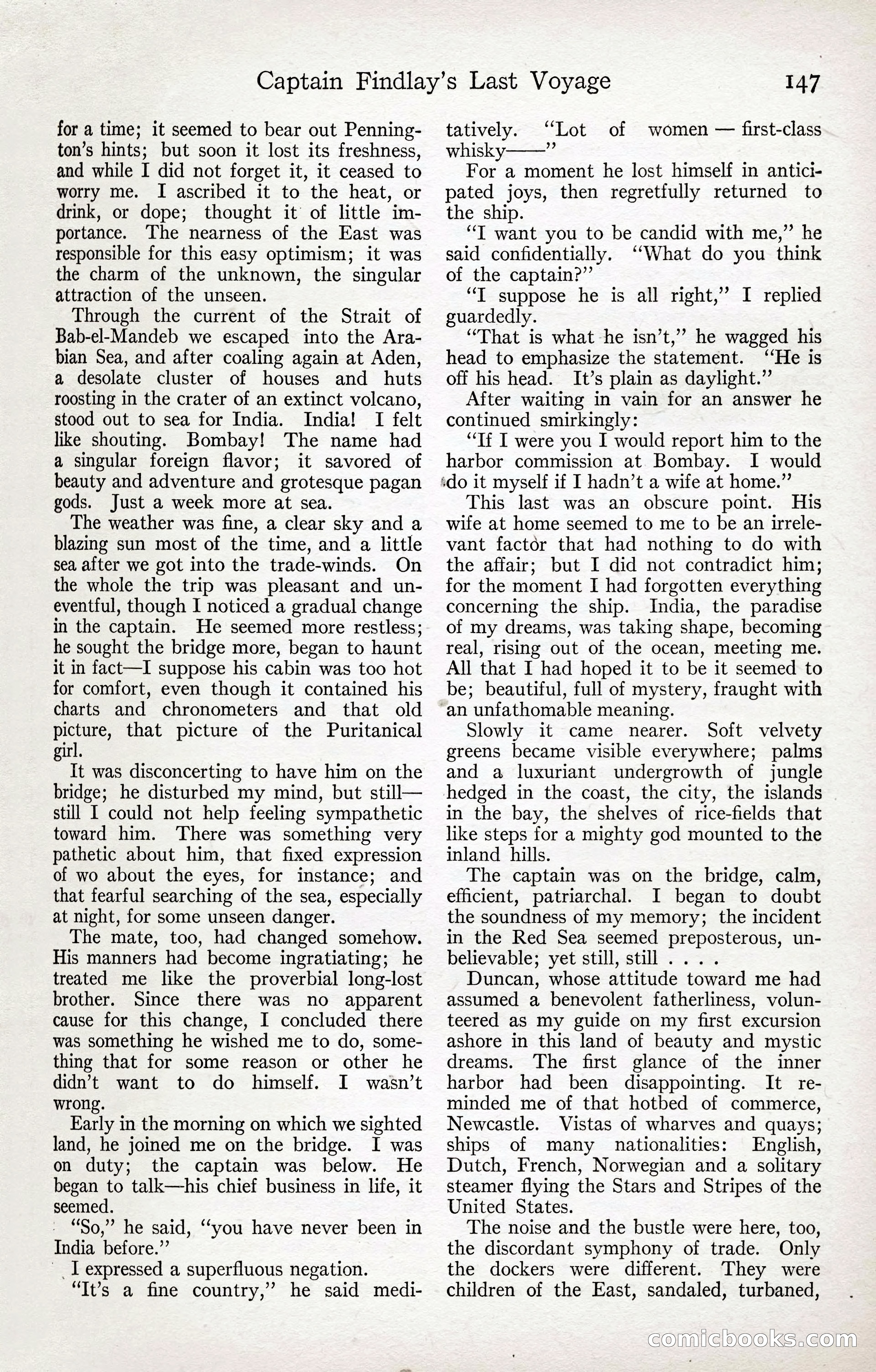
A restored page from Pulp Fiction, 1918. Page through the whole issue in the reader above.
📄 Transcribed text from this page (OCR, searchable)
Machine-transcribed from the original scan — historical spelling and the odd misread are preserved.
Captain Findlay’s Last Voyage 147 for a time; it seemed to bear out Penning- ton’s hints; but soon it lost its freshness, and while I did not forget it, it ceased to worry me. I ascribed it to the heat, or drink, or dope; thought it of little im- portance. The nearness of the East was responsible for this easy optimism; it was the charm of the unknown, the singular attraction of the unseen. Through the current of the Strait of Bab-el-Mandeb we escaped into the Ara- bian Sea, and after coaling again at Aden, a desolate cluster of houses and huts roosting in the crater of an extinct volcano, stood out to sea for India. India! I felt like shouting. Bombay! The name had a singular foreign flavor; it savored of beauty and adventure and grotesque pagan gods. Just a week more at sea. The weather was fine, a clear sky and a blazing sun most of the time, and a little sea after we got into the trade-winds. On the whole the trip was pleasant and un- eventful, though I noticed a gradual change in the captain. He seemed more restless; he sought the bridge more, began to haunt it in fact—I suppose his cabin was too hot for comfort, even though it contained his charts and chronometers and that old picture, that picture of the Puritanical girl. It was disconcerting to have him on the bridge; he disturbed my mind, but still— still I could not help feeling sympathetic toward him. There was something very pathetic about him, that fixed expression of wo about the eyes, for instance; and that fearful searching of the sea, especially at night, for some unseen danger. The mate, too, had changed somehow. His manners had become ingratiating; he treated me like the proverbial long-lost brother. Since there was no apparent cause for this change, I concluded there was something he wished me to do, some- thing that for some reason or other he didn’t want to do himself. I wasn’t wrong. Early in the morning on which we sighted land, he joined me on the bridge. I was on duty; the captain was below. He began to talk—his chief business in life, it seemed. _ “So,” he said, “‘you have never been in India before.”’ __ L expressed a superfluous negation. “It’s a fine country,’ he said medi- tatively. “Lot of women — first-class whisky——”’ For a moment he lost himself in antici- pated joys, then regretfully returned to the ship. “T want you to be candid with me,” he said confidentially. “‘What do you think of the captain?” “T suppose he is all right,’ I replied guardedly. “That is what he isn’t,” he wagged his head to emphasize the statement. ‘He is off his head. It’s plain as daylight.” After waiting in vain for an answer he continued smirkingly: “Tf I were you I would report him to the harbor commission at Bombay. I would ‘do it myself if I hadn’t a wife at home.” This last was an obscure point. His wife at home seemed to me to be an irrele- vant factor that had nothing to do with the affair; but I did not contradict him; for the moment I had forgotten everything concerning the ship. India, the paradise of my dreams, was taking shape, becoming real, rising out of the ocean, meeting me. All that I had hoped it to be it seemed to be; beautiful, full of mystery, fraught with an unfathomable meaning. Slowly it came nearer. Soft velvety greens became visible everywhere; palms and a luxuriant undergrowth of jungle hedged in the coast, the city, the islands in the bay, the shelves of rice-fields that like steps for a mighty god mounted to the inland hills. The captain was on the bridge, calm, efficient, patriarchal. I began to doubt the soundness of my memory; the incident in the Red Sea seemed preposterous, un- believable; yet still, still .... Duncan, whose attitude toward me had assumed a benevolent fatherliness, volun- teered as my guide on my first excursion ashore in this land of beauty and mystic dreams. The first glance of the inner harbor had been disappointing. It re- minded me of that hotbed of commerce, Newcastle. Vistas of wharves and quays; ships of many nationalities: English, Dutch, French, Norwegian and a solitary steamer flying the Stars and Stripes of the United States. The noise and the bustle were here, too, the discordant symphony of trade. Only the dockers were different. They were children of the East, sandaled, turbaned, GomiGcdooksteo