
Pulp Fiction, 1918 · page 148 of 194
Adventure Magazine Cover, April 3, 1918 — page 148: what you’re looking at
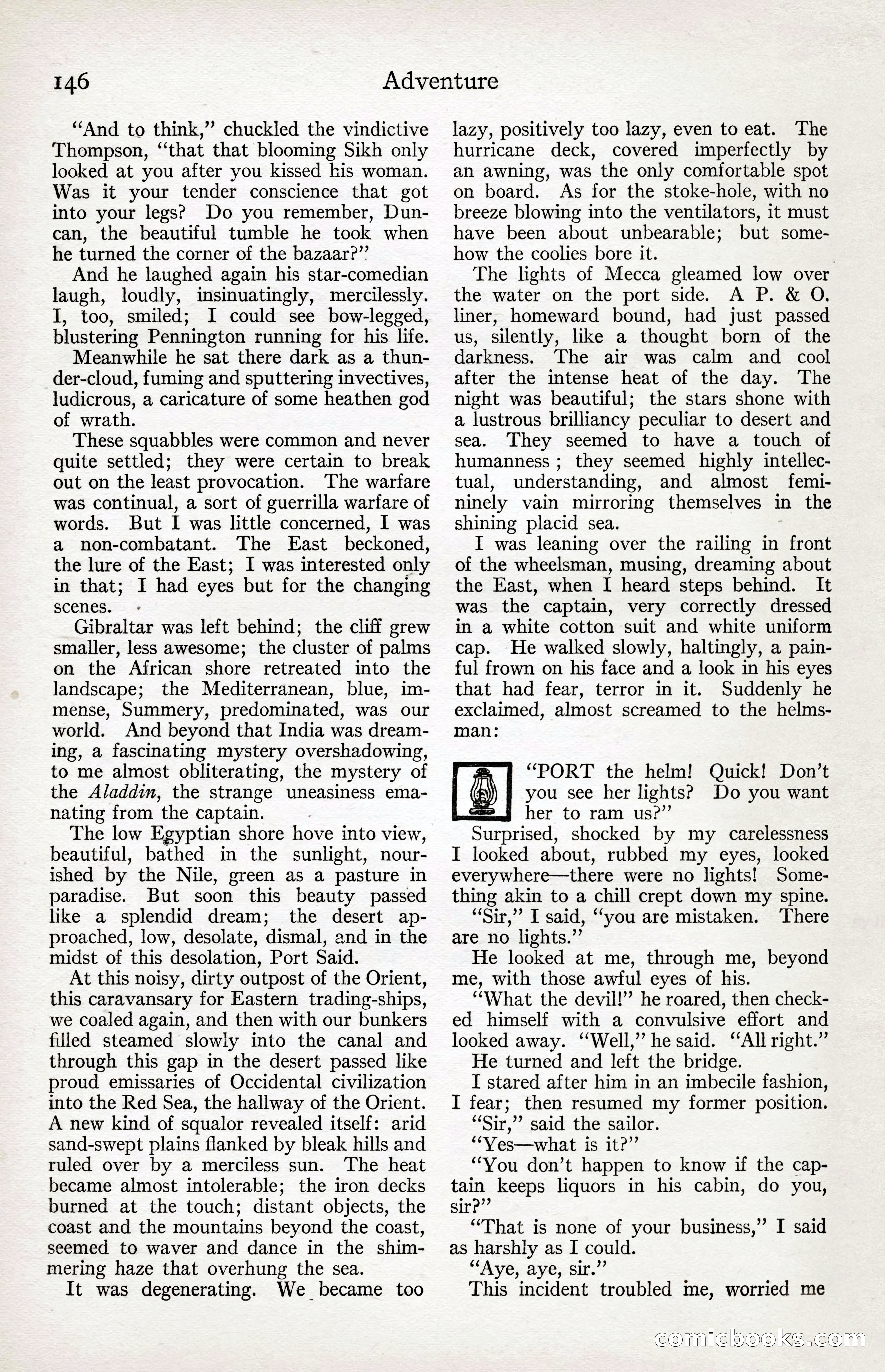
A restored page from Pulp Fiction, 1918. Page through the whole issue in the reader above.
📄 Transcribed text from this page (OCR, searchable)
Machine-transcribed from the original scan — historical spelling and the odd misread are preserved.
146 “And to think,” chuckled the vindictive Thompson, “‘that that blooming Sikh only looked at you after you kissed his woman. Was it your tender conscience that got into your legs? Do you remember, Dun- can, the beautiful tumble he took when he turned the corner of the bazaar?” And he laughed again his star-comedian laugh, loudly, insinuatingly, mercilessly. I, too, smiled; I could see bow-legged, blustering Pennington running for his life. Meanwhile he sat there dark as a thun- der-cloud, fuming and sputtering invectives, ludicrous, a caricature of some heathen god of wrath. These squabbles were common and never quite settled; they were certain to break out on the least provocation. ‘The warfare was continual, a sort of guerrilla warfare of words. But I was little concerned, I was a non-combatant. The East beckoned, the lure of the East; I was interested only in that; I had eyes but for the changing scenes. - Gibraltar was left behind; the cliff grew smaller, less awesome; the cluster of palms on the African shore retreated into the landscape; the Mediterranean, blue, im- mense, Summery, predominated, was our world. And beyond that India was dream- ing, a fascinating mystery overshadowing, to me almost obliterating, the mystery of the Aladdin, the strange uneasiness ema- nating from the captain. The low Egyptian shore hove into view, beautiful, bathed in the sunlight, nour- ished by the Nile, green as a pasture in paradise. But soon this beauty passed like a splendid dream; the desert ap- proached, low, desolate, dismal, and in the midst of this desolation, Port Said. At this noisy, dirty outpost of the Orient, this caravansary for Eastern trading-ships, we coaled again, and then with our bunkers filled steamed slowly into the canal and through this gap in the desert passed like proud emissaries of Occidental civilization into the Red Sea, the hallway of the Orient. A new kind of squalor revealed itself: arid sand-swept plains flanked by bleak hills and ruled over by a merciless sun. The heat became almost intolerable; the iron decks burned at the touch; distant objects, the coast and the mountains beyond the coast, seemed to waver and dance in the shim- mering haze that overhung the sea. It was degenerating. We became too Adventure lazy, positively too lazy, even to eat. The hurricane deck, covered imperfectly by an awning, was the only comfortable spot on board. As for the stoke-hole, with no breeze blowing into the ventilators, it must have been about unbearable; but some- how the coolies bore it. The lights of Mecca gleamed low over the water on the port side. A P. & O. liner, homeward bound, had just passed us, silently, like a thought born of the darkness. The air was calm and cool after the intense heat of the day. The night was beautiful; the stars shone with a lustrous brilliancy peculiar to desert and sea. They seemed to have a touch of humanness ; they seemed highly intellec- tual, understanding, and almost femi- ninely vain mirroring themselves in the shining placid sea. I was leaning over the railing in front of the wheelsman, musing, dreaming about the East, when I heard steps behind. It was the captain, very correctly dressed in a white cotton suit and white uniform cap. He walked slowly, haltingly, a pain- ful frown on his face and a look in his eyes that had fear, terror in it. Suddenly he exclaimed, almost screamed to the helms- man: “PORT the helm! Quick! Don’t you see her lightse Do you want 3§ her to ram us?” Seer: shocked by my carelessness I looked about, rubbed my eyes, looked everywhere—there were no lights! Some- thing akin to a chill crept down my spine. “Sir,” I said, “you are mistaken. There are no lights.” He looked at me, through me, beyond me, with those awful eyes of his. “What the devil!’ he roared, then check- ed himself with a convulsive effort and looked away. ‘‘Well,” he said. ‘‘All right.” He turned and left the bridge. I stared after him in an imbecile fashion, I fear; then resumed my former position. “Sir,”’ said the sailor. ‘““Ves—what is it?” “You don’t happen to know if the cap- tain keeps liquors in his cabin, do you, sirp”’ “That is none of your business,” I said as harshly as I could. “Aye, aye, sir.” This incident troubled me, worried me COnniclooolkxs (C@