
Pulp Fiction, 1918 · page 146 of 194
Adventure Magazine Cover, April 3, 1918 — page 146: what you’re looking at
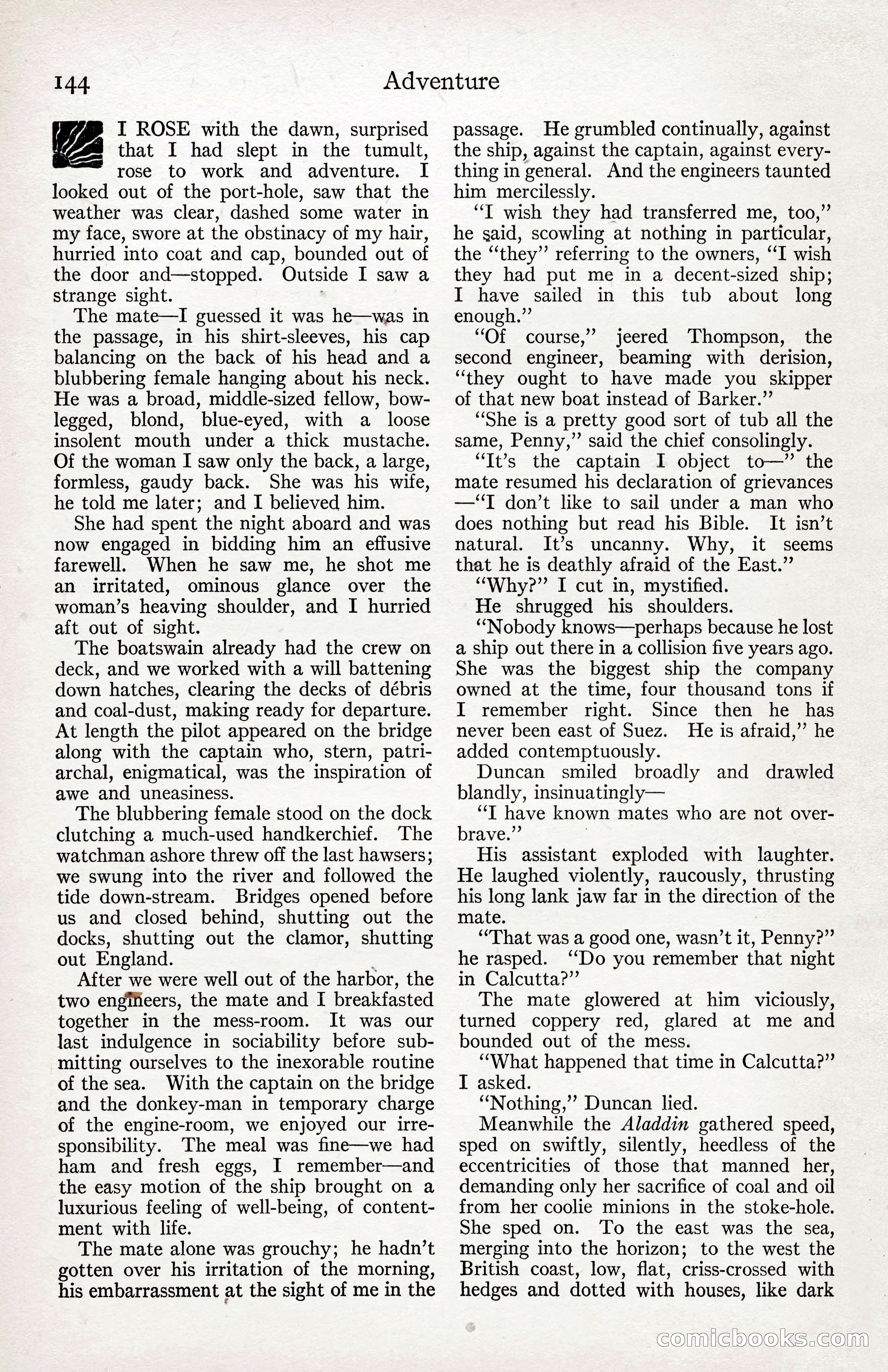
A restored page from Pulp Fiction, 1918. Page through the whole issue in the reader above.
📄 Transcribed text from this page (OCR, searchable)
Machine-transcribed from the original scan — historical spelling and the odd misread are preserved.
144 I ROSE with the dawn, surprised that I had slept in the tumult, rose to work and adventure. I looked out of the port-hole, saw that the weather was clear, dashed some water in my face, swore at the obstinacy of my hair, hurried into coat and cap, bounded out of the door and—stopped. Outside I saw a strange sight. The mate—I guessed it was he—was in the passage, in his shirt-sleeves, his cap balancing on the back of his head and a blubbering female hanging about his neck. He was a broad, middle-sized fellow, bow- legged, blond, blue-eyed, with a _ loose insolent mouth under a thick mustache. Of the woman I saw only the back, a large, formless, gaudy back. She was his wife, he told me later; and I believed him. She had spent the night aboard and was now engaged in bidding him an effusive farewell. When he saw me, he shot me an irritated, ominous glance over the woman’s heaving shoulder, and I hurried aft out of sight. The boatswain already had the crew on deck, and we worked with a will battening down hatches, clearing the decks of débris and coal-dust, making ready for departure. At length the pilot appeared on the bridge along with the captain who, stern, patri- archal, enigmatical, was the inspiration of awe and uneasiness. The blubbering female stood on the dock clutching a much-used handkerchief. ‘The watchman ashore threw off the last hawsers; we swung into the river and followed the tide down-stream. Bridges opened before us and closed behind, shutting out the docks, shutting out the clamor, shutting out England. After we were well out of the harbor, the two engifeers, the mate and I breakfasted together in the mess-room. It was our last indulgence in sociability before sub- mitting ourselves to the inexorable routine of the sea. With the captain on the bridge and the donkey-man in temporary charge of the engine-room, we enjoyed our irre- sponsibility. The meal was fine—we had ham and fresh eggs, I remember—and the easy motion of the ship brought on a luxurious feeling of well-being, of content- ment with life. The mate alone was grouchy; he hadn’t gotten over his irritation of the morning, his embarrassment at the sight of me in the Adventure passage. He grumbled continually, against the ship, against the captain, against every- thing in general. And the engineers taunted him mercilessly. “T wish they had transferred me, too,” he said, scowling at nothing in particular, the ‘“‘they” referring to the owners, “TI wish they had put me in a decent-sized ship; I have sailed in this tub about long enough.” “Of course,” jeered Thompson, the second engineer, beaming with derision, “they ought to have made you skipper of that new boat instead of Barker.” “She is a pretty good sort of tub all the same, Penny,”’ said the chief consolingly. “It’s the captain I object to—” the mate resumed his declaration of grievances —T don’t like to sail under a man who does nothing but read his Bible. It isn’t natural. It’s uncanny. Why, it seems that he is deathly afraid of the East.” “Whye” I cut in, mystified. He shrugged his shoulders. ‘“‘Nobody knows—perhaps because he lost a ship out there in a collision five years ago. She was the biggest ship the company owned at the time, four thousand tons if I remember right. Since then he has never been east of Suez. He is afraid,” he added contemptuously. Duncan smiled broadly and drawled blandly, insinuatingly— al! have known mates who are not over- brave.” His assistant exploded with laughter. He laughed violently, raucously, thrusting his long lank jaw far in the direction of the mate. “That was a good one, wasn’t it, Penny?” he rasped. “Do you remember that night in Calcutta?” The mate glowered at him viciously, turned coppery red, glared at me and bounded out of the mess. ‘“‘What happened that time in Calcutta?” I asked. “Nothing,’’ Duncan lied. Meanwhile the Aladdin gathered speed, sped on swiftly, silently, heedless of the eccentricities of those that manned her, demanding only her sacrifice of coal and oil from her coolie minions in the stoke-hole. She sped on. To the east was the sea, merging into the horizon; to the west the British coast, low, flat, criss-crossed with hedges and dotted with houses, like dark C@Onmniclooo S (C@