
Pulp Fiction, 1918 · page 145 of 194
Adventure Magazine Cover, April 3, 1918 — page 145: what you’re looking at
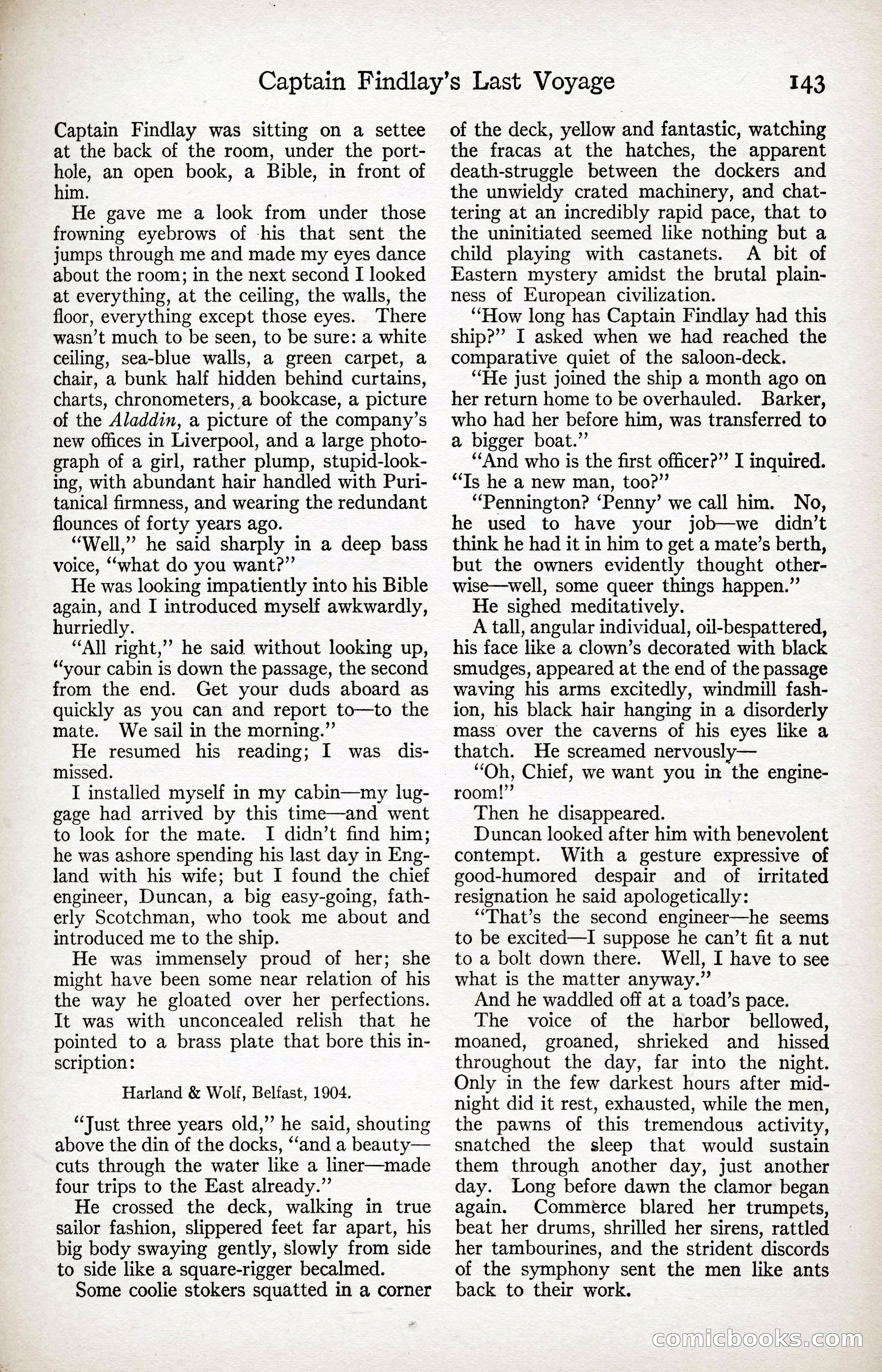
A restored page from Pulp Fiction, 1918. Page through the whole issue in the reader above.
📄 Transcribed text from this page (OCR, searchable)
Machine-transcribed from the original scan — historical spelling and the odd misread are preserved.
Captain Findlay’s Last Voyage Captain Findlay was sitting on a settee at the back of the room, under the port- hole, an open book, a Bible, in front of him. He gave me a look from under those frowning eyebrows of -his that sent the jumps through me and made my eyes dance about the room; in the next second I looked at everything, at the ceiling, the walls, the floor, everything except those eyes. There wasn’t much to be seen, to be sure: a white ceiling, sea-blue walls, a green carpet, a chair, a bunk half hidden behind curtains, charts, chronometers, a bookcase, a picture of the Aladdin, a picture of the company’s new offices in Liverpool, and a large photo- graph of a girl, rather plump, stupid-look- ing, with abundant hair handled with Puri- tanical firmness, and wearing the redundant flounces of forty years ago. “Well,” he said sharply in a deep bass voice, “what do you want?” He was looking impatiently into his Bible again, and I introduced myself awkwardly, hurriedly. “All right,” he said without looking up, “‘your cabin is down the passage, the second from the end. Get your duds aboard as quickly as you can and report to—to the mate. We sail in the morning.” He resumed his reading; I was dis- missed. I installed myself in my cabin—my lug- gage had arrived by this time—and went to look for the mate. I didn’t find him; he was ashore spending his last day in Eng- land with his wife; but I found the chief engineer, Duncan, a big easy-going, fath- erly Scotchman, who took me about and introduced me to the ship. He was immensely proud of her; she might have been some near relation of his the way he gloated over her perfections. It was with unconcealed relish that he pointed to a brass plate that bore this in- scription: Harland & Wolf, Belfast, 1904. “Just three years old,” he said, shouting above the din of the docks, “‘and a beauty— cuts through the water like a liner—made four trips to the East already.” He crossed the deck, walking in true sailor fashion, slippered feet far apart, his big body swaying gently, slowly from side to side like a square-rigger becalmed. Some coolie stokers squatted in a corner 143 of the deck, yellow and fantastic, watching the fracas at the hatches, the apparent death-struggle between the dockers and the unwieldy crated machinery, and chat- tering at an incredibly rapid pace, that to the uninitiated seemed like nothing but a child playing with castanets. <A bit of Eastern mystery amidst the brutal plain- ness of European civilization. “How long has Captain Findlay had this ship?” I asked when we had reached the comparative quiet of the saloon-deck. ‘“‘He just joined the ship a month ago on her return home to be overhauled. Barker, who had her before him, was transferred to a bigger boat.” ‘And who is the first officer?”’ I inquired. ‘“‘Is he a new man, too?” “Pennington? ‘Penny’ we call him. No, he used to have your job—we didn’t think he had it in him to get a mate’s berth, but the owners evidently thought other- wise—well, some queer things happen.” He sighed meditatively. A tall, angular individual, oil-bespattered, his face like a clown’s decorated with black smudges, appeared at the end of the passage waving his arms excitedly, windmill fash- ion, his black hair hanging in a disorderly mass over the caverns of his eyes like a thatch. He screamed nervously— “Oh, Chief, we want you in the engine- room!” Then he disappeared. Duncan looked after him with benevolent contempt. With a gesture expressive of good-humored despair and of irritated resignation he said apologetically: ‘“‘That’s the second engineer—he seems to be excited—I suppose he can’t fit a nut to a bolt down there. Well, I have to see what is the matter anyway.” And he waddled off at a toad’s pace. The voice of the harbor bellowed, moaned, groaned, shrieked and _ hissed throughout the day, far into the night. Only in the few darkest hours after mid- night did it rest, exhausted, while the men, the pawns of this tremendous activity, snatched the sleep that would sustain them through another day, just another day. Long before dawn the clamor began again. Commerce blared her trumpets, beat her drums, shrilled her sirens, rattled her tambourines, and the strident discords of the symphony sent the men like ants back to their work. COnnIclooo S (C@)