
Pulp Fiction, 1917 · page 65 of 196
Adventure Magazine, Mid-September 1917 — page 65: what you’re looking at
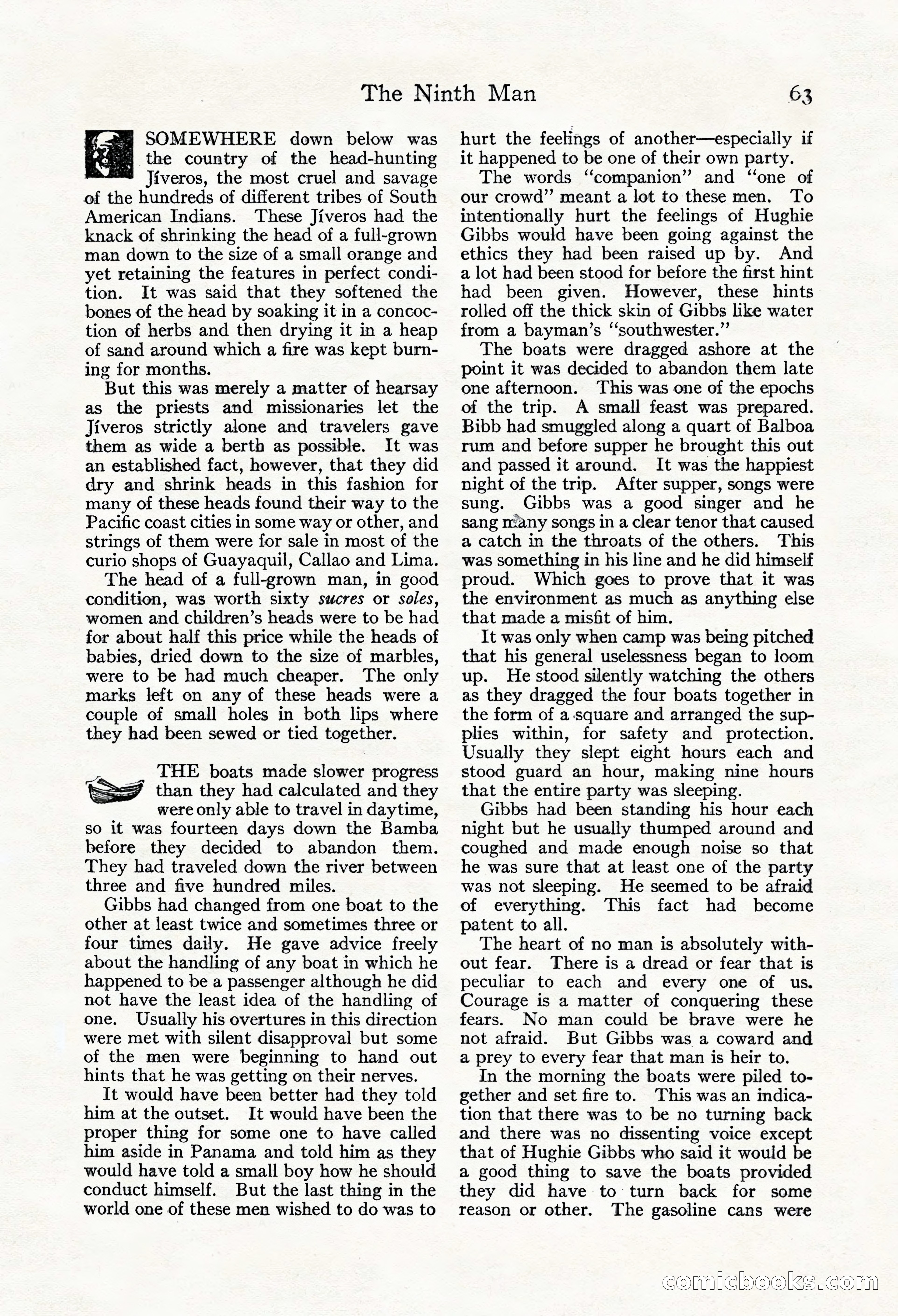
A restored page from Pulp Fiction, 1917. Page through the whole issue in the reader above.
📄 Transcribed text from this page (OCR, searchable)
Machine-transcribed from the original scan — historical spelling and the odd misread are preserved.
The Ninth Man SOMEWHERE down below was Cook the country of the head-hunting ai jiveros, the most cruel and savage of the hundreds of different tribes of South American Indians. These Jiveros had the knack of shrinking the head of a full-grown man down to the size of a small orange and yet retaining the features in perfect condi- tion. It was said that they softened the bones of the head by soaking it in a concoc- tion of herbs and then drying it in a heap of sand around which a fire was kept burn- ing for months. But this was merely a matter of hearsay as the priests and missionaries let the Jiveros strictly alone and travelers gave them as wide a berth as possible. It was an established fact, however, that they did dry and shrink heads in this fashion for many of these heads found their way to the Pacific coast cities in some way or other, and strings of them were for sale in most of the curio shops of Guayaquil, Callao and Lima. The head of a full-grown man, in good condition, was worth sixty swcres or soles, women and children’s heads were to be had for about half this price while the heads of babies, dried down to the size of marbles, were to be had much cheaper. The only marks left on any of these heads were a couple of small holes in both lips where they had been sewed or tied together. Vere Ss. ‘$ “4, , ., LHE boats made slower progress ZF than they had calculated and they were only able to travel in daytime, so it was fourteen days down the Bamba before they decided to abandon them. They had traveled down the river between three and five hundred miles. Gibbs had changed from one boat to the other at least twice and sometimes three or four times daily. He gave advice freely about the handling of any boat in which he happened to be a passenger although he did not have the least idea of the handling of one. Usually his overtures in this direction were met with silent disapproval but some of the men were beginning to hand out hints that he was getting on their nerves. It would have been better had they told him at the outset. It would have been the proper thing for some one to have called him aside in Panama and told him as they would have told a small boy how he should conduct himself. But the last thing in the world one of these men wished to do was to 63 hurt the feelings of another—especially if it happened to be one of their own party. The words “companion” and ‘one of our crowd” meant a lot to these men. To intentionally hurt the feelings of Hughie Gibbs would have been going against the ethics they had been raised up by. And a lot had been stood for before the first hint had been given. However, these hints rolled off the thick skin of Gibbs like water from a bayman’s “southwester.”’ The boats were dragged ashore at the point it was decided to abandon them late one afternoon. ‘This was one of the epochs of the trip. A small feast was prepared. Bibb had smuggled along a quart of Balboa rum and before supper he brought this out and passed it around. It was the happiest night of the trip. After supper, songs were sung. Gibbs was a good singer and he sang many songs in a clear tenor that caused a catch in the throats of the others. This was something in his line and he did himself proud. Which goes to prove that it was the environment as much as anything else that made a misfit of him. It was only when camp was being pitched that his general uselessness began to loom up. He stood silently watching the others as they dragged the four boats together in the form of a.square and arranged the sup- plies within, for safety and protection. Usually they slept eight hours each and stood guard an hour, making nine hours that the entire party was sleeping. Gibbs had been standing his hour each night but he usually thumped around and coughed and made enough noise so that he was sure that at least one of the party was not sleeping. He seemed to be afraid of everything. This fact had become patent to all. The heart of no man is absolutely with- out fear. There is a dread or fear that is peculiar to each and every one of us. Courage is a matter of conquering these fears. No man could be brave were he not afraid. But Gibbs was a coward and a prey to every fear that man is heir to. In the morning the boats were piled to- gether and set fire to. This was an indica- tion that there was to be no turning back and there was no dissenting voice except that of Hughie Gibbs who said it would be a good thing to save the boats provided they did have to turn back for some reason or other. The gasoline cans were COmicloo C©